
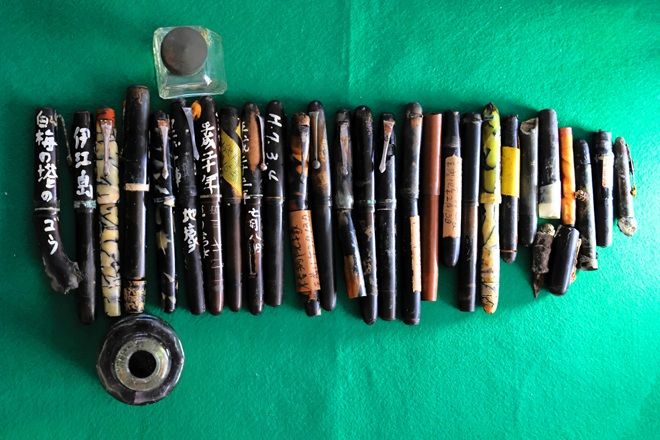
ITOMAN, Okinawa Prefecture–Isamu Kuniyoshi searched for wartime remains and relics from the 1945 Battle of Okinawa on a volunteer basis for about 60 years in hopes of returning them to bereaved families.
The Naha native, who retired from his efforts in 2016 due to his declining physical strength, died in February at age 86.
Today, a journalist and high school students have taken up Kuniyoshi’s search-and-return efforts and are carrying on his work.
While 80 years have passed since the war, many war remains and relics continue to be found in caves used as shelters during the battle to this day.
On a recent day in early March, journalist Tetsuji Hamada, 63, and his wife, Ritsuko, 61, were engaged in excavation work in a cave in the Fukuji district of Itoman with members of a club for interaction activities at the prefecture-run Naha Senior High School.
They descended about 15 meters using a ladder and rope.
Records show that residents were forced out of the cave by Imperial Japanese Army soldiers. Rocks were stacked up in the back to prepare for enemy attacks at the entrance.
With their headlamps on, they dug into dirt and sand to look for war remains and relics.
As usual, they found many pieces of human remains and personal items from the back of the cave, such as buttons from a military uniform and medicine bottles. One was a cap badge of a secondary school under the old education system, suggesting it belonged to a mobilized student.
Kuniyoshi, who lost five of his family members during the Battle of Okinawa, stepped into a cave for the first time after the war when he was about 8 years old with his older brother.
While running a company, he collected remains and relics on a full-scale basis until he was 77.
He unearthed more than 100,000 personal belongings, many of which he donated to the Okinawa Prefectural Peace Memorial Foundation.
Kuniyoshi was once quoted as saying, “I feel like bones are waiting for me.”
The Hamadas, who lead a volunteer group, decided to join his cause after they were inspired by Kuniyoshi, who once told reporters they should dig for remains themselves because they only came to see him for news coverage on anniversary occasions.
That was about 25 years ago.
The Hamadas took over approximately 300 pieces of fountain pens, canteens and other relics on which names are written from Kuniyoshi.
The couple said that learning about the past war can help understand why war is not good.
Tatsuhiro Chinen, 17, joined their efforts after the high school student attended a lecture given by the couple in June last year.
He found a thighbone during his first excavation in January, as well as a toothpaste product and military uniform buttons.
While the work was demanding, “I want to participate every week during my spring break,” he said.
One student said the pupil’s great-grandmother once said she didn’t want to talk about her wartime experience ever again before she was reduced to tears.
But the student was positive about the search activities, saying that it would be difficult to imagine what taking refuge in a cave was like without experiencing it firsthand.
The students also intend to join the Hamadas to help them return relics to bereaved families and conduct DNA tests on remains found.
AloJapan.com