
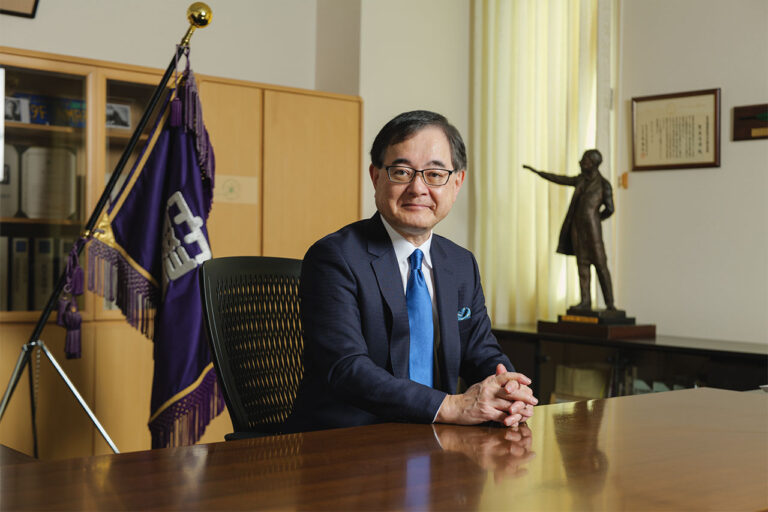
 A Message to Ourselves-and to You-Four Years from Now
Following the decision of the Presidential Selection and Oversight Committee in 2025 and my appointment by the Minister of Education, Culture, Sports, Science and Technology, I have been reappointed as President of Hokkaido University for a four-year term from April 1, 2026, to March 31, 2030. I sincerely ask for your continued support over the next four years.
We live in an age when it is difficult to predict even what the world will look like 24 hours from now-an age in which values rise and fall like a roller coaster. In such a time, it is impossible to leave behind a message that will remain relevant and unchanged for four years. Indeed, parts of this message will likely feel outdated in as little as six months. At a time when some private universities face uncertainty about their very survival amid declining birthrates in Japan, it is inevitable that the role and future of Hokkaido University will also be questioned.
Yet it is precisely because we live in such an unpredictable and complex age that universities must hold fast to a clear vision and an enduring mission. This may seem overly ambitious in the face of great waves of change. But if we, as members of a university, do not choose to believe that the world can be changed, then who will change it?
This is exactly the spirit of “Be Ambitious,” a guiding principle since the founding of our predecessor, Sapporo Agricultural College. While these words were originally directed to students, they are equally a call to our University itself.
Today, universities are being called upon to change society. And through education, research-driven innovation, and social implementation in areas such as regional development and healthcare, universities possess a unique and powerful ability to do exactly that.
A New Vision of the University: The Novel Japan University Model
In 2023, Hokkaido University announced HU VISION 2030, our vision for the future of the University toward 2030. In this vision, we set the creation of a sustainable wellbeing society as our mission and presented a new model for Japanese universities-the Novel Japan University Model-built on two pillars: Excellence in research and education, and Extension to bring about social impact.
At the time, I was not yet able to fully define this model in clear words. However, through discussions both within and outside the University, I have come to believe that the new type of university Hokkaido University should aspire to be is a hybrid of two models: a strategic, comprehensive, integrated research university and a grand engine for regional revitalization.
Since the Industrial Revolution, not only in Japan but around the world, modern nations have struggled with the overconcentration of people and resources in major cities and the decline of regional areas. Tokyo, with virtually no food or energy self-sufficiency, continues to attract vast numbers of young people and workers. Yet we have arrived at the present without finding a clear solution to this structural vulnerability.
Meanwhile, Hokkaido-long described as “the northern land”-has often been seen as a land of potential. To be honest, I have never liked this expression very much since it implies that Hokkaido has long remained merely a “land of potential” in modern history. In reality, however, it has become a region facing advanced challenges such as population decline. But today, in Hokkaido, as if guided by an inevitable force of history, three globally significant opportunities are emerging simultaneously:
(1) the development of abundant renewable energy,
(2) sustainable and regenerative food production, and
(3) the Hokkaido Digital Park initiative, which aims to lead the AI-driven society.
The great gears of history-set in motion since the Industrial Revolution toward concentration in major cities and the decline of regional areas-are now creaking, slowing, and beginning to reverse toward regional revitalization. We may be standing at a historic turning point-what might be described, in more recent terms, as a kind of “singularity.”
Founded here 150 years ago, Hokkaido University has grown into one of Japan’s largest comprehensive research universities, with a wide range of faculties, graduate schools, and research institutes. Its greatest strength lies in the integration of diverse academic disciplines and in the vast natural and social environment of Hokkaido, which serves as one of the world’s largest test beds. This is what defines Hokkaido University as a strategic, comprehensive, integrated research university.
And now, the time has come for Hokkaido-long praised as “the northern land”-to become a true leader in regional revitalization: to help transform a model of society that has persisted for over 200 years, and to serve as a frontrunner in realizing the vision of digital garden cities as a grand engine for regional revitalization. This is, in itself, a response to global challenges.
For this reason, Hokkaido University aims to become a university model that advances human resource development and innovation, serving both as a strategic, comprehensive, and integrated research university and as a grand engine for regional revitalization. This is what we mean by the Novel Japan University Model.
Toward the Next 150 Years
The year 2026 marks the 150th anniversary of the founding of Sapporo Agricultural College in 1876. Various commemorative projects will be carried out throughout this milestone year. This is also an opportunity for us to reflect on where our University has come from and where it is going.
As we celebrate our 150th anniversary, we are reminded that we stand at a point along a much longer journey. We must look not only to the next few years, but to the next 50 years, the next 100 years, and beyond. While keeping this long-term vision in mind, we will also keep our eyes firmly on 2030, taking steady steps toward realizing our vision.

HOUKIN Kiyohiro
President
Hokkaido University
/Public Release. This material from the originating organization/author(s) might be of the point-in-time nature, and edited for clarity, style and length. Mirage.News does not take institutional positions or sides, and all views, positions, and conclusions expressed herein are solely those of the author(s).View in full here.
AloJapan.com