
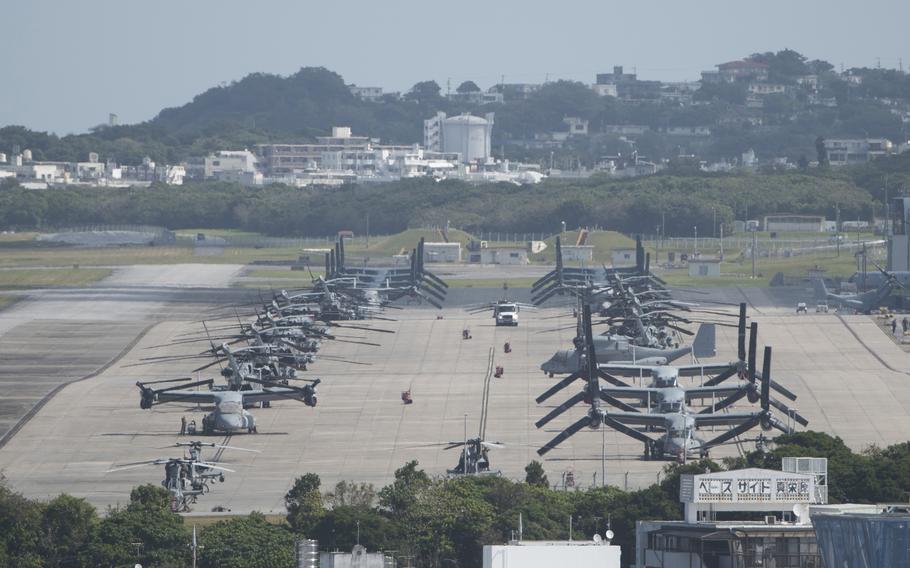
Marine Corps Air Station Futenma, Okinawa, pictured here on Feb. 26, 2026, is home to the 1st Marine Aircraft Wing. (Keishi Koja/Stars and Stripes)
Okinawa prefecture’s latest groundwater survey pinpoints a Marine Corps airfield as the likely source of toxic “forever chemicals” measured as much as 60 times higher than Japan’s legal limit.
The prefecture’s Environmental Preservation Division found elevated PFAS levels at 28 of 40 sites sampled in July, October and December near Marine Corps Air Station Futenma in Ginowan city, according to survey results released Friday.
The division on Monday also released results of a survey around Marine Corps Camp Kinser, where elevated PFAS levels were found at two sites downstream of the base.
Japan’s water quality standard for PFAS is 50 parts per trillion. The U.S. Environmental Protection Agency sets no safe minimum standard for the organic compound.
The highest level of PFAS — 3,000 parts per trillion — was measured at Ijunga, an underground spring downstream of MCAS Futenma. The site was one of 12 sampled in December for the first time since testing began in 2021, a division spokeswoman said by phone Wednesday.
Some Japanese government officials must speak to the press only on condition of anonymity.
The second highest level — 2,600 parts per trillion — was discovered at Kanjaga, another underground spring downstream of the airfield.
The Kinser survey recorded a maximum PFAS level of 400 parts per trillion at a drainage outlet at Irijima 3-chome, downstream of the base, in January 2025. In September, PFAS of 170 parts per trillion was found at the same outlet, and 310 parts per trillion was found at a base stormwater drainage connection point.
The prefecture surveyed the sites after PFAS levels of 170 parts per trillion were detected at the Irijima outlet during the 2024 islandwide survey.
PFAS — per- and polyfluoroalkyl substances — are widely used for waterproof and nonstick coatings and fire suppressants such as aqueous film-forming foams. They are commonly referred to as “forever chemicals” because they persist in the environment. The American Cancer Society has linked PFAS exposure to an increased risk of tumors in the liver, breasts, testicles and pancreas.
U.S. Forces Japan in 2024 announced it had incinerated the last of its stockpiles of firefighting foam containing the substances.
PFAS is a “shared concern” tied to both military and civilian industrial activities across Japan, USFJ wrote in an unsigned statement emailed Wednesday. It added that the command continues to comply with all agreements and procedures with the Japanese government.
The prefecture established an expert committee in 2021 to conduct more detailed surveys around MCAS Futenma after high concentrations of PFAS were found in annual islandwide surveys starting in 2016. Because of these findings, “it is considered highly probable that the base is the source of the contamination,” the survey states.
The prefecture will continue to monitor groundwater around the base and investigate contamination in an underground basin where the firefighting training facility is located, according to the Futenma survey’s response plan.
It will also request information from the U.S. military through the Okinawa Defense Bureau about on-base storage of PFAS at Kinser, according to the Kinser survey report.
The prefecture has sought base access for water sampling four times since 2016. USFJ denied the requests in December, saying the evidence that its installations were sources of contamination was insufficient.
AloJapan.com