
► Kei car’s tested back to back
► Nissan’s Sakura EV and Roox
► Would they make sense in Europe?
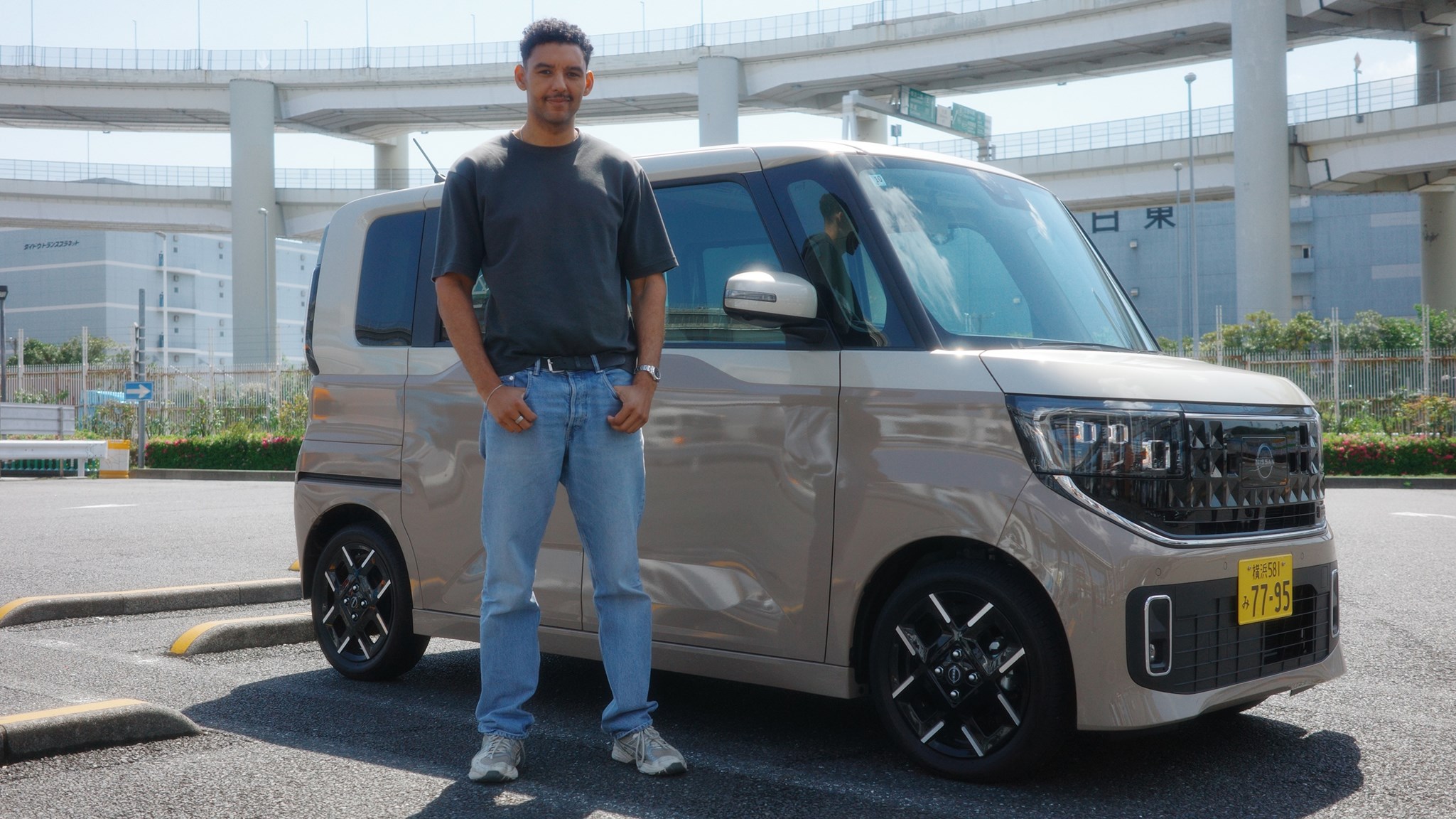
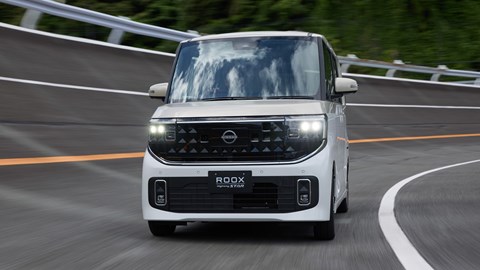
Spend any time in Japan – especially Tokyo – and you’ll notice the road is full of Kei cars. Small, mobility-focused lunchboxes, they’re incredibly compact, with wheels smaller than carry-on luggage and similar overall proportions. Nissan has two on the market right now; the ICE-powered Roox (short for Roomy, Max) you see above, and the electric-powertrained Sakura (the Japanese name for those famous cherry blossoms).
To find out what Kei cars are like to drive, I tested both of Nissan’s urban mobility superstars during the Tokyo commute. Compact, lightweight cars like these have flourished in Japan thanks to advantageous tax benefits but this test comes with a similar set of rules looming in Europe.
Codenamed the E car in Europe, they’ll get similar tax exemptions and could be held to lower safety standards than other cars (though higher ones than quadricycles like the Citroen Ami).
While structure safety could be similar, the cost-saving and lower standards will focus on Advanced Driver Assistance Systems or ADAS, which are currently part of safety regulations but extremely pricey to integrate. Think of Autonomous Emergency Braking (AEB), lane-keeping and things like those drowsiness warnings. As it happens, they can also be pretty annoying…
Like this? Get more CAR delivered to your browser! Click here to add CAR Magazine as a preferred source on Google.
Anyway, keep reading to find out what the Kei experience is like – and go here to find out more about how we test cars.
At a glance
Pros: Easy to manoeuvre, interior layout, cheeky design
Cons: Body roll can be alarming, very vague handling
What’s new?
For me, everything. Honda Super N aside (which isn’t actually a Kei car at all anymore due to its increased track width) Kei cars rarely come to the UK. And that’s because they’re a very Japanese solution to a very specific set of situations.
Coming in lower on tax, with barely-there performance and a footprint the size of washing machine, they’re arguably the best solution to the complex, sprawling Japanese roads – so much so that Kei cars make up 60% of sales in the country.
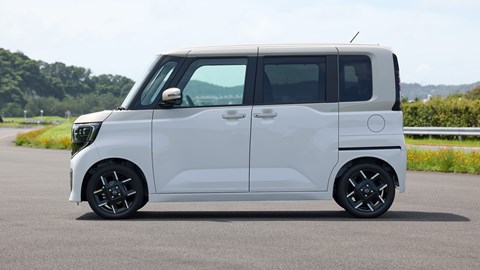
The Sakura and Roox have been around since 2022 and 2025, respectively, and sit firmly in the class. The Sakura is a Nissan-only job and measures 3395mm, by 1475mm and 1655mm, with a wheelbase of 2495. The Roox is a joint partnership with Mitsubishi but has the exact same measurements to stay within the Kei car class.
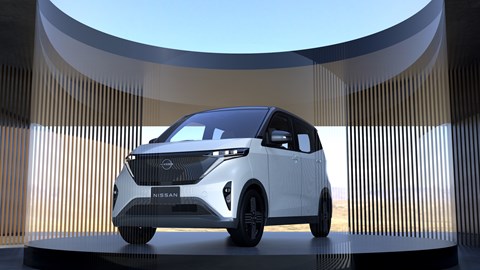
Upon release Nissan said the Sakura’s exterior design ‘exudes sophistication and strength,’ while the Roox draws inspiration from a ‘Karahafu,’ the curved gable found on the roof of traditional Japanese architecture.
What are the specs?
The Roox has an 0.7-litre engine but comes in turbo and naturally-aspirated forms. The forced induction car makes 63bhp while the NA makes 53bhp. In both cars that’s mated to a CVT gearbox that drives the front wheels only. Weight is 1020kg or 920kg, and 0-62mph doesn’t bear thinking about.
The Sakura is propelled by an electric motor producing 63bhp (47kW) and 144ft lbs of torque, and benefits from Leaf-derived technology for more refined NVH. Its 20kWh(!) lithium-ion battery will do 112 miles on Japan’s WLTC cycle – because the entire car weighs between 1070kg and 1080kg depending on the model you go for. That’s less than half of an Audi RS5. Unlike the Honda Super-N, the Sakura doesn’t have one eye on performance and will therefore hit a top speed of just 81mph.
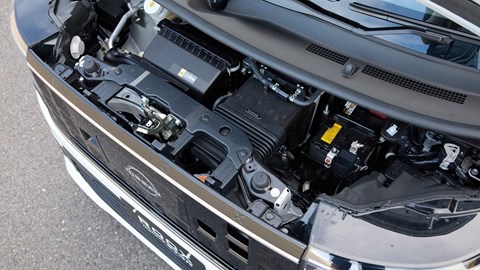
Going from warning lights to 80 per cent charge takes around 40 minutes on a fast charger, while a 7kW top up between the same charge levels will take around eight hours.
What are they like to drive?
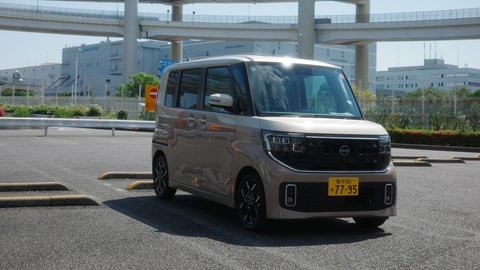
Let’s start with the Roox first. The driving position is somewhat van-like but gives you a commanding view of the road. Hilariously, the Roox boasts the same ‘invisible bonnet technology’ you see on cars like Range Rovers – when you consider it has the overhangs of a carry-on suitcase.
Set off and the steering is vague but easy, and once you do get up to speed – which takes a while – you’ll soon learn that’s for the best. As we make our way to Daikoku (where else?) the Roox’s top heavy dimensions make themselves known. Any hint of steering generates a decent amount of body roll, with even a centimetre of lock causing the Roox to float before changing direction. Hacksaw the wheel and you’ll transport the car to this weight-transfer, phantom zone a fair amount.
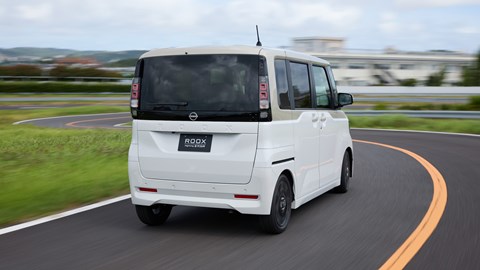
The brakes are as spongy as souffle pancakes, but within the context of the car their softness works. Visibility is good, and the Roox’s soft handling suits the cautious driving style needed for navigating around complex, Japanese roads.
The Sakura is a little more direct, though that’s partly because of the extra weight pinning the car to the ground. The steering feels a little more direct and there is roll present, but it comes in when you’d expect – and not at the mere whiff of steering input. The ride is firmer, with the bump of expansion joints reaching the cabin more intact than they do in the Roox.
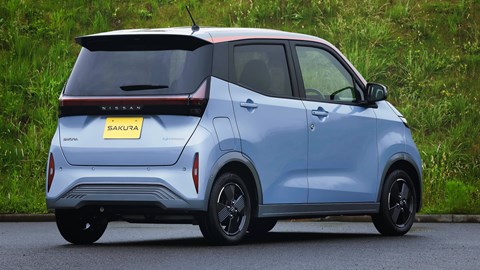
The brakes are also soft but predictable, and they work well with the electric powertrain to make the entire experience that bit more refined. The Sakura has a similar amount of power to the Roox, but its electric powertrain feels both smoother and more immediate. Although we didn’t try it on this occasion, the Sakura can also be set up with one-pedal driving.
What’s the interior like?
Both cars do a lot with the space they have, providing just enough legroom for my 6ft 3in frame, and an impressive amount of headroom. The dimensions themselves are complimented by an airy interior, though the styling differs somewhat.
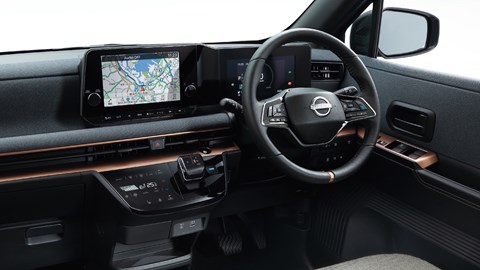
The Roox feels the more premium of the two, with interesting textures which feel unusual without being cheap. At the same time, Nissan has also shoe-horned in an optional 12.3-inch touchscreen. In a normal car that’s normal, but here it feels like sitting in the first row of the IMAX. We didn’t get a go of the native infotainment system, but it ran Apple CarPlay and Google Maps without problems.
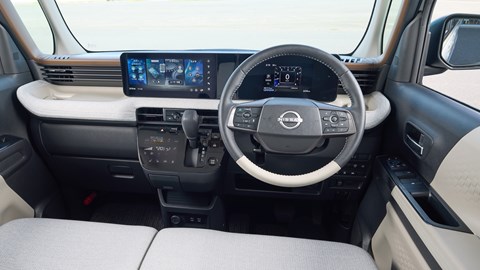
As discussed, the Roox is also available with Nissan’s Intelligent Around View Monitor, as well as virtual 3D view and Invisible Hood View.
Things in the Sakura are pretty much identical, though the materials feel a little less premium – at least on the trim we were driving. It uses a 9.0-inch infotainment system and pairs it with 7.0-inch cockpit dials. Still, the infotainment system ran Apple CarPlay without a hitch, and the dials were both clear and simple to understand.
Luggage capacity is 107-litres on the Sakura, and the Roox can hold four 48-litre suitcases, so about 192-litres. The back row is also just about doable for those over six foot.
Before you buy
You can’t buy either of these cars in the UK, but there’s no harm in going through the costs. The Sakura is the more expensive of the two and starts at ¥2,333,100 or £11,000 for the bottom level S Grade trim and extends to ¥3,940,300, so around £18,000 for the top-level G grade car.
Price-wise the Roox starts at around ¥1600000 which is about £7500.
Verdict
The Nissan Roox and Sakura are both strong examples of the Kei car genre and driving them in Tokyo goes some way to explain why the class is prolific in Japan. Designed to go from A to B, they’re compact a mixture of fun, back-to-basics motoring, and all-out mobility – without any focus on performance.
This juxtaposition, with some clever engineering thrown in, mean they’re a truly novel experience, and their pricing (with the Roox especially) means they’re a practical choice too.
Placing them in Europe would be interesting: they’d occupy a space just above the Citroen Ami (which is more popular than you’d expect on the continent) and they’d do away with some Euro NCAP-promoted safety tech which is frankly annoying in many other cars. They’d be great in cities like Paris then, but will UK buyers trade in their SUVs for something smaller, less safe and a likely precarious higher speed? Maybe not.
AloJapan.com