
The April 20 earthquake off the Tohoku region caused minor injuries, rekindled haunting memories of the 2011 disaster and prompted the government to warn about a heightened risk of a catastrophic mega-quake.
The government’s rare advisory warning for a 9-magnitude-class earthquake was issued for areas mainly along the northern Pacific coast.
It came after a 7.7-magnitude earthquake struck at 4:52 p.m. on April 20, with its focus at an estimated depth of 19 kilometers, according to the Japan Meteorological Agency.
The quake triggered tsunami warnings and advisories, which were all lifted by midnight. An 80-centimeter tsunami wave was observed at Kuji port in Iwate Prefecture but no structural damage was reported.
An intensity of upper 5 on the Japanese seismic scale of 7 was registered in various municipalities, including the town of Hashikami in Aomori Prefecture.
A Hashikami official said the shaking lasted for about 30 seconds and grew stronger partway through.
SEEKING HIGHER GROUND
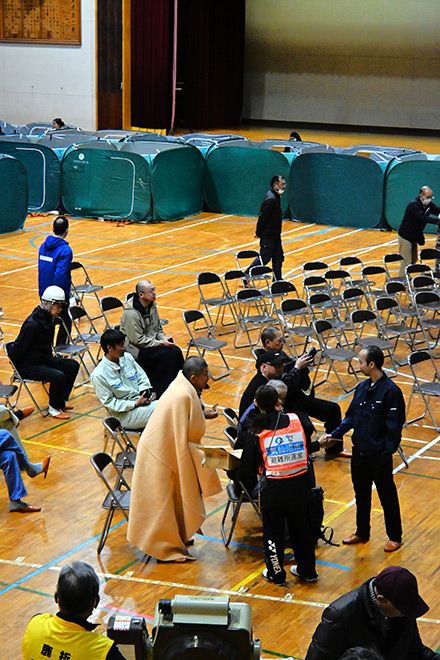
Coastal residents fled for higher ground, causing traffic jams and filling car parks serving as shelters.
Evacuation orders were issued for about 180,000 people in 40 municipalities, but these have since been lifted, according to the Fire and Disaster Management Agency.
Six people were injured in Hokkaido and Aomori and Iwate prefectures, officials said.
A man in his 80s fell in Morioka, Iwate Prefecture, and may have broken his leg, while women in the town of Tohoku in Aomori Prefecture and Oshu city in Iwate Prefecture suffered injuries or felt unwell.
The JMA and the Cabinet Office said the risk of an even stronger quake has increased for the Hokkaido and Sanriku coasts on the Pacific Ocean side.
The government has called for heightened alert for a mega-quake for one week but is not requesting pre-emptive evacuations.
The advisory targets 182 municipalities in seven prefectures from Hokkaido to Chiba Prefecture, primarily on the Pacific coast.
These are areas where the possible subsequent quake could cause shaking of a lower 6 or higher intensity or trigger tsunami of 3 meters or higher.
The potential mega-quake could exceed the scale of the Great East Japan Earthquake that struck on March 11, 2011.
It marks only the second time the alert has been used since the system was introduced in December 2022. The first one was issued in December 2025.
TRAUMA REKINDLED
For many residents in the Tohoku region, the April 20 tremor and tsunami warnings brought back the trauma of 15 years ago.
Kazuaki Abe, 72, a sushi restaurant owner in Rikuzentakata, Iwate Prefecture, said he heard a loud rattling sound and felt strong shaking that continued for about two minutes.
“It reminded me of the Great East Japan Earthquake,” he said. “I hope everyone evacuates safely.”
The 2011 tsunami devastated Rikuzentakata, washing away entire neighborhoods.
Takehiro Oikawa, 46, runs a winery in Ofunato, another city in Iwate Prefecture that was hard hit by the tsunami.
He said the April 20 quake reminded him of the powerful foreshock that occurred just two days before the 2011 catastrophe.
“It has been 15 years, and it’s frightening because a large earthquake could happen at any time,” Oikawa said. “I want to be well-prepared.”
About 200 people gathered at the civic cultural hall in Ofunato after the latest quake, including Nayoko Suzuki, 69, who fled from her home with her three grandchildren.
“During the Great East Japan Earthquake, a tsunami larger than what the Japan Meteorological Agency had announced came, and the diner I ran at the time was flooded with 1.5 meters of water,” Suzuki said.
Two of her grandchildren slept at the cultural hall while their father, a volunteer firefighter, was out patrolling the city.
In Kesennuma, Miyagi Prefecture, Akira Hatakeyama, 84, and his wife, on the urging of their children, fled from their fourth-floor apartment in public disaster housing with only the clothes on their backs.
They took shelter at a local junior high school.
“The shaking was enough to make me recall 15 years ago a little,” Hatakeyama said.
The evacuations around the Tohoku region showed a continued reliance on vehicles.
In Otsuchi, Iwate Prefecture, about 100 cars had arrived by 6 p.m. at a mountain recycling center designated as a shelter.
A 74-year-old woman who drove there with her 90-something neighbor noted the difficulty of evacuating on foot in an aging community.
“I’m glad the earthquake happened while it was still light out,” she said.
UNFINISHED RUPTURE
According to Shinji Toda, a seismogeology professor at Tohoku University, the April 20 event was a plate boundary earthquake.
It occurred in an area where strain has remained since 2011 because the great quake did not fully extend the plate boundary rupture, Toda said.
RECOMMENDED PRECAUTIONS
Under the government warning for a subsequent mega-quake, residents are urged to take the following precautions: ensure they can evacuate from a tsunami at any time of day or night; sleep in clothing that allows for immediate escape; keep shoes and other items within reach of their bedside while sleeping; carry valuables such as cash and identification at all times; and review daily preparedness measures, such as evacuation routes, methods of contacting family members, and stock of emergency supplies.
AloJapan.com