
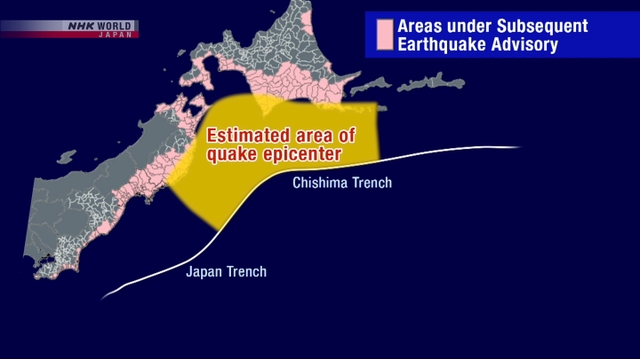
After a strong earthquake struck northern Japan, tsunami advisories were issued but have since been lifted. However, people across wide areas of Japan should be on alert for a potential mega quake.
The Japan Meteorological Agency has issued an alert for a potential mega quake, following the magnitude 7.7 quake on Monday. The agency says residents in seven prefectures should prepare for disaster and listen for any updates.
Officials say there is an increased probability of a mega quake along two deep-sea trenches in the Pacific Ocean.
The alert covers 182 municipalities in the prefectures of Hokkaido, Aomori, Iwate, Miyagi, Fukushima, Ibaraki, and Chiba. People in those areas should follow the advisory until 5 p.m. next Monday, April 27. It does not call for advance evacuation.
Officials urge people to keep emergency evacuation kits on hand, secure home furniture, and confirm backup food, water and portable toilets. In addition, they urged people to seek correct information and always refrain from spreading fake news.
Tsunami advisories lifted
The Japan Meteorological Agency issued tsunami warnings for Iwate Prefecture and Pacific coasts of Hokkaido and Aomori Prefectures in the Monday afternoon. Tsunami up to 3 meters high were expected, but the warnings were later lifted.
Then tsunami advisories for parts of Hokkaido, Aomori, Iwate, Miyagi and Fukushima Prefectures were lifted at 11:45 p.m. on Monday.
80-centimeter tsunami observed
One 80-centimeter tsunami struck Kuji Port in Iwate Prefecture. A 40-centimeter tsunami also struck Miyako Port in Iwate Prefecture, Urakawa Town in Hokkaido and Hachinohe Port in Aomori Prefecture. Less than 30-centimeter tsunami reached other parts of Japan.
Magnitude 7.7 quake struck northern Japan
The agency raised the scale of the quake from magnitude 7.5 to 7.7 that occurred off the coast of Sanriku, Iwate Prefecture at 4:52 p.m., and had an intensity of upper 5 on the Japanese scale of 0 to 7 in the hardest-hit areas. The quake is estimated to be 19 kilometers deep.
Class 3 long tremors in Tohoku
Long tremors that could rock high-rise buildings have been recorded in Tohoku.
The agency calls this “long-period ground motion.” It affects people on higher floors. A four-level scale ranks their intensity.
Class 3 tremors make it difficult to remain standing. These were felt in Wakuya Town in Miyagi Prefecture and Yokote City in Akita Prefecture. Experts say they can be strong enough to topple furniture.
Weather officials held a news conference on Monday, saying the second and third waves could be higher than the first one. They urged residents who received tsunami warnings to evacuate until the warnings are lifted.
They also advised people in Japan to watch out for earthquakes with a maximum seismic intensity of upper 5, especially in the coming days.
Over 176,000 residents ordered to evacuate
The government says over 176,000 residents in Hokkaido, Aomori, Iwate, Miyagi and Fukushima prefectures had been ordered to evacuate as of 7:45 p.m. on Monday.
Shinkansen restarts full service
East Japan Railway Company says Tohoku, Akita and Yamagata Shinkansen bullet trains resumed their services around 9 p.m. on Monday. They suspended their operations because of the earthquake. The Tokaido Shinkansen is operating normally.
Airports operating normally
The operators of airports in Shin-chitose and Sendai say their operations have not been affected due to the quake.
No abnormality at Fukushima plants
Tokyo Electric Power Company says it’s confirmed there are no abnormalities at its Fukushima Daiichi and Fukushima Daini nuclear plants. The operator also says there’s been no change in radiation levels around the sites.
Further north…the Tohoku Electric Power Company says currently there are no abnormalities at either its Higashidori nuclear power plant in Aomori Prefecture or its Onagawa plant in Miyagi Prefecture.
The Recyclable-Fuel Storage Company says there are no abnormalities at its interim storage facility for spent nuclear fuel in Aomori Prefecture.
Researchers note speed of tsunami that hit northeast Japan coast
A research team says the tsunami generated by the powerful earthquake that hit northeastern Japan on Monday reached some areas in Iwate Prefecture in about 20 minutes.
The team, led by Associate Professor Suppasri Anawat at Tohoku University’s International Research Institute of Disaster Science, simulated how the tsunami waves traveled. The magnitude 7.7 quake occurred off the Sanriku coast.
The researchers said it took the waves about 20 minutes to reach Miyako Port in Iwate Prefecture and other areas on the coast close to the quake’s epicenter.
An 80-centimeter tsunami, the highest recorded after the quake, was observed in Kuji Port in the prefecture about 30 minutes after the quake occurred.
Anawat said the highest wave hit the port quickly due to its proximity to the epicenter. He said waves measuring several dozens of centimeters hit the port repeatedly due to its geographical features.
He called on people to evacuate immediately in case a tsunami warning is issued again.
The Japan Meteorological Agency has issued a subsequent earthquake advisory for areas on the Sanriku coast and the northernmost prefecture of Hokkaido.
AloJapan.com