
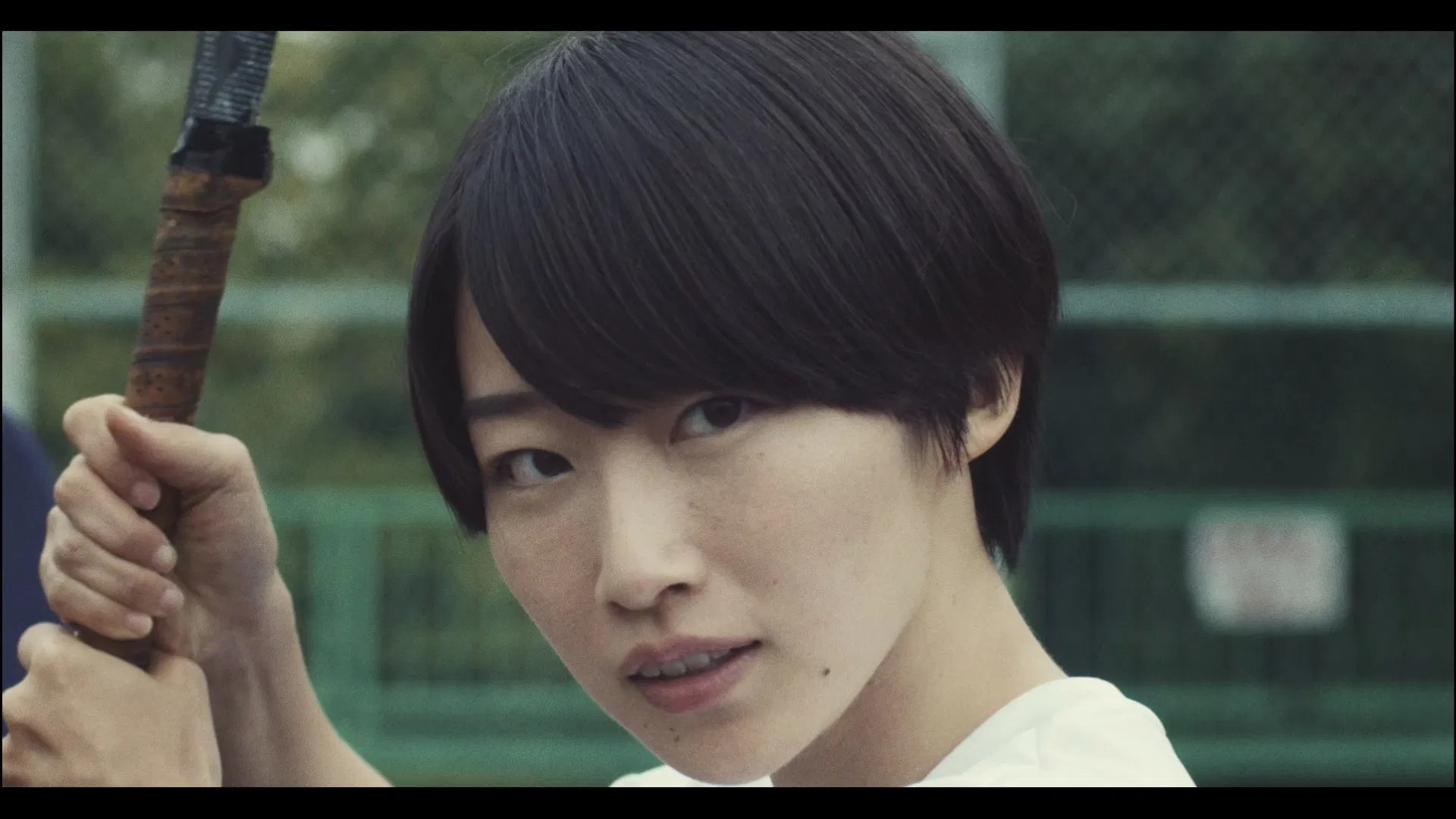
Every now and then you see a film where the only viable response is: where did that come from? The beauty of Third Window’s new Takashi Ono collection is that it answers that question. As collections go, it’s modestly-scaled stuff; three shorts and a feature, and the feature’s only just over an hour long. But it tracks the whole arc of a director’s career from his earliest shorts to his breakthrough, and it shines a light on a Japanese cinema scene most Westerners will be completely in the dark about: the jishu-eiga, or ultra-independent films.
The jishu-eiga are low-budget films exhibited at independent Japanese cinemas like Tokyo’s Cinema Rosa, smudging the line between amateur and professional film-making in a way that makes it much easier to bring new talent into the Japanese industry. Shinichiro Ueda’s international hit One Cut of the Dead was a notable Cinema Rosa graduate, and so was Takashi Ono’s I Am Baseball, a sporting comedy whose run at the cinema was repeatedly extended by public demand.
The least you can say about I Am Baseball is that it’s a sports comedy unlike any other. Rather than any childhood love of the game, Mitsuki Moriyama’s heroine Natsuko starts playing baseball in order to pay off her late husband’s outstanding debts. If this suggests a tougher, This Sporting Life-style examination of the economy and exploitation of professional sports, park that suspicion immediately. Natsuko sees baseball as her ticket to fortune largely because hard-nosed local coach Shigeno, played in an absolutely go-for-broke performance of comic aggression by Takehito Fujita, sees her as a channel for the spirit of baseball, and as she trains with him she starts to agree.
Many baseball films have a similar sense of the sport as a near-mystical art – nobody makes a film like Field of Dreams about boxing – but I Am Baseball wilfully pushes it past the point of total absurdity. The director’s own editing accentuates the cartoonish quality, slowing down and repeating action shots in a way that curiously reminded me of late ’70s-early ’80s Godard, but the overall effect these tricks have on the film could not be more different. If the chapter titles and musical numbers also suggest a certain nouvelle vague influence, the ending reveals what the true Western equivalent of Ono’s film is. With its ramped-up close-ups and Looney Tunes slapstick, it’s pure Sam Raimi. Indeed, it’s closer to what you’d hope a Sam Raimi baseball film would be like than Sam Raimi’s actual baseball film, 1998’s For Love of the Game, which is probably his most anonymous work.
If he’d had to earn the trust of a studio, he might be working with bigger budgets by now, but equally he might have been steered towards more commercial material, rather than making films where violent gang rumbles erupt over the issue of littering. Who wants that?
CLICK THE IMAGE AT THE BOTTOM OF THE PAGE TO BUY NEW DIRECTORS FROM JAPAN: TAKASHI ONO, AND TO SUPPORT BOTH THE GEEK SHOW AND THIRD WINDOW FILMS
So, again, where did that come from? Viewers in search of an answer can double back to the earliest film in the set, 2016’s Cheating Office Lady: Wet Galaxy. As the title implies, this is a tribute to a quintessentially Japanese film genre… that’s right, the karate movie. Yes, despite having the most pinku eiga title imaginable Ono’s debut is a series of increasingly absurd swerves, first into science fiction, then into martial arts. It’s clearly the most low-budget film in the set, and the others are hardly $200 million blockbusters. The digital video looks at least ten years older than the film’s year of production, and the alien monster costume (just go with it) is delightfully cheap and plasticky. (Although there is one scene where said costume is augmented with claymation effects that may remind Britons of my generation of the children’s show Trap Door). The pacing is surprisingly slow, which can be chalked down to it being a debut: Ono is too thrilled to have simply shot something to edit it with as much ruthless comic precision as I Am Baseball. But it’s consistently surprising and outrageous, and it immediately establishes a central theme of Ono’s work.
That theme is, simply, plucky, resilient comic heroines. All of the films in this set have female leads, and all of them are of a type: resourceful, naïve yet determined, vaguely obsessive-compulsive, diving headfirst into completely unfamiliar situations and never hesitating to pick themselves up when they fall down. That last metaphor becomes literal with the many pratfalls of 2018’s Fashion Runner, the shortest film in the set but also perhaps the strongest. After Cheating Office Lady: Wet Galaxy‘s lo-fi digital video, Ono is clearly happy to be working with film, beginning with a leader-strip countdown and pushing the colour saturation as far as it can go. There is no logical reason for the walls and windows of the heroine’s house to change colour in between scenes, but it allows Ono to get as many different slabs of glowing primary colours into the film as possible, and that’s a worthwhile exercise in itself.
The plot of Fashion Runner is a pocket restatement of the central theme of teen classics like Heathers or Mean Girls; an outsider’s attempt to gain access to an elite clique of fashion-conscious queen bees whose colour-coded outfits suggest a lack of individuality. Ono was himself a student when he made the film, and presumably the imposing concrete buildings the film makes such great use of were found on site. It’s full of charm, and it confirms that the formal talent that shone through Cheating Office Lady: Wet Galaxy‘s budgetary limitations is very real. As does the final film in the set, 2019’s Pick It Up and Throw It Away!, a sprawling tale in which a littering problem becomes all-out war between rival gangs. By this point his comic sensibility – an absurd, action-packed, slapstick approach to banal problems, a heroine who retains her innocence, optimism and determination in the face of ridiculous odds – is fully established, and he only has to extend the run-time by twelve minutes or so to get to his feature-length debut.
At a point where studio-produced, reasonably-budgeted British films are struggling to get cinema showings in their home country, this Third Window set looks like a broadcast from a parallel universe: a world where even something as home-made and flatly insane as Cheating Office Lady: Wet Galaxy can get out there, get seen and be the springboard to a prolific career. You want to compare it to the Corman school, except there’s no Roger Corman to play schoolmaster: everything Takashi Ono has is the result of his own hard work and the cinema owners who took a chance screening these films. If he’d had to earn the trust of a studio, he might be working with bigger budgets by now, but equally he might have been steered towards more commercial material, rather than making films where violent gang rumbles erupt over the issue of littering. Who wants that?
As it stands, Ono was allowed to work his way to feature status while keeping his core themes and eccentricities completely intact. The result is, after watching these four films, “the Takashi Ono heroine” feels like it’s as recognisable a cinematic archetype as the Hawksian woman or the Herzogian outsider. The only extra is an interview with the director, although the disc packages the three shorts as extras, so really that’s a pretty unbeatable set: a striking comedy debut by a director you’ll be completely unfamiliar with, plus the three equally impressive shorts that show you where, exactly, that came from.
NEW DIRECTORS FROM JAPAN: TAKASHI ONO IS OUT NOW FROM THIRD WINDOW FILMS

GRAHAM’S ARCHIVE – TAKASHI ONO – NEW DIRECTORS FROM JAPAN
AloJapan.com