
Reported by Chuncheon Citizens
Similar Incidents from the Past Resurface
A domestic financial institution is facing controversy over an inappropriate design related to the March 1st Independence Movement Day featured in calendars provided to customers. Criticism has arisen over a lack of historical awareness and sensitivity, as images symbolizing Japan were included on a page meant to commemorate a national holiday.
On March 31, Professor Seo Kyungdeok of Sungshin Women’s University stated on his social networking service (SNS), “I learned about this through reports from citizens of Chuncheon, Gangwon Province,” and added, “The March design in this year’s calendar produced by a credit union has become a problem.”
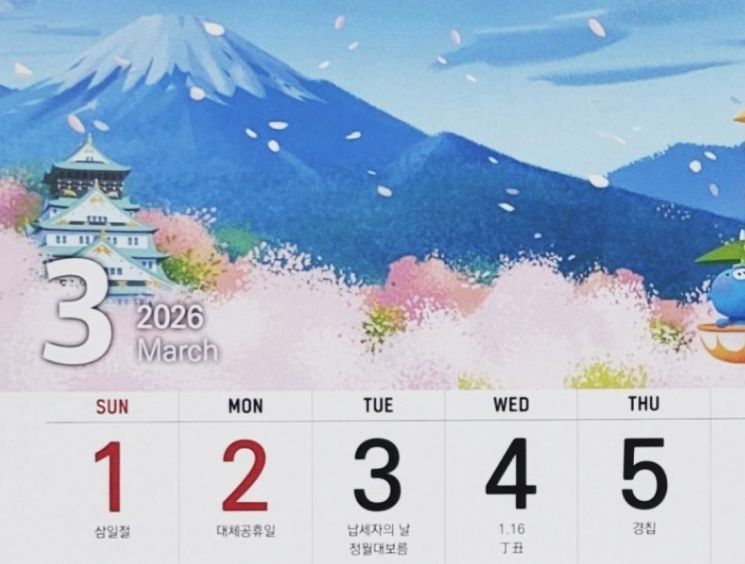
Catholic Chuncheon Credit Union’s calendar design for March this year provided to customers. Seo Kyungdeok SNS
View original image
According to the calendar shared by Professor Seo, the top of the March page features images representing Japan, such as Mount Fuji, Osaka Castle, and cherry blossoms. Notably, these images are placed directly above the 1st day, which marks Independence Movement Day, further fueling the controversy.
Professor Seo pointed out, “March 1st Independence Movement Day is a national holiday established to honor the spirit of independence and to inspire unity and patriotism among the people,” and criticized, “Placing symbols of Japan in a calendar for a month that includes such a significant day shows a disregard for the sentiments of customers and is highly inappropriate.”
He further added, “March is not only the month of Independence Movement Day, but also when many major independence activists, including Ahn Jung-geun, Ahn Changho, and Lee Dong-nyeong, died for the cause. Considering this historical context, even more caution should have been exercised.”
This controversy is evolving beyond a simple design issue, raising broader questions about public responsibility and historical awareness. There is growing opinion that organizations serving a large number of citizens, such as financial institutions, bear heightened social responsibility.
Similar cases continue to occur. Last year, a promotional video produced by the Ministry of Land, Infrastructure and Transport to commemorate Liberation Day included scenes of Tokyo Station and Shinkansen tracks, which sparked significant criticism. At the time, the production was also denounced for its carelessness in failing to consider the symbolism of the national holiday and public sentiment.
Hot Picks Today
!["Thought It Was Just Milk?"... The 'Fake Milk List in Korea' Was Real [Matjalal X-File]](https://www.alojapan.com/wp-content/uploads/2026/04/2023072413274517286_1690172865.jpg)
“Thought It Was Just Milk?”… The ‘Fake Milk L…
There have been ongoing instances of some local governments and public agencies using foreign tourist images or inappropriate backgrounds in promotional materials related to commemorative days. In response, Professor Seo emphasized, “For national holidays such as Independence Movement Day and Liberation Day, content should fully reflect the sentiments of the people and the historical significance. It is important for us to develop a correct understanding of history and strive to incorporate this awareness throughout society.”
This content was produced with the assistance of AI translation services.
© The Asia Business Daily(www.asiae.co.kr). All rights reserved.
AloJapan.com