
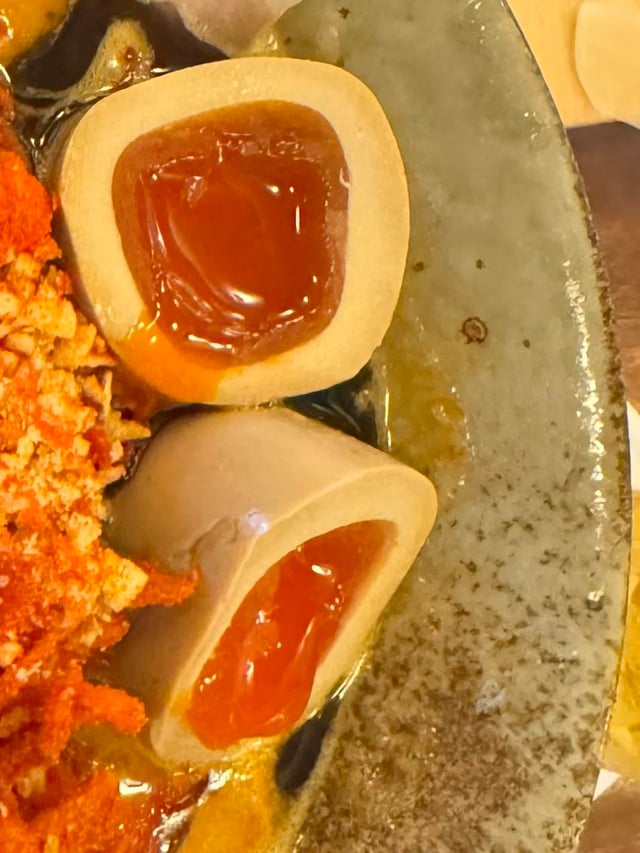
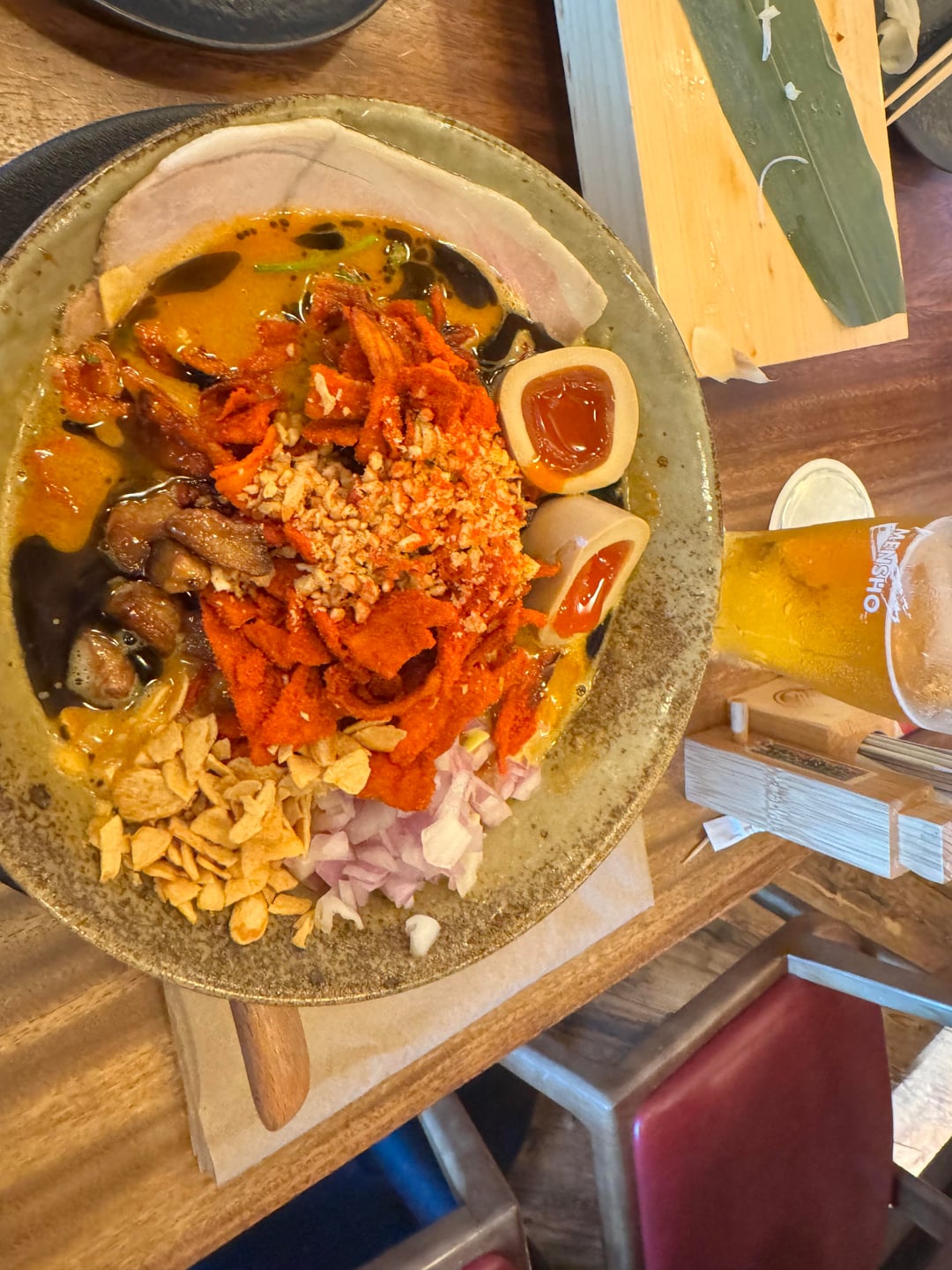
Recently at a trip I had this bowl of ramen at a restaurant and the thing that impressed me the most was the consistency of the ajitama, I have made it before but i haven’t got close to something this consistent and creamy (genuinely it felt like honey/jam), I am just curious if there is anything extra to do it like this or if is just nailing the cooking and the marinade timing.
Thanks
by RFL1703
9 Comments
Boil exactly 6 minutes, then straight into the ice bath.
>if is just nailing the cooking and the marinade timing.
Correct.
8 minutes typically you have a solid yolk so if you time it to like 6 minutes depending on your range or stove power you can achieve this by undercooking and immediately dumping the eggs into an ice bath then cold steeping the eggs for a 24-48 hours to achieve the color. I use a zip lock bag.
* Start by using ‘golden yolk’ eggs that can be found in Japanese and other Asian markets.
* Use a sous vide method and set temp to 149°F (65°C) for 45 minutes. You need a sous vide to consistently get this kind of result. The difference between 149f and even 155f is a major change for the yolk result. You can see photos of the different temps here: [https://www.seriouseats.com/sous-vide-101-all-about-eggs](https://www.seriouseats.com/sous-vide-101-all-about-eggs)
* When cooked, cool and peel then soak in a tsuyu mixture. Be careful as some recipes use vinegar which I don’t recommend since it makes the marinated parts tough.
These cook times are spot on, but to achieve the jammy consistency of the yoke and not just a soft boiled egg you need the right marinade ratio. I don’t know off the top but it’s a mix of soy sauce, mirin, and rice wine vinegar cut with water. Submerge your peeled eggs with a paper towel on top and leave in the fridge for 24-48 hours. You can also add ginger, green garlic, seaweed (I prefer wakame or kombu), and chili oil/flakes for an extra punch.
Personally I prefer jammy which is 8 minutes low boil and then blanch, but if you pull up short of that at 6-7min you’ll probably get a runnier texture.
It’s definitely just the timing and marinade. I use this recipe: https://www.justonecookbook.com/ramen-egg/
My eggs are at their best after about 48h marinating. They start out very soft boiled and can be tricky to peel because of that, but the marinade cures them a bit and you get the perfect honey texture yolk.
The real answer: marinade them for 5, 6, or maybe even 7 days. It’ll get you that honey/jam consistency.
6 to 7.5 minutes produces very creamy yolks like this. You can do what I did and test is yourself. I put on a pot of boiling water and dumped 4 eggs in at once. I took one out at 6 minutes, one at 6.5, one at 7, etc. I dumped each into a bowl of ice water immediately. I think for ajitama, 6.5 to 7 might be perfect. I used cold eggs from the fridge. I think it helps the white cook faster than the yolk.
Then you just have to find a good tare recipe to soak them in.
If you want to cut them perfectly, you can use a piece of thread so the yolk doesn’t get pushed out by the knife.
I have made Aji tamago several times. [Here is the main video I learned how to make them from](https://www.youtube.com/watch?v=F9IepMO2DIc), but I will also brain dump all of my notes from watching and experimenting.
1. Prepare the eggs. The eggs can be cooked straight out of the fridge. You could bring them to room temperature but it is unnecessary. What you do want to do is to orient the eggs pointed side down with the butt pointed up as that is where the air sack is.
2. Stab a pin sized hole at the butt of the egg. This hole will do several things.
* Allow trapped air to escape and room for the egg to expand preventing the egg from cracking when it enters the boiling water. (Bringing eggs to room temp will also help prevent this.
* Allows water to enter the egg when placed in the ice bath helping the shell release from the egg.
* Give the egg a more round shape (if aesthetics is important to you)
* Note: When you put the eggs into the boiling water, you will see beads of air escaping. If you did not pre-orient the eggs, you will see egg come out of the hole which is not a good sign.
3. Bring the water to a boil, gently lower the eggs into the water, and boil for 5:30-6 minutes
* Important: For the first 1-2 minutes of boiling, you must continuously rotate the eggs to center the yolk. If you don’t do this, you could end up with a really thin wall of egg white with a partially cooked yolk which you do not want
* Cook time is based on ensuring the whites are almost cooked all the way through, but the yolk is left untouched and raw. It is okay if the white is slightly uncooked.
4. After the timer is up, immediately place eggs in an ice bath and let them cool for 1 minute.
5. You can peel the eggs the moment they no longer burn your hands. I normally peel them under the cold water of the ice bath.
* Technique to peel the eggs: Do not tap them against a surface to crack the eggs. Instead, press the egg gently into the bowl of the ice bath until it cracks, then rotate the egg against the bowl while applying pressure to create cracks all around the egg. Personally I like starting at the tip of the egg at an angle and and working my way down for the entire egg. It is especially important to ensure all of the shell is fractured as it is possible that while peeling off the shell, it could rip off a chunk of egg white as it is still delicate. Parts that are especially more fragile are the tip and butt of the egg.
* [Reference video for egg techniques, watch till 3:31](https://youtu.be/gmIwxqdwgrI?si=CyOd7Igcy-ltt2dz&t=184) I spend more time cracking the shell because I’m not as good as he is.
6. Marinating and curing the egg will require a bit of trial and error. The more jammy you want your eggs, the longer you want to leave them in the cure, and the longer you leave them in the cure, the more salt you need. Curing time is 1-3 days.
* About what to use are your cure: Straight black soy sauce is not used in Japan. They normally use light soysauce, but not light in sodium, light in color. This is called Usukuchi Shoyu. They care a lot about the aesthetics so to ensure the eggs don’t end up turning brown, they will often use this.
* What I recommend, is to actually use Shirodashi which is around the same salinity as soysauce. The brand I recommend is called Yamaki Kappo Shirodashi.
* Ratio for 6-8 eggs is
* 1/2 cup of soysauce or shirodashi
* 1/2 cup of mirin
* 1/4 cup of nihonshu (known as sake)
* If you want to to marinate more eggs at once, you must scale up the liquid proportionally otherwise there will not be enough salt for all the eggs and they will turn out bland.
* Add aromatics like dried shitake or kombu.
And sorry for the messy formatting, just dump them into chatgpt or something to clean it up if it’s too hard to follow.