

 A radiation-resistant wireless receiver could reduce tethered cable constraints during Fukushima Daiichi–style nuclear decommissioning robotics. The scene visualizes safer remote operations in high-dose environments. (Credit: Intelligent Living)
A Japanese research team recently showcased a 2.4 GHz Wi-Fi receiver prototype capable of surviving a staggering 500 kilograys of radiation. This high-dose tolerance solves a primary frustration in nuclear decommissioning: the restrictive data cables that hold robots back. By cutting the cord, engineers can finally deploy machines that navigate contaminated ruins without snagging on debris.
Operating wireless control in nuclear cleanup environments requires electronics that resist total ionizing dose effects. Utilizing a radiation-hardened receiver facilitates more flexible robotics deployment, transforming hazardous waste remediation and long-term facility dismantling.
The significance of this result lies in its engineering specificity rather than vague claims about shielding. Engineers designed this receiver chain to specifically counteract radiation failure modes, validating its performance under extreme doses for critical nuclear decommissioning applications.
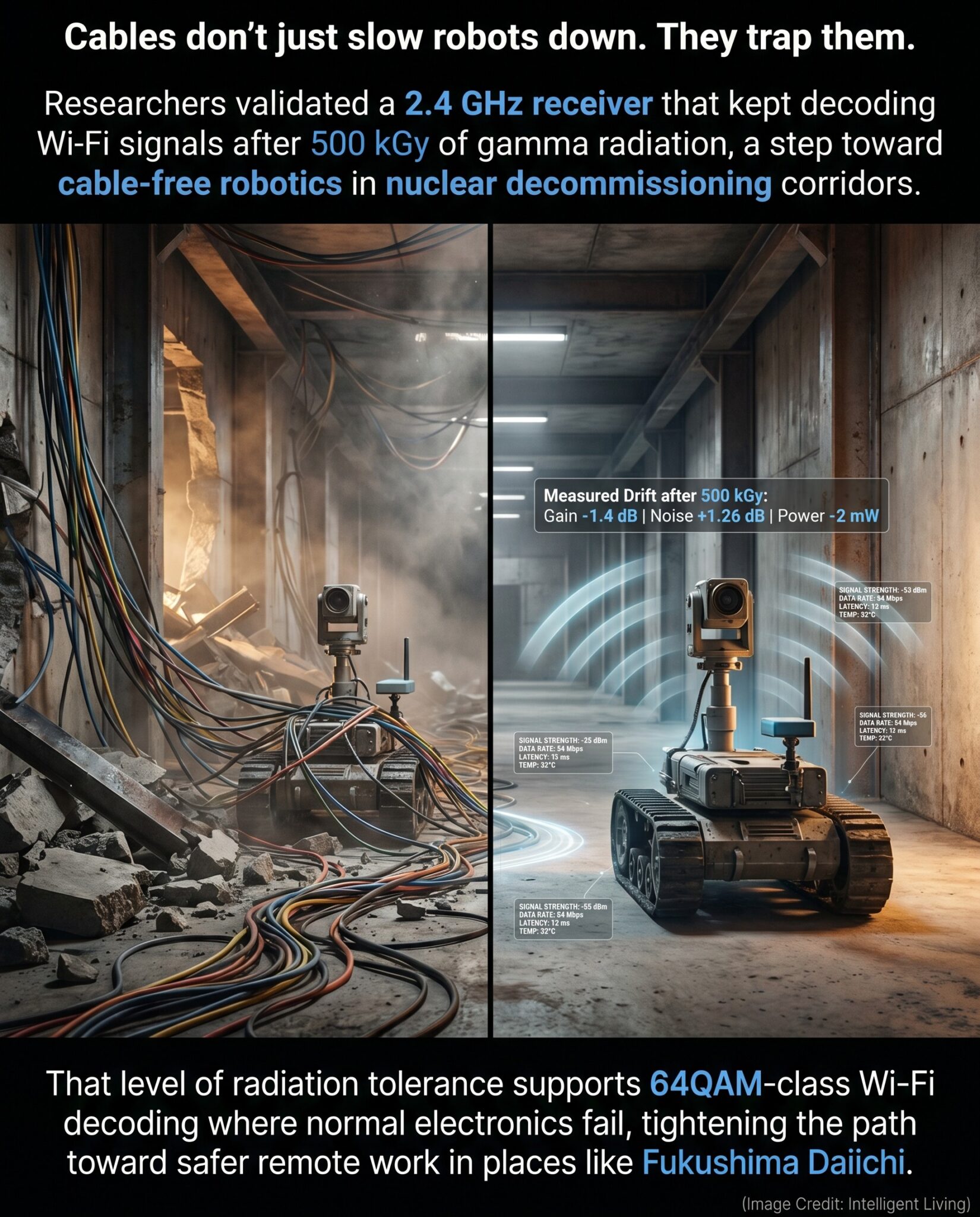 A 2.4 GHz receiver tested to 500 kGy hints at cable-free robot control for nuclear decommissioning zones like Fukushima Daiichi. The image turns the engineering proof into a clear “why it matters” visual without oversimplifying the data. (Credit: Intelligent Living)
Breaking News: 500 kGy Wi-Fi Hardware for Nuclear Decommissioning and Fukushima Robotics
2026 IEEE Conference Showcases 500 kGy Wireless Prototype
At the 2026 IEEE International Solid-State Circuits Conference, the team presented their radiation-hardened receiver architecture to an audience of global engineering experts. The team reported a radiation-hardened 2.4 GHz receiver intended for contaminated decommissioning zones, with validation focused on whether real Wi-Fi signaling holds up after irradiation.
Fluctuations in signal margin often lead to sudden dropouts when rescue hardware maneuvers behind dense concrete barriers. These signal gaps are more than just a nuisance; they can stall a critical inspection midway, forcing crews to wait or manually retrieve stalled equipment. IAEA technical briefings highlight how remote decommissioning technologies decide whether a remediation plan survives contact with high-dose reactor environments.
Technical Specifications of the 500 kGy Radiation-Resilient Receiver
Building hardware for high-dose zones requires moving past traditional design limits. These technical specifications show how the team reinforced the receiver for real-world survival:
A 2.4 GHz Wi-Fi receiver acts as the primary sensory interface, converting faint radio signals into usable digital commands for remote control.
Research teams established a measurable baseline for total ionizing dose resistance through extensive gamma irradiation validation using cobalt-60 sources.
Technical documentation provided by Science Tokyo defines critical metrics such as TID, noise figure, and EVM for the 500 kGy receiver.
Testing confirmed only modest degradation, ensuring performance remains sufficient for maintaining link quality in real-world scenarios.
Such results imply the receiver chain maintains signal decoding during extreme cumulative dose, addressing a specific bottleneck for cable-free control. While the current milestone focuses on reception, it provides the structural foundation needed for a complete, two-way wireless package.
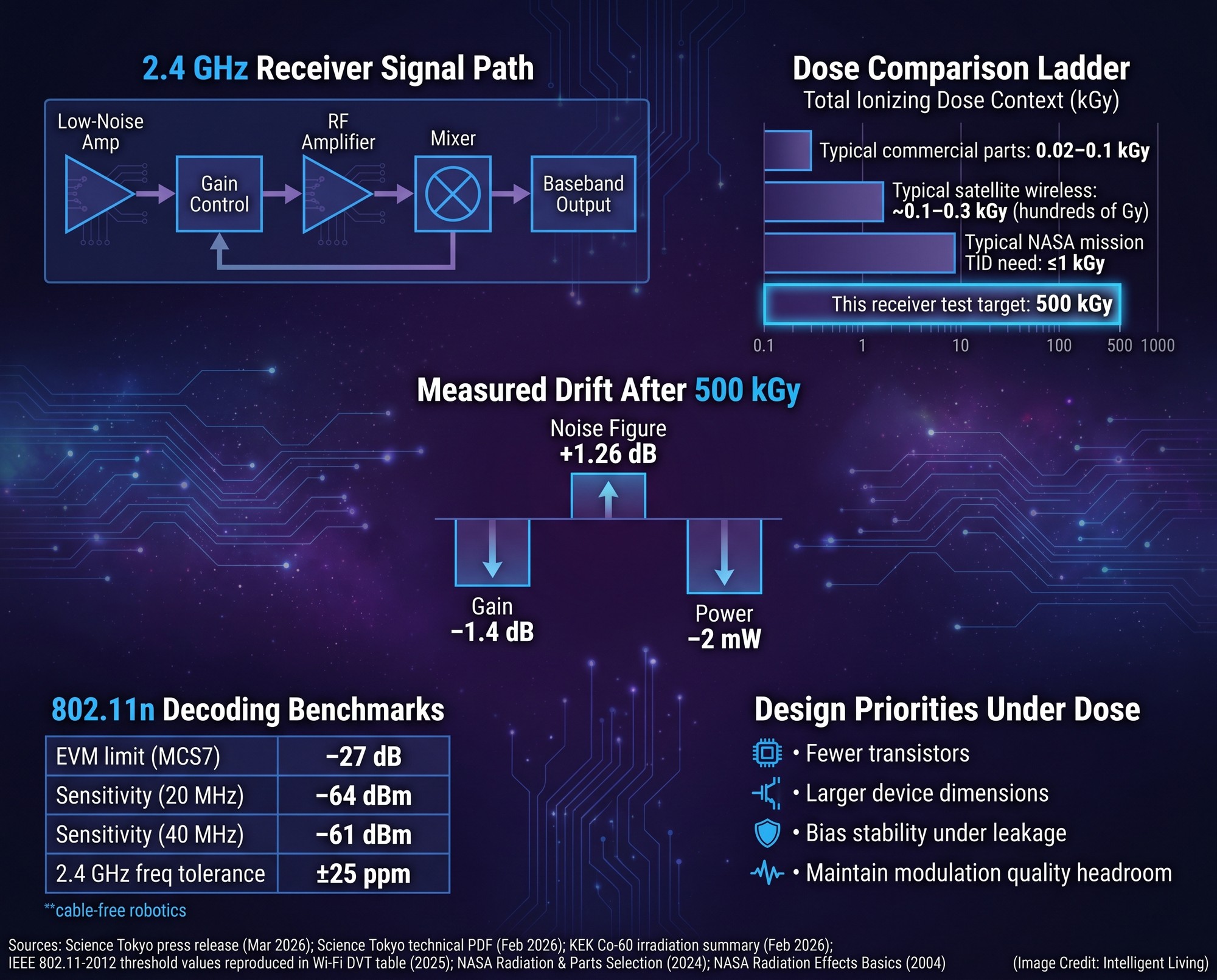 This visualization explains why total ionizing dose ruins ordinary wireless electronics and how a radiation-hardened receiver keeps Wi-Fi decoding stable. It grounds the story in measurable deltas and standard Wi-Fi performance thresholds. (Credit: Intelligent Living)
How the 2.4 GHz Receiver Works and Survives Extreme Radiation
Capabilities and Limitations of the 2.4 GHz Receiver Architecture
The prototype is a specialized receiver front end rebuilt for radiation resilience. Prototype circuitry processes weak 2.4 GHz signals by amplifying and filtering them for seamless controller interpretation. Wi-Fi receiver testing relies on measuring error vector magnitude to quantify how far signals drift from ideal constellation points during irradiation.
Current achievements do not yet constitute a complete cable-free robotics network ready for immediate deployment. Field systems still require transmitters that deliver stable power under intense radiation and rugged packaging to resist heat.
Industry standards for wireless physical-layer stability demonstrate how reflections and geometry impact modulation, a challenge that only intensifies in a decommissioning environment.
Receivers are where ‘small damage’ often turns into ‘big failure.’ In any wireless connection, the ‘link budget’ acts like a signal’s bank account. If noise increases even slightly, the system runs out of ‘credit,’ and the connection drops.
This sensitivity is why a small drift in performance can force a robot to slow down its data speed or lose its connection entirely. NASA research suggests that cumulative radiation is a long-term reliability threat rather than a one-time stress test.
Mitigating Total Ionizing Dose Effects in Wireless Hardware
Total ionizing dose describes the gradual alteration of transistor behavior caused by trapped charge within insulating layers. This phenomenon occurs alongside sudden hazards like particle strikes. Aerospace engineering protocols treat radiation reliability risks as distinct hazards that can cause sensitive receiver stages to drift during sustained contact.
Prolonged exposure triggers a slow shift in bias points as leakage increases, eventually turning a tuned amplifier into a noisy component. To limit failure paths, the team emphasized a design philosophy that reduces reliance on dense transistor networks. The team implemented simplified circuit topologies to keep sensitive stages stable under charge trapping and leakage growth.
Think of it like a corrosive environment at sea. A complicated micro-hinge might seize up quickly, while a thicker steel pin keeps turning. The receiver’s design follows this same logic: simplify where possible, reinforce the essentials, and accept a tiny drop in efficiency to avoid a total breakdown.
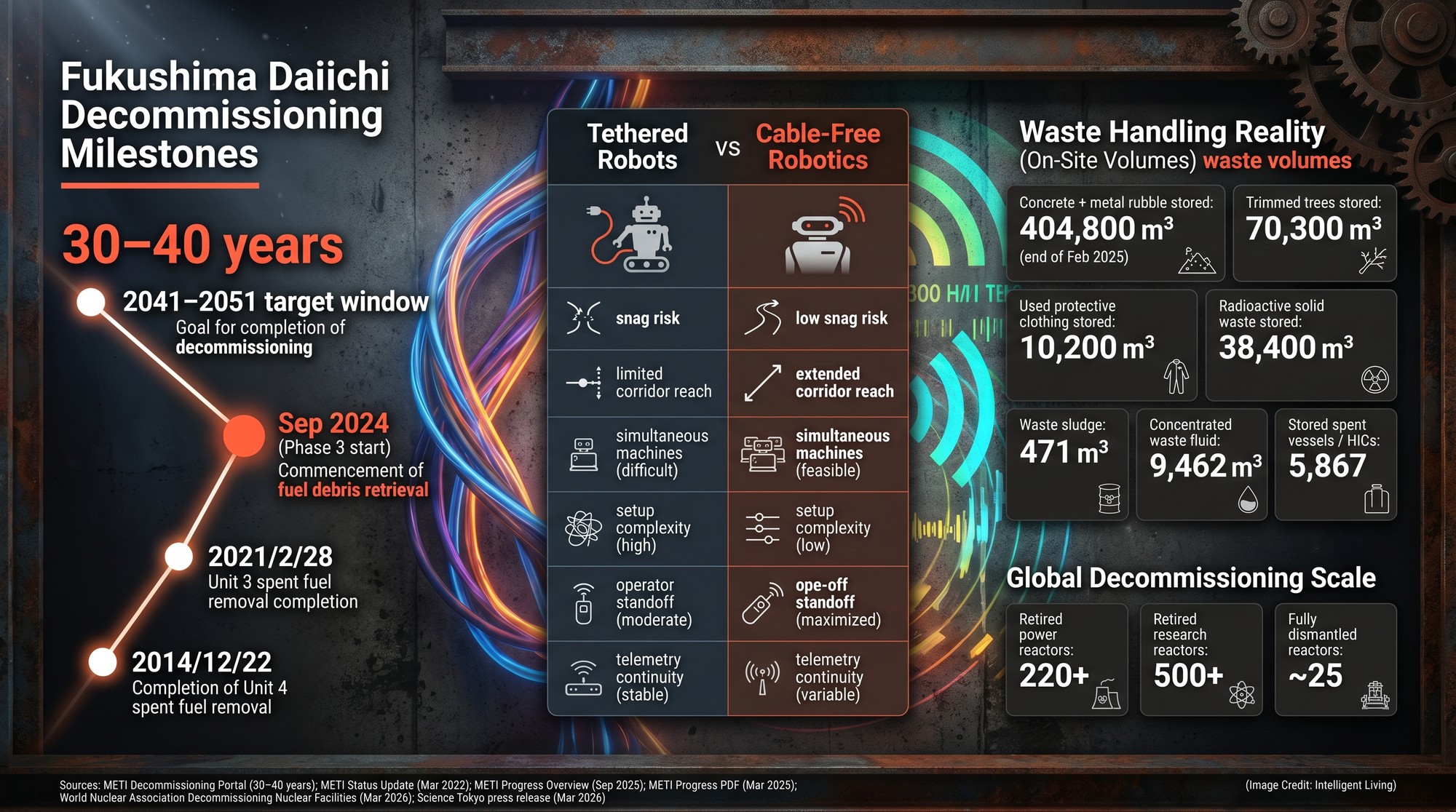 This visualization connects cable-free robotics to real remediation constraints: decades-long timelines, huge waste-handling volumes, and field operations where tether management limits what robots can do. It shows why radiation-hardened wireless decoding is a practical lever, not a sci-fi promise. (Credit: Intelligent Living)
Operational Impact of Cable-Free Robotics on Nuclear Remediation
Enhancing Remote Work Loops in Hazardous Decommissioning Zones
Nuclear cleanup is measured in decades, not months. As aging plants retire worldwide, the need for machines that can work without constant human intervention is growing. Projections for the global decommissioning workload describe an expanding need for reliable remote work loops that survive heat and dust. In cramped spaces, managing physical tethers often determines which tasks are actually possible.
Regional recovery efforts in Japan align with sustainable infrastructure reinvention, where recovery timelines stretch far beyond the plant boundary. Long-term remediation strategies include large-scale hydrogen production, illustrating how engineering choices must support real-world durability.
Field Applications for Radiation-Hardened Wireless Technology
Deploying radiation-hardened hardware opens several practical avenues for facility remediation. These use cases illustrate how wireless connectivity can transform operational safety:
Corridor Inspection: Removing tethers reduces entanglement risks when multiple robots navigate confined hallways simultaneously. Hazardous remediation at Fukushima reactor facilities utilizes remotely operated robots to navigate complex environments where wireless links remove mobility constraints.
Sensor Nodes: Hardened receivers enable temporary nodes that stream telemetry from high-radiation reactor zones without the need for additional cabling.
Mapping Loops: Scans conducted wirelessly facilitate efficient contamination mapping in high-risk areas, reducing operator exposure.
Waste Management: Enhanced data quality improves process control during complex wastewater decontamination operations, ensuring more precise remediation outcomes.
Extreme Hardware: This logic applies to fusion testbeds and aerospace materials design, where electronic components must withstand extreme environmental stressors.
Moving these wireless strategies from the lab to the field changes the game for cleanup crews. These applications prove that connectivity is the key to faster, safer, and more reliable remediation cycles.
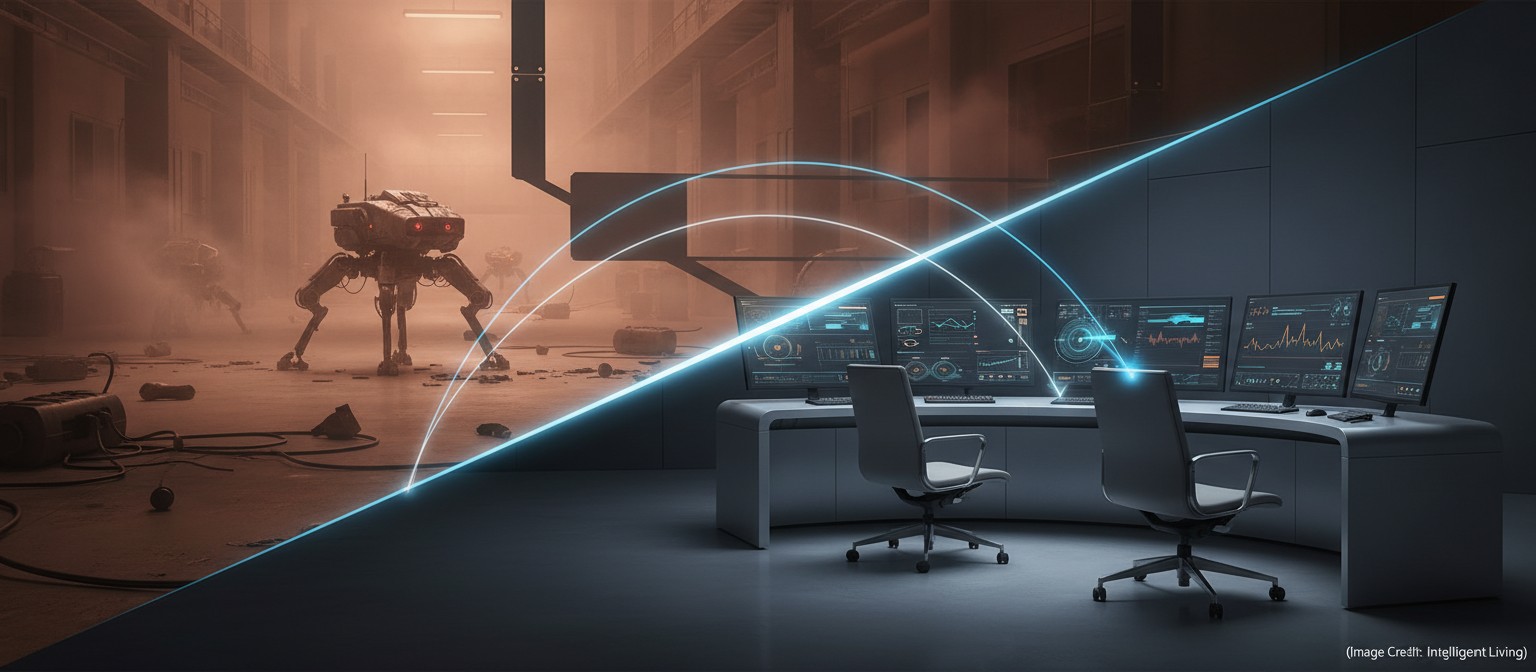 The conclusion emphasizes that receiver survival is a major milestone, while real deployment still depends on system engineering and reliability. This image bridges “what’s next” planning with practical nuclear remediation realities. (Credit: Intelligent Living)
Scaling Wireless Connectivity for Nuclear Decommissioning and Cleanup
Receiver resilience represents an essential milestone but does not yet solve every hurdle in wireless power delivery. Designing for 500 kGy resilience allows this receiver to target the quiet failure points that traditionally cause electronic drift. Simplifying the internal circuitry and reducing transistor counts creates a blueprint for resilient RF front ends that maintain signal stability where ordinary hardware fails.
While this milestone secures the reception chain, the path toward fully autonomous, cable-free robotics requires further transmitter hardening and ruggedized system packaging. Advanced hardware will eventually allow multiple machines to operate in parallel, significantly shortening remediation timelines in places like Fukushima Daiichi. Resilience is becoming a global performance standard, as seen in advanced extreme-environment electronics that maintain functionality under heat and radiation.
FAQ: 500 kGy Wi-Fi in Nuclear Environments
What does a 500 kGy radiation dose mean for electronics?
Extreme cumulative exposure at this level would instantly disable standard consumer chips by shifting transistor bias points and increasing electrical noise.
Can robots work wirelessly inside a nuclear reactor now?
Field deployment depends on further transmitter development and system-level engineering to manage signal reflections within dense, metallic facility structures.
How does radiation-hardened Wi-Fi improve cleanup safety?
Eliminating physical data cables reduces robot entanglement risks, allowing operators to conduct remote inspections in tighter and more hazardous zones safely.
What is the role of 2.4 GHz frequency in this technology?
Standard Wi-Fi protocols utilize the 2.4 GHz band, ensuring this receiver remains compatible with existing wireless control and real-time telemetry systems.
Why is the Fukushima cleanup driving this research?
Fukushima’s decommissioning requires long-horizon sensing solutions capable of surviving hazardous fuel debris and intense gamma fields over decades.
AloJapan.com