
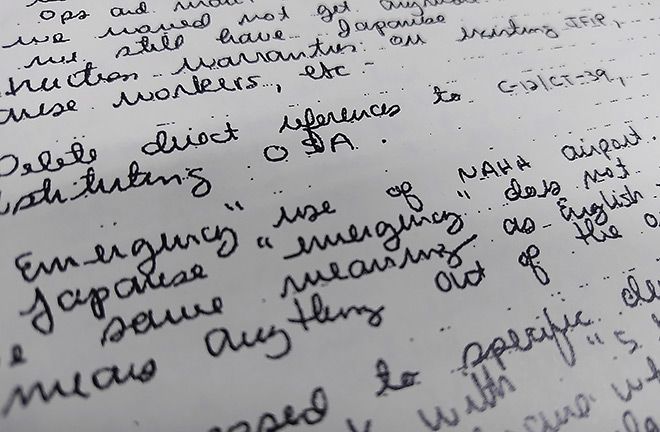
While compiling a final report on reducing the burden on Okinawa Prefecture of U.S. bases, discussions between Japanese and U.S. officials touched upon the need to use Naha Airport during an emergency.
The utilization was mentioned in an internal document obtained more than two decades after discussions that included returning Marine Corps Air Station Futenma in Ginowan, Okinawa Prefecture, to Japan.
The Japan-U.S. Special Action Committee on Okinawa (SACO) was set up to deal with the huge public outcry over the rape in 1995 of an Okinawa schoolgirl by three U.S. service members.
In 2008, Masaaki Gabe, then a professor of international politics at the University of the Ryukyus, obtained an internal document from the U.S. Defense Department regarding the year-long discussions in SACO.
The document, dated Nov. 26, 1996, was titled, “Bilateral meeting with MOFA (Foreign Ministry), JSD (Defense Agency), USFJ (U.S. Forces Japan).”
The objective of the meeting was to “Review and amend draft SACO Final Report” and the document states that one topic discussed was “’Emergency’ use of Naha airport.”
On April 12, 1996, Japan and the United States announced the complete return of U.S. Marine Corps Air Station Futenma to Japan.
The internal document described working-level discussions in Tokyo regarding the draft of the SACO final report, which would include the Futenma return.
The discussions, while not saying who made the comments, touched upon the differences between the English “emergency” with the Japanese word “kinkyu,” which can mean urgent or an emergency.
In Okinawa, there are only two airfields of the U.S. military with long runways, Futenma and Kadena Air Base.
If Futenma was returned to Japan and Kadena came under attack, the U.S. military might lose its air capabilities in Okinawa.
Gabe believes that the American side from the very start asked their Japanese counterparts to allow the use of Naha Airport, the only one on the main Okinawa island with a runway exceeding 3,000 meters, as a condition for the Futenma return.
Six days after the meeting the SACO final report was released on Dec. 2, 1996.
The report covered 11 facilities and areas, including Futenma, that would be returned.
Nothing was said about Naha Airport, and the report only said that research would be conducted about the use of an alternative facility during an emergency.
“Japanese officials obviously knew that ‘alternative facility’ could only mean Naha Airport,” Gabe said. “But if SACO, which was set up to reduce the Okinawa burden, indicated that the U.S. military would use Naha Airport in exchange for the return of Futenma, that would have set off an uproar in Okinawa so there was likely no clear reference made to that option.”
AloJapan.com