
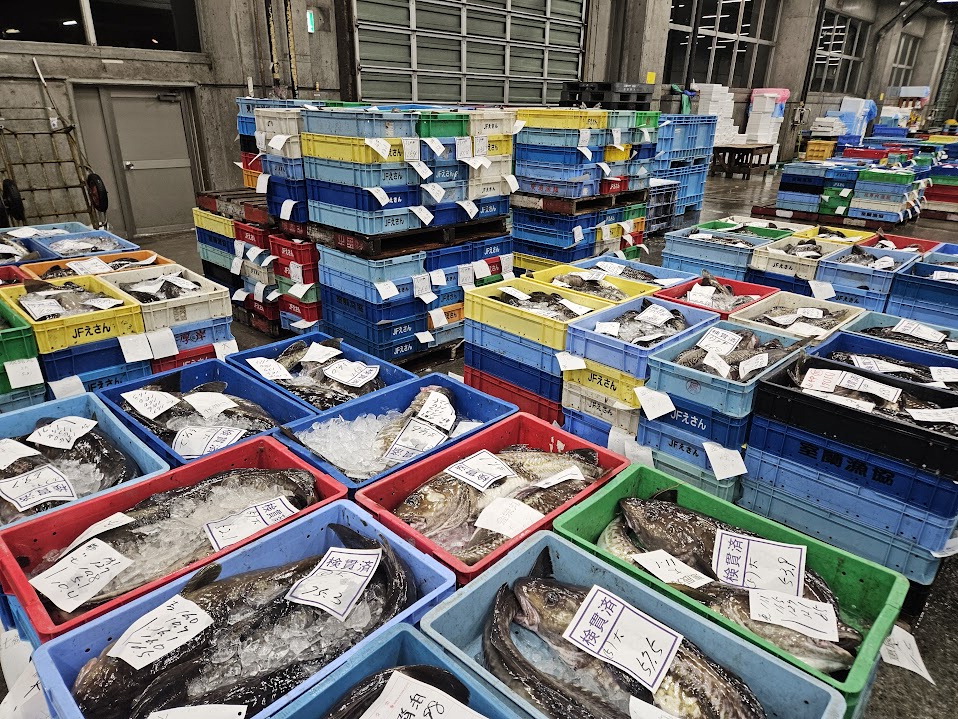
 사진 확대 Seafood products waiting for auction at a seafood wholesale market in Hakodate, Hokkaido, Japan. I can’t see a single box of squid. Correspondent Lee Seung-hoon of Hakodate
“There is not a single squid at the auction today. Hakodate was called the city of squid. Compared to a decade ago, the catch is one-tenth of that.”
Earlier this month, when the early morning air still hasn’t gone, a seafood wholesale market in Hakodate, Hokkaido, Japan. The words of the merchant I met in the middle of the auction house remained in my ears for a long time. This is a key market for supplying marine products throughout Japan, as well as Hakodate’s specialty Asaichi (morning market). Every day at 6 a.m., the auction begins before darkness clears. The auction house was filled with 21 tons of seafood, more than the average. The auction house’s voice echoed through the fish boxes lined up on the ice. However, the squid, a symbol of Hakodate, did not appear in the end.
CEO Junya Kawamura, who runs Maruhira Kawamura Fisheries, a wholesale seafood company, said this after taking a tour of the auction house.
“In Hakodate, squid fishing was a life and culture so that citizens gathered in August every year to dance squid. But as the water temperature rose, the squid disappeared, and instead fish species such as sardines, herring, and yellowtail began to be caught.”
In fact, most of the auction houses were cod, herring, and sardines. There was no squid box anywhere, but flounder and forest fish caught my eye from time to time.
Statistics show the experience of the field as it is. According to Hakodate City, squid catch, which reached 16,706 tons annually in 2014, plunged to 877 tons in 2024. It has decreased by nearly 90 percent in just 10 years. The number of fishing companies also decreased by 65% from 3,357 in 1993 to 1,156 in 2023.
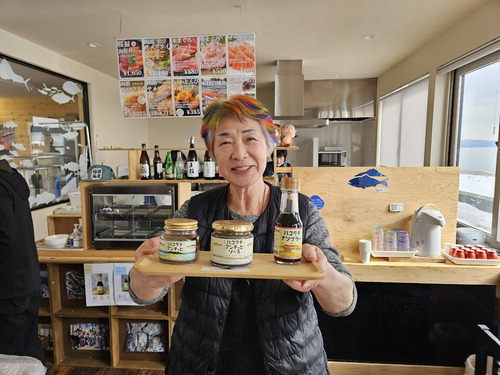 사진 확대 Fukuda Kumiko Fukuda, CEO of Fukuda Haesan, introduces the Anchobi product produced by the Hakodate Anchobi project. Correspondent Lee Seung-hoon of Hakodate
The coast of Hakodate is where the Tsushima Current in the East Sea, the Kuroshio Current in the Pacific Ocean, and the Korean Wave coming down from Russia meet around the Tsugaru Strait. Various currents are mixed to produce high-quality plankton, and accordingly, it has been evaluated as a “fishing ground of heaven” where various fish species gather. But climate change has changed that order. “For sustainable fishing, distribution and processing methods must also be changed in line with changes in fish species,” Kawamura said. “We are trying fishing methods and advanced strategies to increase freshness.”
Hakodate City launched a 10-year ‘regional fisheries sustainability project’ from 2022 with support from the Japanese Cabinet Office Industrial Revitalization Fund. The core businesses are kelp and king salmon farming. Takahiro Sato, head of the Department of Agriculture, Forestry and Fisheries, said, “King salmon is the largest and most delicious salmon species, so it is called the ‘Wagyu of the Sea’,” adding, “New Zealand and Alaska are the main producers, and Hakodate is the first to succeed in complete aquaculture.”
Hakodate city launched king salmon farming in December 2023 at a 12-meter diameter and 8-meter depth marine aquaculture facility. In seven months, the first generation of fry has grown to about 4.8 kg. “We will continue to improve varieties that suit the picky taste of Japanese consumers,” Sato said. “We will replace work reduced by climate change with aquaculture.”
Climate change has given rise to new industries as well. As the sardines filled the spot where the squid disappeared, the “Chili (Chopsticks)” project using it began.
Keigo Okamoto, CEO of Local Revolution, said, “Cham sardines are a fish species that is not familiar with Japanese food culture, so they are cheap or neglected at all. We started the Anchobi project with the idea of giving value to the increased cham sardines.” Anchovy is usually made from small anchovies. It is difficult to find a case of processing large-sized sardines into anchovies in the world.
CEO Okamoto said, “We realized a taste that is comparable to the existing anchovies with only three kinds of sardines, rice bran oil, and salt. Even though it is 1,200 yen per bottle, production cannot keep up with sales.”
The characteristic of this project is the regional win-win structure. Fishermen guaranteed their income by purchasing Cham sardines for 200 yen, which were only tens of yen per kilogram. Processing company Fukuda Haesan has reduced the burden by only taking charge of saline processing without large-scale facility investment. Work that requires a lot of labor, such as grooming and bottling, was entrusted to local employment support facilities for the disabled, and about 60% higher wages were paid than before. The Hakodate Anchovy project was also noted by the Japanese government. Last month, he received the top prize at the ‘primary industry revitalization sector’ award ceremony held at the Japanese Prime Minister’s residence.
[Hakodate correspondent Lee Seunghoon]
AloJapan.com