
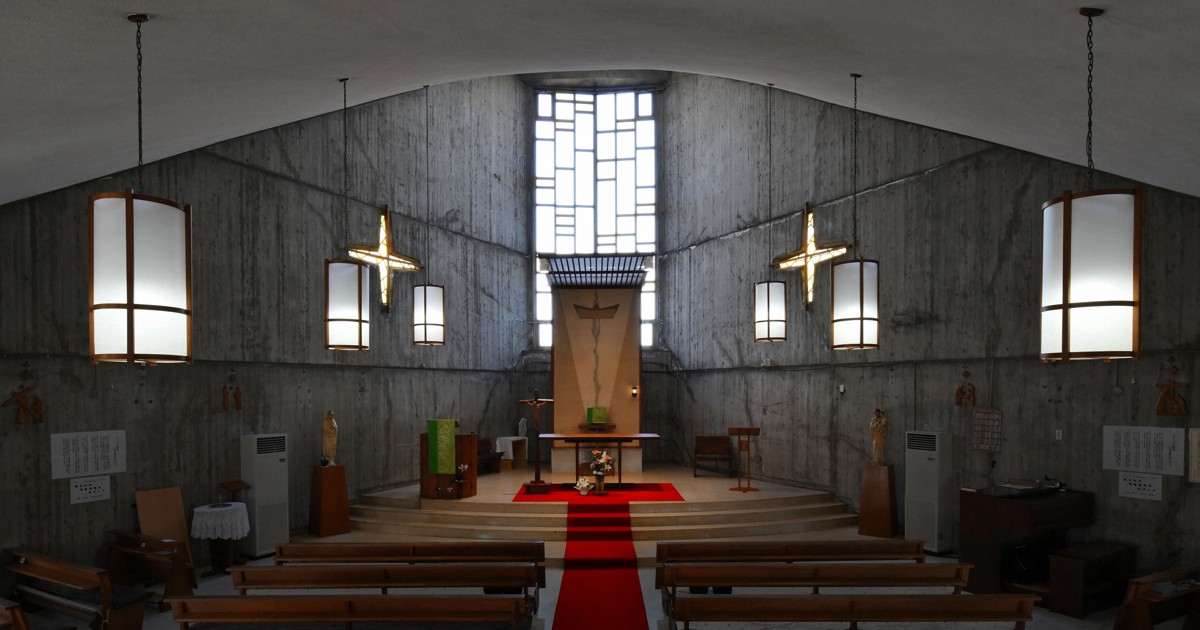
KYOTO — A Japanese American man who was interned during World War II later designed a Catholic church in Kyoto to express thanks to its head priest for his wartime support.
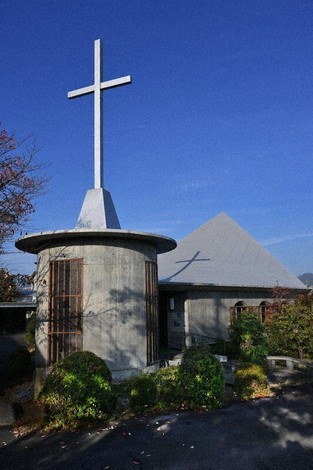
The shadow of a cross, mounted atop the baptistry and illuminated by the morning sun, casts a shadow on the sanctuary’s roof at Catholic Katsura Church in Kyoto’s Nishikyo Ward, Nov. 21, 2025. (Mainichi/Takao Kitamura)=Click/tap photo for more images.
Catholic Katsura Church is in a quiet residential area of Kyoto’s Nishikyo Ward. It was designed by George Nakashima, a second-generation Japanese American known for his work as a furniture maker, and completed in 1965. This church is the only building in Japan he designed independently.
The roof of the sanctuary is diamond-shaped when viewed from above, rising toward the back. The baptistry is cylindrical, with a cross mounted on top.
Inside the sanctuary, there are no columns or beams. The ceiling gently curves toward the altar, and the walls are exposed concrete. The altar, pews, lighting and “shoji” paper screens fitted into round windows were also designed by Nakashima. His designs incorporate Japanese elements throughout, with the wood providing a sense of warmth.
Nakashima met Father Leopold Henry Tibesar in the United States before the Pacific War. During the war, Nakashima, being of Japanese descent, was interned but received support from Tibesar. After the war, when Tibesar came to Japan to serve as a priest at Katsura Church, he requested Nakashima to design the new church building. Nakashima accepted the task without charge as a gesture of gratitude for Tibesar’s past kindness.
(Japanese original by Takao Kitamura, Osaka Photo and Video Department)
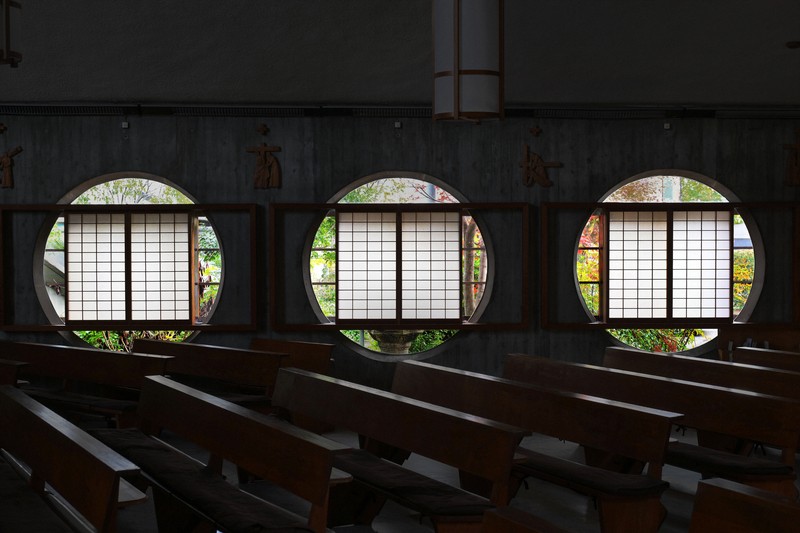
Circular windows with “shoji” paper screens fitted inside are seen on a side of the sanctuary at Catholic Katsura Church in Kyoto’s Nishikyo Ward, Nov. 26, 2025. (Mainichi/Takao Kitamura)=Click/tap photo for more images.
* * *
The Japanese version of this article was originally published on Jan. 11, 2026.
* * *
This series explores Japan’s architectural wonders and secrets of yesteryear. Read more Retro Japan articles here.
AloJapan.com