
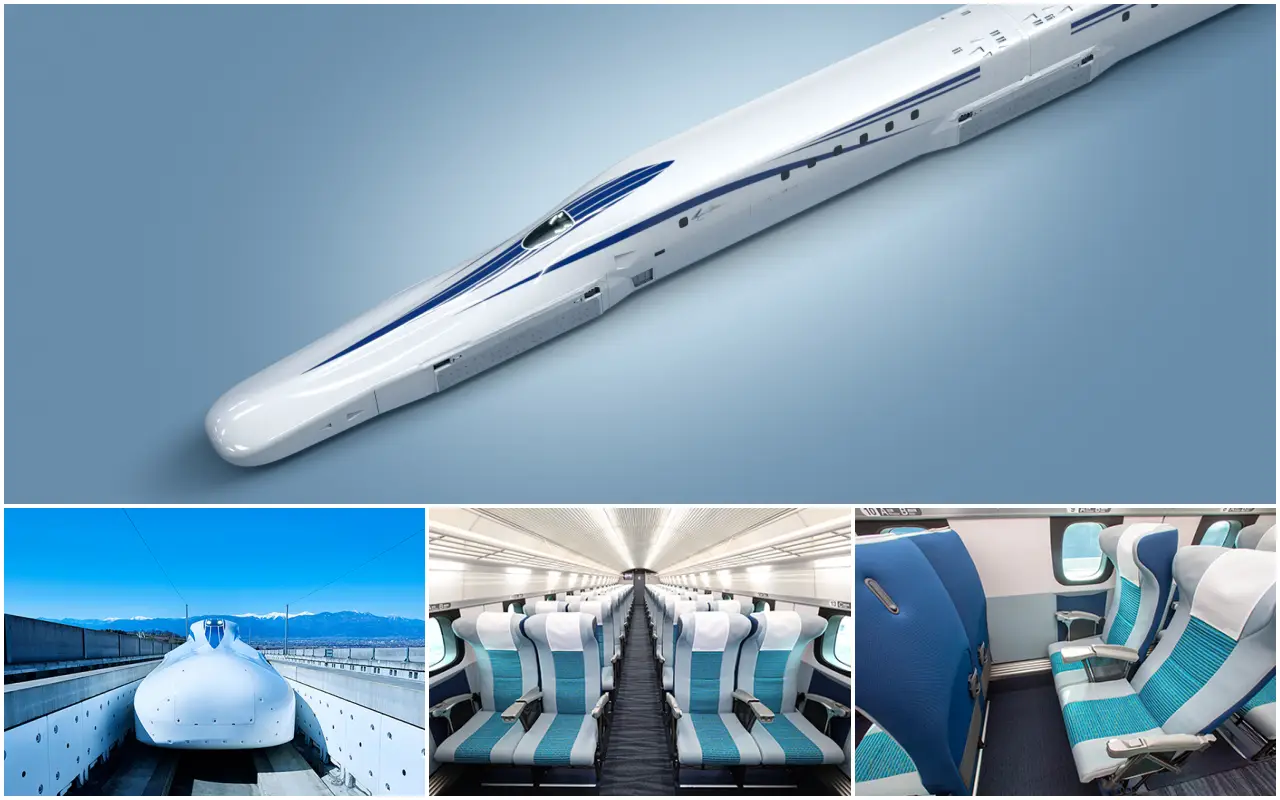
Japan’s Central Japan Railway Company continues construction of the Chuo Shinkansen maglev line using the L0 Series train, a superconducting magnetic levitation system designed to connect Tokyo, Nagoya and Osaka at speeds exceeding 600 km/h, with the first Tokyo–Nagoya section targeted to open in the coming years and the full Osaka extension planned for the following decade to cut end-to-end travel time to about 1 hour.
The project, one of the largest rail infrastructure developments in the world, aims to ease congestion on Japan’s existing high-speed rail corridor while strengthening economic links between the country’s three largest metropolitan regions through dramatically faster intercity travel.
Construction Progress and Technology Focus
The Chuo Shinkansen is being built primarily underground through mountainous terrain between Tokyo and Nagoya, requiring extensive tunneling, seismic engineering, and water management systems. Recent reporting highlights continued work on deep underground tunnels designed to withstand earthquakes and geological challenges common in central Japan.
The L0 Series maglev train uses superconducting magnets that lift the train several centimeters above the guideway, eliminating wheel friction and allowing for ultra-high speeds with reduced noise and vibration at cruising altitude. During test runs, prototype versions of the L0 Series have already recorded speeds above 600 km/h, setting world records for passenger rail.
Operational service speeds are expected to be lower than the maximum test results, with commercial runs projected around 500 km/h. Even at those speeds, the Tokyo–Nagoya trip is expected to take about 40 minutes, compared with roughly 1 hour and 40 minutes on existing bullet trains.
Engineers have emphasized safety systems designed specifically for Japan’s seismic environment, including automatic braking triggered by earthquake detection networks and structural reinforcements along underground segments. The route has also been planned to minimize surface disruption by placing most of the line in tunnels.
Travel Tokyo–Osaka Corridor and Travel Impact
Following the completion of the Tokyo–Nagoya section, the line is planned to extend westward to Osaka, forming a new high-speed spine across central Japan. Once fully operational, the Tokyo–Osaka journey is projected to take roughly 1 hour, less than half the current fastest rail travel time.
The shortened travel times are expected to reshape domestic tourism, business travel, and commuting patterns. Tourism analysts note that same-day trips between the capital and western Japan’s cultural and commercial centers would become routine, potentially redistributing visitor flows across regions.
Rail industry observers have also pointed to the project’s role in relieving pressure on the existing Tokaido Shinkansen line, one of the busiest high-speed rail corridors in the world. With passenger volumes steadily rising, the maglev line is intended to provide both capacity relief and long-term resilience for Japan’s transport network.
The Chuo Shinkansen is being financed primarily by Central Japan Railway Company, with costs running into tens of billions of dollars due to the extensive tunneling, specialized guideways, and advanced maglev systems required. The scale of the investment reflects Japan’s long-term strategy of maintaining global leadership in high-speed rail technology.
Beyond domestic transportation benefits, the L0 Series project continues to attract international attention as countries explore next-generation rail solutions to reduce carbon emissions from short-haul flights. Several governments have studied Japan’s maglev technology as a potential model for future ultra-fast rail corridors.
Despite its technological promise, the project has faced delays related to environmental approvals, local government negotiations, and the engineering complexity of long underground segments. Officials have adjusted timelines accordingly, with the Tokyo–Nagoya opening now expected later than originally planned, while the Osaka extension remains scheduled for the mid-2030s.
Recent coverage continues to frame the L0 Series as the fastest passenger train ever developed, highlighting its role as both a national infrastructure project and a global showcase for advanced rail engineering. As construction progresses, Japan’s maglev corridor is moving steadily from experimental test tracks toward full commercial reality.
When operational, the Chuo Shinkansen is expected to stand as one of the most transformative transportation projects in modern Japan, compressing travel times across the country’s economic heartland and redefining the limits of commercial rail speed.
AloJapan.com