
What happened
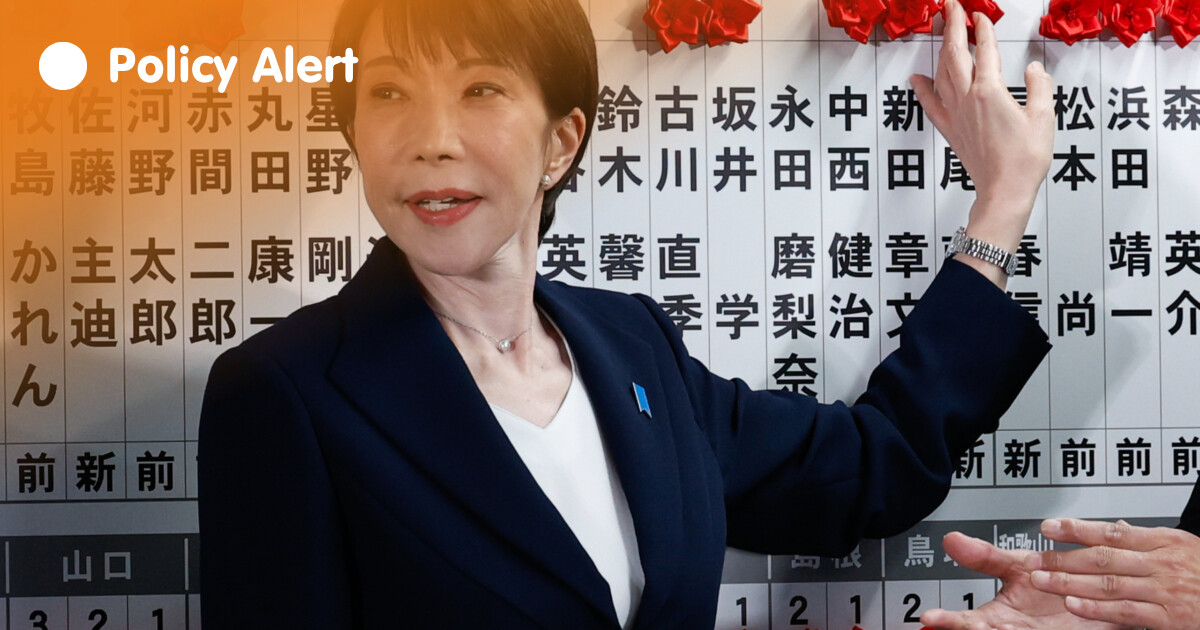
Japan’s lower-house elections on Sunday delivered a decisive victory for Prime Minister Sanae Takaichi and the ruling Liberal Democratic Party (LDP). The LDP secured 316 of 465 seats, granting it a two-thirds supermajority in its own right; together with coalition partners, the governing bloc now controls well over three-quarters of the chamber. This supermajority sharply reduces legislative obstacles because it allows the government to override the upper house on most legislation and push contested policies, particularly in security, defence spending, the economy and institutional reform.
The election does not mark a radical ideological shift. Rather, it consolidates trends already underway domestically: the normalisation of defence policy, sustained increases in military spending, deeper alliance integration and a tighter linkage between economic and security policy. What changes with this result are pace, confidence and political durability. Japan’s strategic direction is no longer tentative.
What this means for Europe
Takaichi’s win brings Japan stability and consensus, strengthening its G7 role and reinforcing its value as a reliable ally for the United States, particularly at a time of growing geopolitical volatility.
For Europe, this brings greater predictability—and sharper contrasts. A politically consolidated Japan is more likely to push harder to implement existing commitments, sustain long-term investments and accept the strategic trade-offs that come with higher defence and economic ambitions. It will also be more pragmatic and interest-driven, which means that the Japanese government will judge European policymakers more by their performance as partners in economic security, advanced technologies and defence‑industrial cooperation, rather than by their shared values. These priorities closely mirror European debates on technological competitiveness and de-risking supply chains from China.
At the same time, Japan’s more “forward” security posture—particularly vis-à-vis China—will increase pressure on European leaders to clarify their own strategic thresholds. As Tokyo’s capacity and willingness to act grow, European ambiguity will become more costly. To match Japan’s new level of ambition, Europeans should use the existing EU–Japan Security and Defence Partnership and economic security agenda to rapidly conclude the Security of Information Agreement; launch at least one visible EU-anchored defence‑industrial co‑development project; and systematically plug Japan into their emerging economic security toolkit.
Context
Takaichi’s victory reflects a broader shift in Japanese politics shaped by a deteriorating regional security environment and uncertainty about long-term US engagement. Japanese voters have rewarded decisiveness over caution. As a result, domestic debate has moved from whether Japan should adapt to its security environment to how far and how fast it should do so.
This comes at a moment when EU–Japan relations are institutionally dense but operationally uneven. Strategic partnerships, dialogues and joint statements are already in place but prioritisation and delivery are often missing. Takaichi’s strengthened mandate raises expectations—and the costs of European under-prioritisation.
More broadly, Japan is transitioning from a primarily normative partner for Europe to a strategic actor with concrete expectations. This should prompt European leaders to reassess how seriously they treat the partnership. The bottom line is that Japan’s election locks in a more assertive and durable strategic trajectory. For Europe, the question is no longer whether Japan is a key partner—but whether it can engage Japan on equal terms.
The European Council on Foreign Relations does not take collective positions. ECFR publications only represent the views of their individual authors.
AloJapan.com