
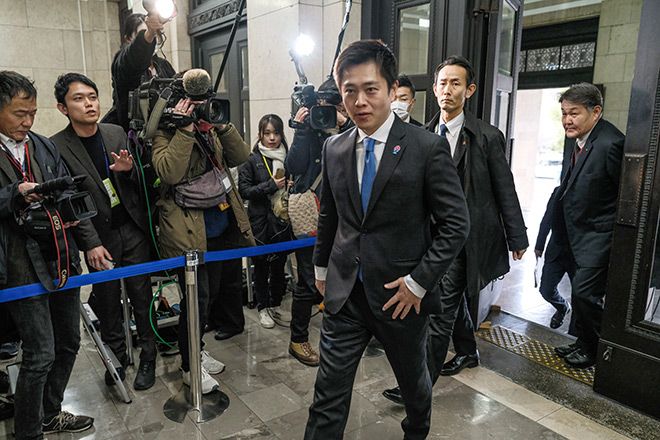
OSAKA—Fresh off a triumph in a snap Feb. 8 election, Osaka Governor Hirofumi Yoshimura and Osaka Mayor Hideyuki Yokoyama are moving to resurrect the controversial Osaka metropolis plan, which voters have rejected twice.
They intend to hold a third referendum on the issue before their terms end in April 2027.
The proposal would realign Osaka Prefecture into a greater metropolis, similar to Tokyo. It would dissolve the Osaka city government and reorganize it into special wards.
Referendums on the issue were narrowly defeated in 2015 and 2020.
However, the latest push faces skepticism even from members within their own party, casting doubt on the plan’s prospects.
“We want to begin creating the blueprint for the metropolis plan,” Yoshimura told reporters at the Osaka prefectural government office on Feb. 9, the day after the vote.
Yoshimura, leader of the Nippon Ishin (Japan Innovation Party), and Yokoyama, the party’s deputy leader, initiated the snap election—timed to coincide with the national Lower House election—to seek what they called a mandate for another attempt at the plan.
The abrupt nature of the election left major political parties with no time to prepare, and they ultimately opted not to field opposing candidates.
Despite the lack of opposition, Yoshimura claimed the victory gave him a public mandate.
“We have gained a certain mandate to take on the metropolis plan,” he said at a news conference on Feb. 8, declaring his intention to move forward in earnest.
Yoshimura aims to hold the referendum by April of next year, leaving a tight timeline of just over a year to complete the necessary procedures to put it on the ballot.
Holding a referendum first requires establishing a “statutory council” to draft the specifics of the plan—a proposal that must then be approved by both the prefectural and city assemblies.
Given the tight schedule, Yoshimura acknowledged that discussions would have to be rushed.
“First, I want to devote my energy to launching the statutory council,” he said.
Ishin’s caucus in the prefectural assembly held a general meeting on Feb. 9 and decided to begin internal discussions this week on establishing the council.
But Yoshimura’s claim of a “mandate” is being heavily scrutinized, with critics pointing to the record number of protest votes.
According to election commissions, the number of invalid ballots, including blank votes, surged to 416,783 (10.29 percent) in the gubernatorial race and a record-high 170,620 (13.77 percent) in the mayoral race—both sharp increases from previous elections.
Masaki Hata, an associate professor of political psychology at Osaka University of Economics, challenged the governor’s assertion.
“It is a stretch to claim to have ‘gained the public’s will’ from the results of an election that had no major opposing candidate representing the pros and cons of the metropolis plan,” Hata said.
The maneuvering has also generated significant friction within Ishin itself.
The decision to call the election was made top-down, with most party executives reportedly kept in the dark until the last minute.
Dissatisfaction is swirling within the party, according to an Ishin Lower House member from Osaka.
“Everyone tried to persuade (Yoshimura) that now is not the time, but he refused to listen,” the lawmaker said.
During the campaign, citizens frequently questioned the timing, while some members of Ishin’s own Osaka city assembly caucus have privately questioned Yoshimura’s heavy-handed tactics.
Apparently acknowledging the internal and external hurdles and strife, Yoshimura struck a more conciliatory tone.
“We cannot launch the statutory council without the approval of the assembly,” he told reporters. “I want to proceed carefully.”
(This article was written by Yuichi Nobira and Takefumi Horinouchi.)
AloJapan.com