
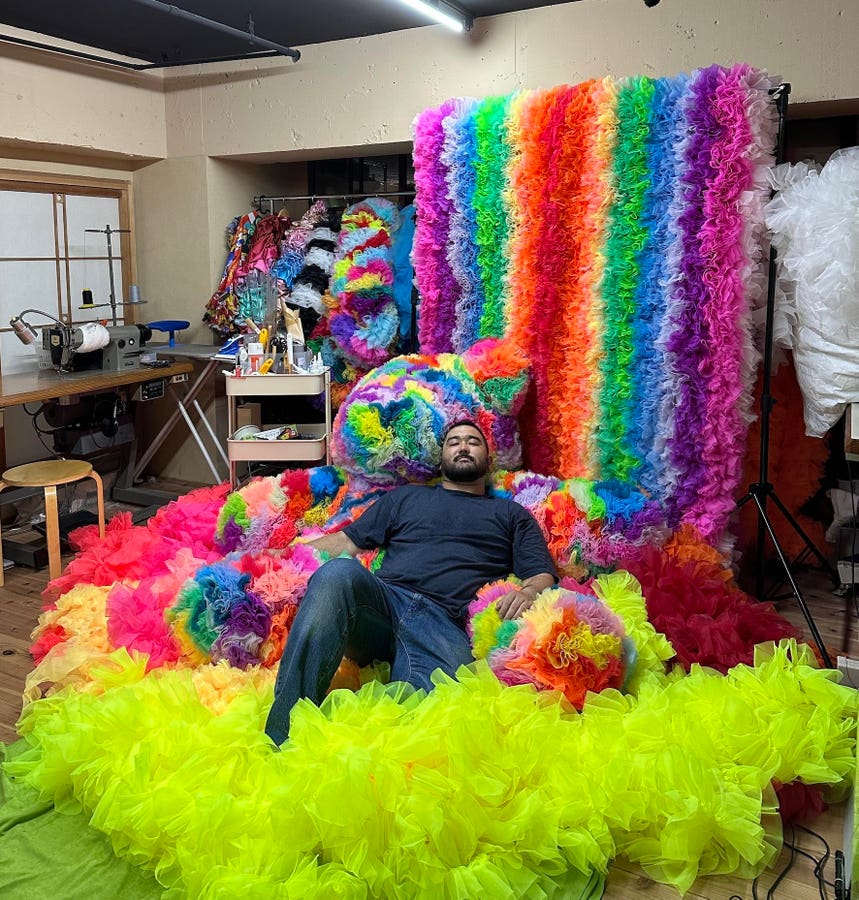
Tomo Koizumi in his Tokyo studio with his signature poofy, rainbow-hued organza creations.
Tomo Koizumi
Tokyo may be one of the world’s most photographed cities, but few visitors see the side that fuels its creative spirit. For fashion designer Tomo Koizumi, the place he calls home never stops inspiring his wearable art—from the strobe-lit drag shows and club kid–filled dance floors of Shinjuku Nichome, Tokyo’s vibrant LGBTQ+ epicenter, to the fabric shop–lined streets of charmingly old-school Nippori, where he first discovered the Japanese organza that became central to his now-signature, larger-than-life looks.
The LVMH Prize finalist, whose unapologetically voluminous, ruffled, technicolor designs have been worn by the likes of Lady Gaga, Björk, Miley Cyrus and Sam Smith, takes us through his deeply personal Tokyo—and slightly off the tourist trail—from a locals’ favorite izakaya in Shinjuku Nichome, where he meets friends before a night of gay bar-hopping, to a meditative herbal shop in stylish Omotesando. Each stop reveals a Tokyo you won’t often see on TikTok, offering a glimpse into what keeps one of its most talented residents creating work as exhilarating as the megacity itself.
Where to Eat, Drink and Party in Shinjuku Nichome, Tokyo’s LGBTQ+ Epicenter
Shinjuku Nichome—simply called Nichome by locals—is a few tight alleyways crammed with hundreds of pint-sized bars and clubs that Koizumi has been frequenting for years. “There are so many visitors coming from outside Tokyo. Even on weekdays, many go out in Nichome. I love meeting new people there,” he says.
Low-key izakaya Kanva is a hidden gem near the vibrant Shinjuku Nichome.
Kanva
He often kicks off the night at Kanva, a queer-owned, no-frills, all-thrills izakaya tucked beneath a narrow stairway that feels like sneaking into a secret lair, before bar-hopping nearby. With only a handful of tables and counter seats plus handwritten menus featuring ever-changing bites, the warmly lit spot is a magnet for creative types. “It’s my favorite place to eat with friends. They serve unique dishes and everything tastes great,” he says. There’s no English menu, so use Google Translate or, better yet, let the friendly staff recommend a few dishes. Wash everything down with an ice-cold beer or one of Kanva’s inventive seasonal cocktails and you’ll understand why so many Nichome club kids frequent this lively den.
AiSOTOPE Lounge in Shinjuku Nichome hosts some of Tokyo’s most popular LGBTQ+ parties, including “Beefcake.”
AisOTOPE Lounge
One of Koizumi’s favorite nights out in Nichome is when “Beefcake” takes over AiSOTOPE Lounge, a wild neighborhood fixture known for its themed events and anything-goes energy. The recurring party caters to beefy partygoers and features dizzying DJ sets, go-go boys clad in barely-there “Beefcake” merch and bears, gym rats and their admirers packing the dance floor. Koizumi also looks forward to AiSOTOPE’s annual New Year’s Eve drag queen extravaganza, “Joso Kohaku Uta Gassen,” a glammed-up spoof of Japan’s year-end television special of the same name (with joso, meaning cross-dressing in Japanese, aptly added to the title). “It’s always a good time. Everyone wears their most fabulous outfits to this event,” he says.
It’s no wonder Koizumi feels so connected to Nichome: his kaleidoscopic designs mirror the exquisite drag queens and pulsing nightlife of the legendary neighborhood’s few neon-soaked alleyways, where missing the last train comes with the territory.
Ramen Spots, Konbini Snacks and Cozy Coffee Shops
Asking a Tokyoite “What’s your favorite konbini?” (convenience store) is like asking a New Yorker where to find the best pizza. Expect strong opinions about the big three: 7-Eleven, Lawson and FamilyMart. Convenience stores are an essential part of daily life in Japan, with nearly 60,000 locations nationwide, open 24/7 and stocked with a wide variety of delicious grab-and-go meals and snacks. Koizumi’s go-to is FamilyMart, where he reaches for an onigiri (rice ball) filled with edamame and cheese. Beyond its standout onigiri selection, FamilyMart is known for its popular Famichiki, a juicy boneless fried chicken, and its affordable apparel line—especially the striped socks in the brand’s signature green and blue, which have become a cult souvenir.
When it comes to Japanese comfort food, Koizumi loves ramen but admits he tries not to indulge too often these days. Still, in a megacity with thousands of ramen shops, from crowded chains to tiny local favorites, temptation sometimes wins. When it does, he heads to Dogenzaka Mammoth in Shibuya, a hole-in-the-wall specializing in tsukemen, or dipping noodles, though regular ramen is also on the menu. Here, guests buy a ticket from vending machines before settling into one of the few counter seats to slurp their way through steaming bowls of chewy noodles and umami-rich broth that are, in Koizumi’s words, “quite thick and addictive.”
Cafe Den in Nakano is a tranquil, tourist-free hideaway.
Cafe Den
While Tokyo’s thriving coffee scene is packed with social-media-famous cafes, Koizumi skips the latte-art circus for Cafe Den, a laid-back hideaway on the ground floor of an unassuming apartment building in Nakano. The pared-back space feels like a study in light and stillness: sunlight slips through tiny circular openings in exposed concrete walls as locals linger over porcelain cups of coffee and slices of chiffon cake at wooden tables overlooking a lush courtyard.
Shop for Secondhand Art Books, Vintage Fashion and Rare Fabrics in Tokyo
Nippori Fabric Town, Tokyo’s textile district, is home to shops like Furikake, known for its sequins, rhinestones and rare materials.
Furikake
Nippori Fabric Town, an old-school neighborhood near bustling Ueno, has long been the heart of Tokyo’s textile industry, where designers dig through floor-to-ceiling rolls of material in search of inspiration. “Since I was a teenager, I’ve gone there to look around the fabric stores. Every time I visit, I get so much inspiration for my creations,” Koizumi says. The low-key yet enchanting area features around 90 shops selling fabrics, leather, zippers, beads and buttons in every conceivable shape and color. Tomato is perhaps the neighborhood’s most famous shop, with several locations dedicated to specific types of fabric. Then there’s Furikake, devoted to all things sparkly—think rhinestones, sequins and rare fabrics perfect for a glittering DIY project or a pop star’s stage outfit.
For an enviable vintage haul, Koizumi suggests visiting Koenji, a bohemian neighborhood known as the birthplace of Tokyo’s punk-rock scene and home to a sea of secondhand shops. Compared with tourist-packed Shimokitazawa, often cited as Tokyo’s vintage-shopping mecca, Koenji feels refreshingly unfiltered. Think: locals on bikes pedaling past record stores, smoky yakitori joints, mini music venues and hip cafes as thrifters dig for perfectly distressed denim.
Jimbocho, Tokyo’s retro secondhand book district, is lined with vintage bookstores and cozy coffee shops.
getty
To get his book fix, Koizumi goes to Jimbocho, Tokyo’s famous used-bookstore district, recently named the world’s coolest neighborhood by Time Out. The area is home to over 100 primarily secondhand bookstores and bookworm-filled coffee shops. His favorite stop in this bibliophile’s paradise is the two-story Bohemian’s Guild for its “unique selection of vintage art books.” And when he wants to see art beyond the page, he heads to The National Museum of Modern Art, Tokyo. “It’s my favorite place to check out art shows. They have really great collections,” he says.
Where to Unwind and Recharge in Tokyo
The Shinjuku-based designer visits Shinjuku Chuo Park for runs and relaxation, but for a more Zen-luxe experience, he heads to ritzy Omotesando to stop by Neroli Herb, a specialty store offering custom-blended herbal teas rooted in both Eastern and Western traditions. “It’s my favorite place to relax,” he says. “The owner, Ayumi, creates original herbal tea blends for me based on my health. I’ve started learning about herbs and spices myself—blending my own tea feels very meditative.” It’s a fitting ritual for Koizumi’s Tokyo, where vibrancy and stillness shape his endlessly imaginative world.
AloJapan.com