
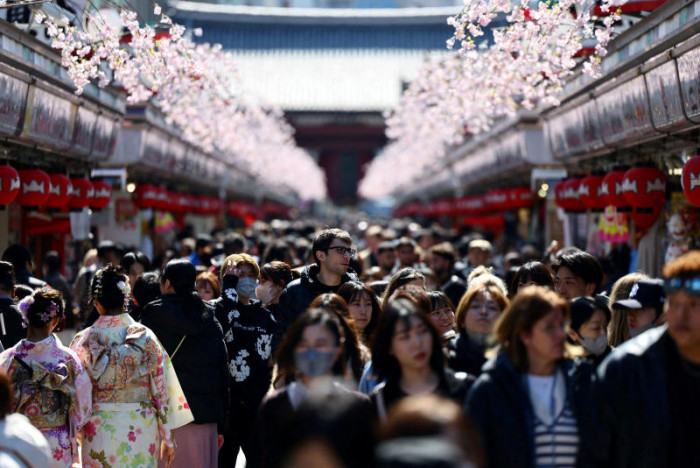
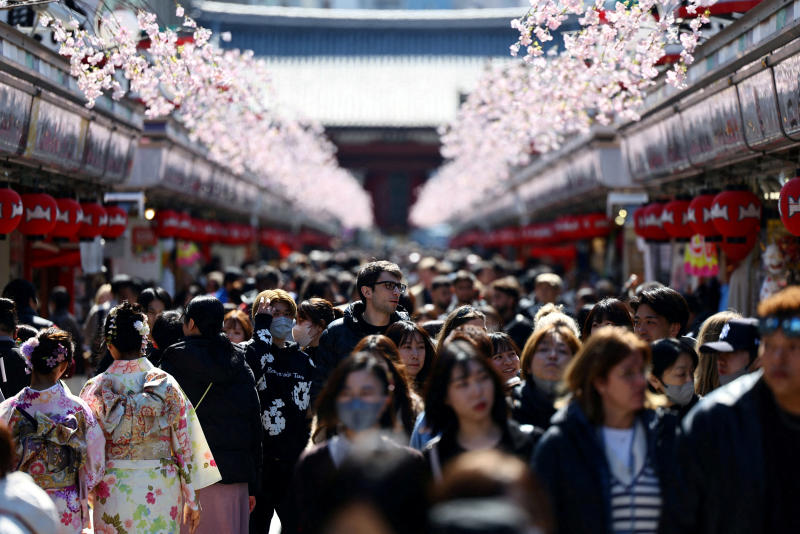
Visitors walk along Nakamise-dori street as they visit Sensoji temple at Asakusa district, a popular sightseeing spot in Tokyo, on March 10, 2025. (Photo: Reuters)
Hong Kongers’ enthusiasm for travelling to Japan is expected to remain robust even as more municipalities in the country plan to impose lodging taxes to ease overtourism, according to industry leaders.
Steve Huen Kwok-chuen, executive director of EGL Tours, which specialises in package tours to Japan, also said on Sunday that the additional tax was unlikely to push up the prices of tours to the country.
According to a Kyodo news agency report, 42 municipalities have already either imposed or plan to charge accommodation taxes at hotels and ryokans – traditional Japanese inns.
The tax levels vary in the different places and in accordance with the type of accommodation. In general, the tax can range from 200 yen to 10,000 yen (44 baht to 2,200 baht) per night for a guest room.
The local governments said they aimed to use the levies to maintain or upgrade tourism facilities amid surging inbound arrivals.
A survey by the news agency between June and July showed that 728 of the 1,723 local governments polled had expressed “interest” in introducing lodging taxes.
The report did not say how high the possible levels of the accommodation taxes could be.
Development of facilities, promotion of tourism, and preservation of historical landscapes and natural environments were among the most common reasons cited for potential uses of the tax money
Some local governments also said they hoped to use the additional tax money to improve infrastructure for coping with foreign visitors, according to the news report.
Huen said: “The additional cost for visitors is insignificant. For a general five-day package tour, this could mean an extra cost of 800 yen to 1,200 yen for the whole trip.
“We do not think many travellers will shun Japan just because of the lodging tax.
Huen added that he saw no “big reason” for agencies to increase the prices of their tours “just because of the tax”.
Yuen Chun-ning, CEO of travel agency WWPKG, shared a similar view and said that independent travellers would not mind paying a little more.
“The accommodation taxes are too trivial to affect one’s travelling decision. They can mostly be absorbed by travel agencies for package tours,” he said.
To introduce an accommodation tax, local governments have to pass a law and get the approval of the minister of internal affairs and communications.
According to the Japan National Tourism Organisation, the country received 21.5 million overseas travellers in the first half of 2025.
In June alone, it received 3.38 million overseas visitors, up about 7.6% from the same period last year. The highest number of visitors came from mainland China, with 797,900 people, followed by South Korea at 729,800 and Taiwan at 585,000.
Hong Kong was fourth with 166,800 visitors. But the figure was down by 33.4% from a year ago, which the sector mainly blamed on fears about the possibility of a “megaquake” in early July.
Huen conceded that the predictions had caused significant concern among some Hongkongers, who had shelved trips to Japan. But he expected a rebound during the autumn and winter seasons as fears were subsiding.
Last year, about 2.68 million Hong Kongers visited Japan, accounting for around 7.3% of the total foreign visitors to the country.
In Hong Kong, the government is also imposing a 3% hotel accommodation tax from this year amid a budget deficit.
AloJapan.com