
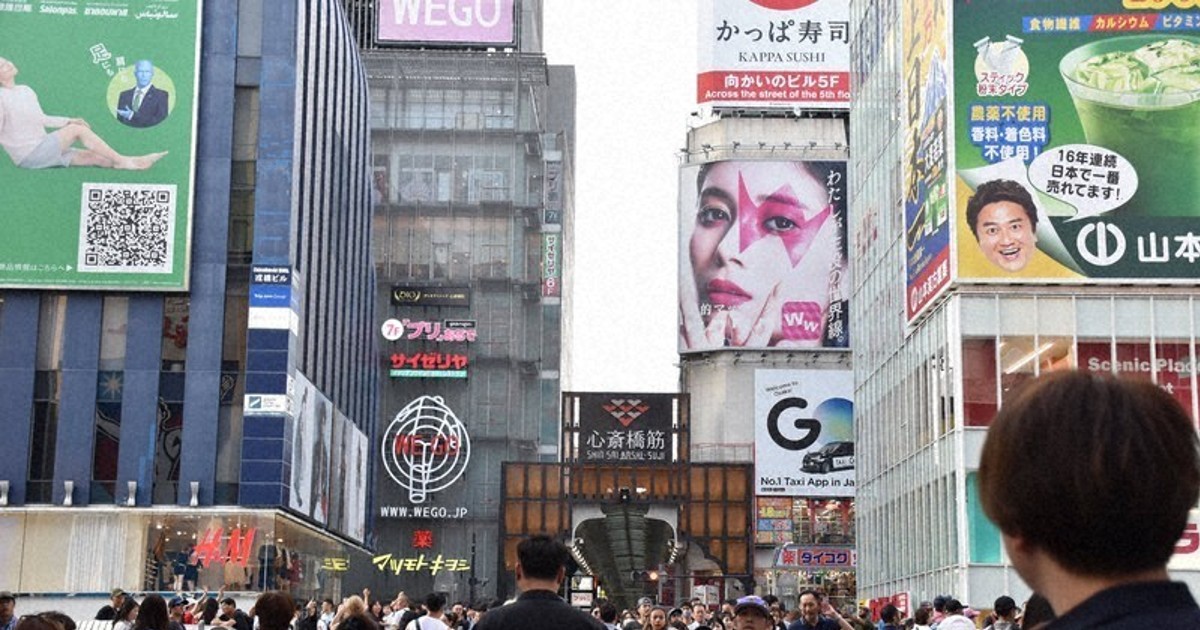

Tourists are seen in the Minami district of Osaka’s Chuo Ward on June 27, 2025. The 31-year-old Vietnamese woman told a court hearing, “I handed a residency card to a Vietnamese man on a bridge where we met up.” (Mainichi/Takashi Kawachi)
OSAKA — Osaka Prefectural Police have arrested at least five people in connection with cases of Vietnamese technical intern trainees acting as “proxy test-takers” in the Japanese language test required to switch residency status in Japan.
For foreign technical trainees to work under better conditions or stay longer in Japan, they need to change their status of residence. In some cases, passing the Japanese language test is a requirement. The five arrested include those who requested proxy test-taking and those who performed it.
It is suspected that technical trainees with poor Japanese language skills have asked Vietnamese nationals who have lived in Japan for a long time to take the tests on their behalf. The presence of their intermediaries has also been confirmed, and the prefectural police believe that such cheating methods are widespread within the Vietnamese community in Japan.
The issue first came to light after The Japan Foundation, the organizer of the Japanese language test, grew skeptical over the prominently high pass rate at the Osaka exam venue when the rate normally stands at around 40%. At one point, almost all examinees at the Osaka venue were passing. This led the foundation to suspect that impersonators were taking the exams in Osaka.
After being consulted by the foundation, Osaka Prefectural Police arrested a 31-year-old Vietnamese woman in December 2024 for allegedly taking the test by posing as another individual. “I’ve done it 10 times or so,” the woman was quoted as telling investigators, raising suspicions that proxy test-taking is rampant.
Playing the central role in her case was a broker who connected the clients requesting the cheating and those who carried it out.

The building where the 31-year-old Vietnamese woman repeatedly took the Japanese language test as a proxy test-taker is seen in Osaka’s Chuo Ward on June 27, 2025. (Mainichi/Takashi Kawachi)
To take the test, the examinee needs to have their own residency card and other documents. The broker allegedly contacted the clients via social media and obtained their residency cards and other necessary materials, before handing them over to the proxy test-takers with instructions to take the exam in their place.
In the case of a group allegedly involved in this crime, the client paid 160,000 yen (approx. $1,090), of which the broker received 100,000 yen (some $680) and the remainder went to the proxy exam-taker. It is believed that there are multiple such mediators, and the prefectural police arrested one Vietnamese man in June.
Many technical trainees aspire to pass the Japanese language test as their labor conditions vary significantly depending on their residency status.
Technical trainees are not required to take a Japanese language test when entering Japan, but they are prohibited from changing jobs. Their average monthly wage stands at around 180,000 yen (approx. $1,230).
Under the specified skilled worker residency status introduced in 2019, foreign nationals are allowed to change jobs, and they receive an average monthly wage of roughly 210,000 yen (about $1,440), higher than that of technical trainees.
As of 2024, there were about 450,000 foreign technical trainees and some 280,000 specified skilled workers in Japan. By nationality, Vietnamese account for more than 40% of both groups. On social media, there are many posts in Vietnamese asking for proxy test-taking.
At a court hearing, the 31-year-old Vietnamese woman who repeatedly took the test on others’ behalf explained her motive, saying, “I wished to be of help to those wanting to work in Japan.”
(Japanese original by Takashi Kawachi, Osaka City News Department)
AloJapan.com