
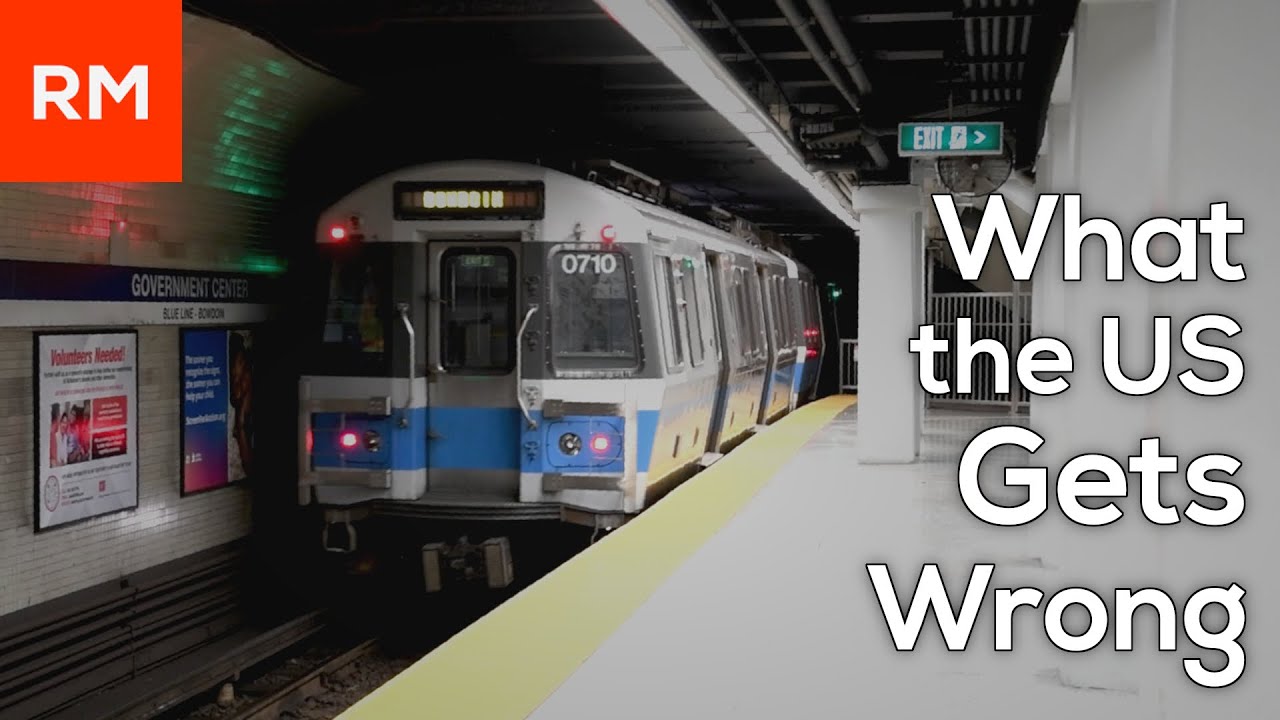
We’ve heard of multiple subway systems in the US having to close large parts of their system or cut service massively in the past little while, and I think a lot of it is how subway systems are fundamentally thought of – They are set up to fail. Let’s talk about it!
Special thanks to Zion Orent, Max Katz-Christy (who also provided the clip at 6:06), and Wallace Donahoe for providing the MBTA footage used in this video!
As always, leave a comment down below if you have ideas for our future videos. Like, subscribe, and hit the bell icon so you won’t miss my next video!
=PATREON=
If you’d like to help me make more videos & get exclusive behind the scenes access and early video releases, consider supporting my Patreon! Every dollar goes towards helping my channel grow & reach more people.
Patreon: https://www.patreon.com/rmtransit
=ATTRIBUTION=
Epidemic Sound (Affiliate Link): https://www.epidemicsound.com/referral/sgptna/
Nexa from Fontfabric.com
Map Data © OpenStreetMap contributors: https://www.openstreetmap.org/copyright
=COMMUNITY DISCORD SERVER=
Discord Server: https://discord.gg/jfz3fqT
(Not officially affiliated with the channel)
=MY SOCIAL MEDIA=
Twitter: https://twitter.com/RM_Transit
Instagram: https://www.instagram.com/rm_transit/
Website: https://reecemartin.ca
Substack: https://reecemartin.substack.com
=ABOUT ME=
Ever wondered why your city’s transit just doesn’t seem quite up to snuff? RMTransit is here to answer that, and help you open your eyes to all of the different public transportation systems around the world!
Reece Martin (the RM in RMTransit) is an urbanist and public transport critic residing in Toronto, Canada, with the goal of helping the world become more connected through metros, trams, buses, high-speed trains, and all other transport modes.
42 Comments
A lot of comments mention funding but, I’m skeptical it’s a primary issue. US cities including Boston have actually spent a lot on transit such as with the very expensive green line extension (and have done some expensive things like getting rid of trolley buses) – the issue is that money is too rarely spent on things that enhance reliability and service quality. This is a great resource for more details on how systems in the US get less transit for more money: https://transitcosts.com/about/
Thank you for highlighting frequency of service as a foundational element of good transit. Long and inconsistent wait times are a huge reason people lose the habit of relying on transit and buying cars.
Delhi is good example of good proportion of radiant and ring network.
I am not sure I agree with your argument that multiple procurements for different vehicle fleets reduces risk, certainly not in the long term.
Volume, volume, volume still holds true. Maybe more 'standardization, standardization, standardization' in this case.
Operating costs can absolutely be managed (lower) with commonality of fleets (read sub-systems). Sure, the engineering must be done right up-front in the procurement cycle, but again, steering clear of bespoke systems is key. Even better is commonality among agencies. I recognize this has not been the historical norms, but anyone planning a new line or network would be insane to spec. a bespoke technology.
Look at sub-systems that need the most frequent maintenance – doors, A/C, wayfinding, toilets, propulsion & braking. In NA Wabtec literally has cornered the market. They are quite happy to design custom sub-systems to integrate on vehicles. It's much much much harder to find (cheaper and more available) alternatives to solve maintenance issues. These are not like cars or even buses where this is commonality or even a grey market for brake shoes or even wiper blades.
Anyone who writes an RFP these days that does not insist (or score) on established sub-systems in reliable use in other markets or across networks is looking for expensive trouble a few years (after the warranty period) down the road. It means the RFP was written by an engineer that has limited understanding of Life Cycle Costs.
Wabtec have been smart. They enjoy 80% of the in-service sub-systems and subsequent aftermarket. Essentially a monopoly. Makes if very difficult to established sources even from Asia or Europe.
Capital and Operating budgets are 2 distinct buckets of money. Most procurements miss linking the two together on the front end of technology selection.
İ heard that brightline needs to pay toll roads for profit lose because of people using trains instead of toll roads thats why us doesnt have a high speed rail
More governments and city/transit planners need to watch your videos
no one loses elections screwing transit users
"Most powerful country in the world"
I laughed out loud there. Yeah, right.
The only country in the world where mass transit is considered "communism" and only for the poorest
Oil companies have seen to it transit fails. Also maintenance seems to be very low on the list. Everyone knows what you do not maintain will fail. Taking workers out of the stations also makes them less safe, so folks don't want to be in an unsafe place.
Aw man, I love your channel but please please get rid of that terrible low-level music. It really grates and distracts form the message. Seriously, I can't stand it. Sorry.
But of course they are set up to fail. How else can ford and exxon make more money from us if we have gasp cheap and semi reliable public transit?. Ask them how they did in streetcars back in the day * cough*
seems more like a specific city issue than a us issue. nyc subway has more significance to the country than all other transit systems combined due to ridership and scale, and it absolutely nails redundancy, reroutability and flexibility. quad and triple tracking, parallel routes, interlining, non revenue connections, ability to fall back on lirr for queens commuters, path/ferries, etc.
chicago also does have some reroute capabilities using nonrevenue connections: orange, brown, and purple line trains via state street subway, red line via loop, pink line via mikwaukee dearborn subway. metra electric, rock island, and up north routes typically run well enough to be useful alternatives to cta as well. would be nice if there were more trains stopping local in the city though. and yes a crosstown line would be fantastic
mbta is a dump, just terribly managed over the years, and wmata is an odd design, it really is more commuter rail-like outside of the district, those are tricky systems to fix. as far as other metros go, like tren urbano, cleveland, miami, marta, baltimore, bsl/mfl/patco they're not really expansive and used enough for service disruptions to scare people away. people already don't use them and wont until the entire city changes. maybe like what la is doing will help. also I feel you should have mentioned the cta red purple modernization project as an example of a good maintenance project, quad tracking makes life much easier.
While I lived in Tokyo from 2007-2013, a section of the Odakyu-Odawara line was moved entirely underground. It took the entire six years I was there, but it was done without disrupting service even once. Even the final switch to the new underground tracks was done overnight without disrupting any trains, before the old overground tracks and stations were demolished.
Part of the reason it took so long was because Odakyu couldn't purchase any land next to the tracks, since it was all built on. They had to tunnel directly down underneath the existing tracks, all while still running the normal service, which is one of the busiest commuter lines in the world.
In the states people don’t like to invest in anything that doesn’t benefit them. In transit is seen as something that only benefits the working class or the poor. That’s why most states with big cities have issues maintaining public transport.
I lived across the river from Boston for thirty years. The T is one of the worst mass transit systems I have ever had the displeasure of having to rely on. For some reason, the locals defend it, but it blows. And yes, the big dig made it worse.
The masses can't get to the stations so they can use the mass transit system only to be taken to a station so they can walk too far or pay for a cab just to get where they actually need to go. Screw that, We're getting in our cars and driving the whole distance.
Excellent video! Please more videos on frail transit! Thanks.
To be fair, some of the "frail transit" issues discussed in this video do apply to highways too. In Seattle, a major freeway bridge closed two years ago, with essentially no notice, due to cracks detected in concrete columns. In Houston, a ramp between two major highways is closed for over a year while they rebuild the interchange.
The difference is that, as you say, when the highway network experiences a service disruption, the system has lots of redundancy and, so long as you travel during off-peak hours, the actual delay from the disruption is just a few minutes at most. When a major transit line shuts down, however, the replacement options are far more limited, and the time penalties, much larger.
When they shut down a part of metro in Prague, they do it just in weekend AND they literally close streets for buses that go every minute, and all that only during weekend. When the metro was shut down for moths after severe floods 20 years ago half of the city was closed for private cars to allow trams and busses free passage, and man were they overcrowded. And yes 50% of all trips are made by transit.
If USA copies Hong Kong's metro, it will be amazing
So the issue with the current T shutdown is that the Orange line connections to other modes are concentrated in the downtown and to the southern part of the line. If you look at the increase in congestion heatmap sent out by MassDOT it even shows that disparity.
Running infrequent service is bad, but here in Chicago we are now dealing with infrequent and unreliable service simultaneously. On the blue line, actual service service is only at ~70% on weekdays and less than ~50% on weekends. The situation with buses is the same as there is no guarantee that a scheduled bus arrives where wait times of up to 45 minutes are not uncommon (even during weekday evenings). Such blatant disregard for transit riders is pushing existing riders away while discouraging anyone from even thinking about using it.
Subways in all US cities are dangerous, unreliable., overcrowded, and dirty. The fares are entirely too high. But the F____ nyt thinks that they're perfect & that everybody has to use them!!!!
Like always, you forgot to mention outside of New England m subway are designed for car drivers. That's biggest flaw. Without mentioning this, it's not worth to watch your movie. Boston transit may not be ideal, but Boston is of the few cities in the USA that utilize car to use rail. Ok you need cars to use rail in suburbs
Thumb down for misleading topic
FRAIL TRANSIT.
The United States has a different culture than Europe why compare them. And with the emergence of electric bikes and scooters who needs public transportation anyways, it's time has passed. We just need a very scaled down version of it for people who can't operate these vehicles on their own. Except for regional lines due to distance.
He reminds me vaguely of Brian Linehan but the video is not as interesting as promised. The result is a failed Monty Python piece on British Rail.
Londonboner
I live in DC (I used to live in Toronto) and the subway system here is so unreliable that it effectively limits my mobility. Even though we bought a house that is 5 minutes from a station, it really didn't have the advantages it should have, so we had to buy a car. It's a vicious circle, bad service leads to lower ridership and thus you get less service. Also, the system is too large for it's ridership, it's so structurally loss making. Having lived in Toronto most of my life, I really appreciate the TTC and every time I go back, I miss it.
Good points all around. Something I think about a lot with Washington D.C.'s WMATA is that a lot of the decision makers don't seem to understand the system, who uses is, and what it's for. It was originally built in the 1970s, primarily as a means of getting government & government adjacent folks from the suburbs into the city. But Washington D.C. and its surrounding area has changed dramatically in the decades since. However, it's still treated like something used for 9 to 5 shift government workers. if you work in a coffee shop, or a bar, or a restaurant, you likely don't make enough money to live within the city limits, but you can't use the Metro to get to work early in the morning or late at night, because of limited service. If you work on the weekends, forget it. I worked on-site throughout the first two years of the pandemic, and I can tell you, the train still had a lot of people riding every day, because a hell of a lot of people who use is aren't working office jobs.
You add to that problems with system integration, where WMATA buses are scheduled to arrive at stations two minutes after the train leaves in the morning & only run once an hour, and the trains are running on 20 to 30 minute headways once you're out of the city core, and it became a real problem.
I'm lucky I left my job when I did, about a week before the 7000 fleet's removal. But my wife still has to deal with it, and it's a daily problem. She has to use rideshares a lot, because she can't rely on the trains or buses. And those costs add up.
We're constantly told that because folks are working from home, nobody is riding the train, but every time I've taken it in the last year, it's been full, and that's getting on at the end of the line.
Would love to see more on frail transit and how to fix it. Maybe start a Transit Intensive Care Unit (call it 'Transit ICU' with Dr. Reece!) playlist: in a short 10-minute video, dive into a particular urban area or type of problem and identify solutions and exemplars of how other cities fixed it in the past. For example, on bad maintenance and decay, discuss TfL improving after they took over the network from the British Gov; and on lack of care for and communications with customers, discuss the thiny changes at the TTC by Andy Byford.
Back here in Hamburg Germany they closed the U3 for many months and now the U3 is the most modern line next to the U4 in Hamburg
Used to take the orange line to work, had to quit my job and get one closer to home. It sucks. A lot.
As a Boston local, it’s sad to see the state of the orange line, especially since I take it the most out of the four. The new trains were supposed to be fully incorporated by about now, but all the teething problems make the old stock still everywhere. MBTA’s subway system is still good, it’s just showing cracks.
im just glad the buses come more often then the actual trains
It's almost as if no one has ever made a mass transit system before.
It's how PATH system (between New York and New Jersey) spends a lot of money to expand stations and accommodate longer trains right now to "increase capacity". Then how did you manage to transport 113 million people in 1927 compared to only 32 million now? Oh, because the trains run every 15-20 minutes most of the day, that's why… Only at peak hours it runs every 4 minutes on the WTC-Newark line. And it's not even that crowded! So if we have longer trains, we can run them every 5-6 minutes at peak, instead of 4, mmm? And have less drivers, efficiency!
The Red Line is also getting new trainsets built by CRRC. They’ve been supposed to be on the way for years. I think you can count the number in existence on one hand. I have seen them a few times while out on the city and never been on one. The trains they are replacing are over 50 years old—the oldest non-heritage heavy metro rolling stock in the entire US (perhaps all of North America?); older (though arguably in better shape) than the crustiest, panel-falling-off–iest old Orange Line cars.
The T has gotten so much worse in the past 5 years, and it seems like everything is coming due all at once.
The main problem with public transport is that it's public
and "public" means *KOMMUИIZM!!!*
Great video! Thank you for talking about this. I do have to jump in to say that you forgot some of the Green Line on your map! You've probably realized this by now, but you're only showing the D branch, and leaving out the B, C and E branches. Keep up the good work!
This is another great video and I really appreciate you continuing to harp on the issue of frequency over capacity for these metro lines. I hadn't even really considered the fact that metro lines were running bigger trains at lower frequencies, so that while they had the same capacity technically, they were worse overall service. It's amazing to me how this simple point seems to be missed by many transit operators in the US.
I also thought your point about having too many of the same train model can actually be a big negative for systems, because you can reduce system resilience. I think many in the US are too focused on efficiency and don't understand that higher efficiency = less resilience, but hopefully the pandemic will bring some change to that train of thought.
One minor disagreement I have with your comment on funding, though. You state that transit agencies spend plenty of money on transit, but tend to get less value for the money. I agree, but I think that's missing the actual issue. The issue is not that we don't overpay for transit, it's that we don't value maintenance and operations budgets as much as capital budgets. It makes sense, big capital projects get a lot of press, so they make transit agencies and politicians look good, but if maintenance and operations budgets are cut at the same time, you get what we're seeing now with MBTA.