
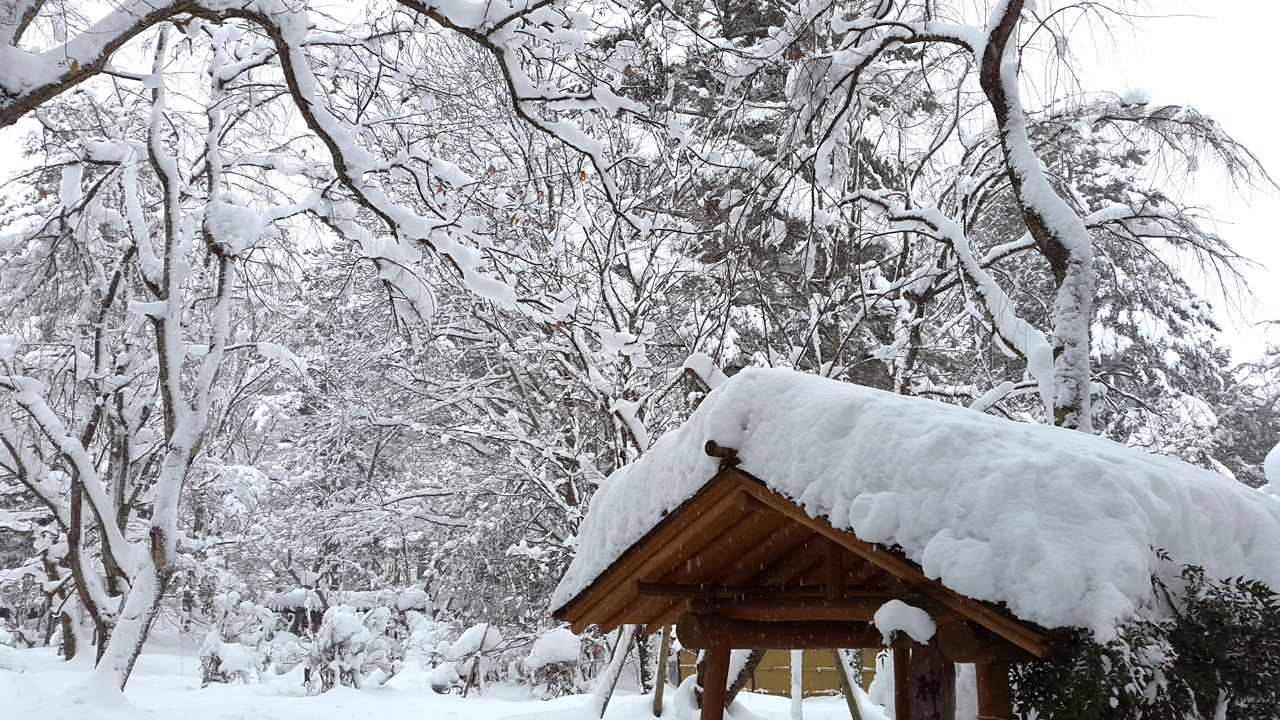
Snowy landscapes, covered in softly piled snow like cotton tufts, stir a traveler’s heart. Snow can hardly be called warm, but the image of snow that forms in the mind somehow creates a warm, wistful longing. Yes, let’s set off on a winter journey. Let’s travel to a snow country to hear the crunch of snow underfoot.
For Koreans, there is no need to agonize over the destination for a snow trip. Japan’s Tohoku region, at the northernmost tip of Honshu, and Hokkaido are true snow countries where tremendous amounts of snow fall. So where and how should one travel?
Tohoku and Hokkaido are both snow countries that receive tremendous snowfall, but their snowy landscapes are sharply contrasting. In Aomori, the moist seasonal winds blowing from the East Sea of Korea meet the mountain ranges and quietly pour down heavy, moisture-laden snow like an ink wash painting. The literary atmosphere of Nobel Prize-winning author Yasunari Kawabata’s <‘Snow Country’> is fully present. Hokkaido’s snow, created by the southward movement of the Siberian air mass, is “powder snow,” drifting down with almost no moisture. The weather is also much harsher. It resembles the imagery of the film <‘Doctor Zhivago’>. Yet there is a majestic beauty in racing through snow-covered wilderness stretching endlessly across snowy fields, rolling hills and lakes.
Although Tohoku is relatively farther south, its snowfall, particularly in the Aomori area, is overwhelmingly greater than Hokkaido’s. In mountainous areas, snow piles up to well over 10 meters, creating the spectacular snow monsters, or juhyo, that are on many Japanese people’s bucket lists. Snow accumulates layer upon layer on the trees and freezes into forms several times larger than the trees themselves, earning them the name snow monsters because they resemble monsters made of snow. Once down from the mountains, snow-covered landscapes unfold across quiet rural villages. Aomori’s famous “Stove Train” recreates winter scenery from a wistful past. Outside the windows, winter fields as white as snow rice cakes stretch endlessly, while the stove in the center of the train radiates intense heat. Sitting around it and grilling squid can make even travelers in the twilight of life feel as though they have returned to childhood ten years earlier. Tohoku’s winter is certainly cold, but not as cold as in Korea. Even at its coldest, temperatures are around minus 3 to 4 degrees Celsius, and because there is little wind, those who dress properly in a thick Korean winter coat will barely feel the cold. It is wonderful to touch the snow, walk on it and even let the snow tossed playfully by companions hit you.
Snow in Hokkaido, including Hakodate and Sapporo, is entirely different. Compared with Tohoku, including Aomori and Akita, it is much more continental, urban and dazzling.
AloJapan.com