

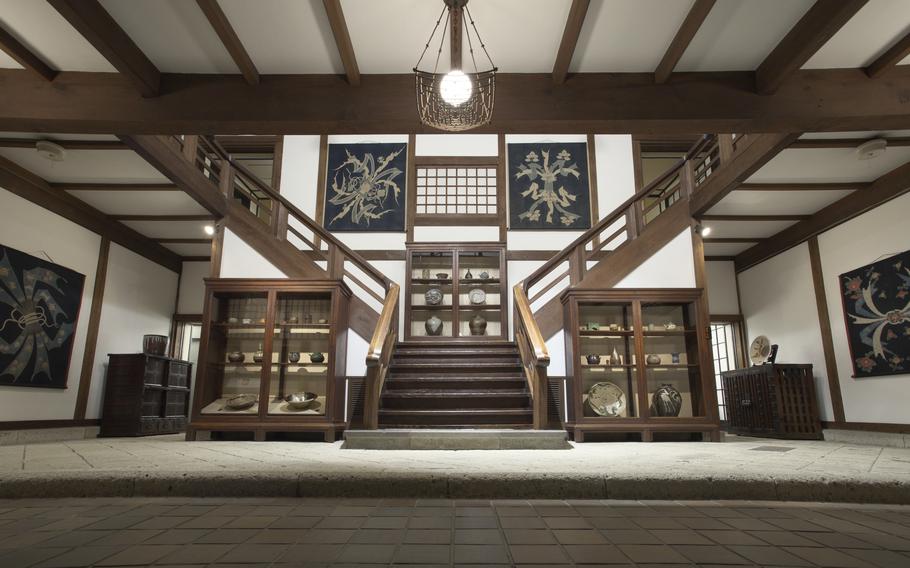
Japan Folk Crafts Museum (Photo courtesy of Japan Folk Museum)
Within spacious Komaba Park, Nihon Mingeikan, or Japan Folk Crafts Museum, houses more than 17,000 traditional craft works collected from Japan and other countries. These items are displayed in an impressive wooden two‑story Japanese‑style building.
When Korean writer Hyemin Lee and I visited the museum, we found it truly unique that the museum’s focus was not on typical elaborate art pieces created by renowned artists, but rather on everyday tools and vessels crafted by anonymous artisans.
Museum founder Soetsu Yanagi (1889–1961) and his art colleagues recognized the practical beauty found in daily tools and utensils made by craftsmen, along with various local objects shaped by regional traditions, and they called them “mingei” or folk crafts, according to the museum website.
Interestingly, Yanagi frequently traveled to Korea where he was fascinated by Korean Buddhist sculptures and ceramics. He founded the Korean Folk Art Museum in Seoul in 1924 to display folk crafts made by locals there, before Japan’s folk craft museum opened in 1935.
Inside the museum, seven galleries display the vast craft collection and a large shop sells books, ceramics and various folk crafts and artworks.
Among the displayed folk crafts in the museum, we saw the ceramics and paintings of the Joseon Dynasty (1392–1897) on the Korean Peninsula, as well as old Japanese ceramics from the Tamba, Imari and Seto regions. Costumes of Japan’s indigenous ethnic group, the Ainu, and Okinawan woven textiles are must‑see, as they were highly acclaimed for their practical beauty.
Among the exhibited items, one that especially impressed me was a large white porcelain jar made during the Joseon Dynasty around the 17-18 century. The decent, gentle and enveloping glossy egg-shaped jar reminded me of the creator’s affection for those who would use it. I felt as if the jar were telling me that it could comfort you if you were suffering from something.
As we perused the displays, to our surprise, the museum does not have a fixed viewing route, nor does it have elaborate explanations for each item. It almost made us feel as if we were merely walking in an old traditional folk house, not a museum.
According to the museum website, the founder believed that methods of display were also a form of artistic creation. For Yanagi, this museum was not an exhibition hall, but a place that enhances the beauty of displayed objects with carefully selected placement, background colors and lighting.
He was right. We felt the practical beauty of folk crafts can best appreciated in a folk house setting, rather than in a modern museum.
When we finished touring the museum and went out of the unique space, we realized that our own sense of beauty could be biased and stereotyped, and that true beauty can also be found in anomalous crafts of everyday life.
AloJapan.com