
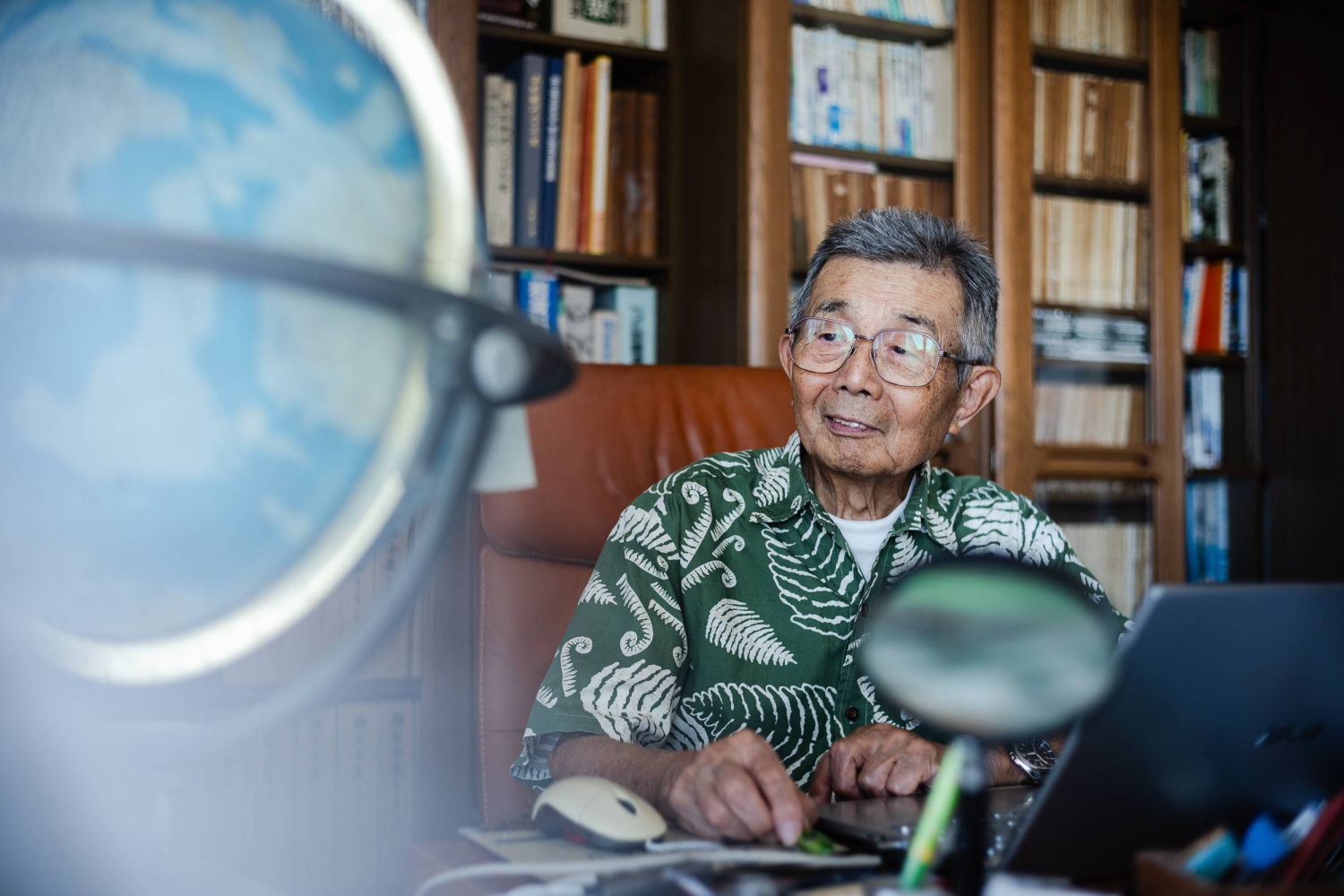
Katsutada Kaminuma probably knows more about Antarctica than anybody else in Japan.
The 89-year-old geophysicist and professor emeritus at the National Institute of Polar Research (NIPR) has traveled to the remote region more than a dozen times since 1966, when he was recruited to join Japan’s 8th research expedition to Antarctica. In addition to working on Japan’s Syowa Station, he was involved in international research projects, including searching for meteorites and studying the seismic activity of Mount Erebus on the Antarctic continent.
The impact of his research is highlighted by the fact that he has two places named after him: Kaminuma Crag, a craggy outcrop rising above the glacier, and Kaminuma Bluff, an ice-covered bluff near the shore in southeast Ross Island.
Kaminuma, who specializes in seismology, has also authored more than 20 books on Antarctica and is currently putting the finishing touches on his next one, scheduled to come out this fall and titled “Showa Kichi Konjaku Monogatari: Nankyoku Kansoku no Nanaju-nen wo Tadoru” (“The Past and Present Stories of Syowa Station: Following 70 Years of Antarctic Observation”).
On the occasion of the 70th anniversary of Japan’s Antarctic research program, which began with the November 1956 departure of the icebreaker Soya from Tokyo’s Harumi Pier, The Japan Times caught up with Kaminuma at his home in Kanagawa Prefecture.
Over apple juice served with ice brought back from Antarctica, Kaminuma spoke about the foresight of Japanese leaders who launched the country’s first expedition all those years ago, and he recalled his own experiences of wintering at Syowa Station in the early days, as well as the importance of keeping Antarctica free from geopolitics.
This interview took place in Japanese and has been translated and edited for brevity and clarity.
What originally motivated you to study earthquakes?
I was initially interested in astronomy and meteorology, which study phenomena on Earth’s surface, and then thought, “If we are to study inside the Earth, that’s earthquake research.” I simply wanted to know about everything inside and out of the Earth.
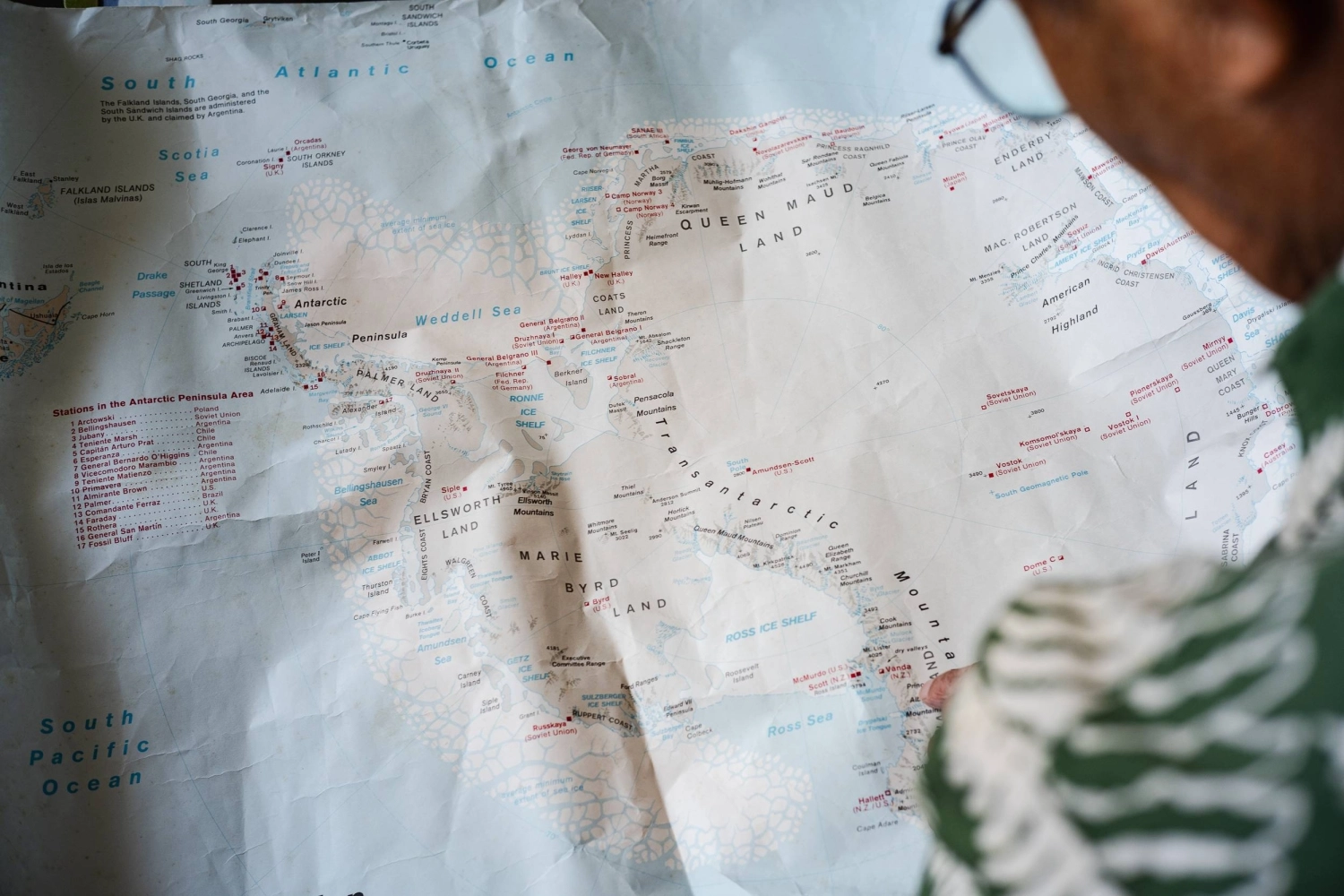
Katsutada Kaminuma looks at a map of Antarctica. After discovering that space travel wasn’t for him, he soon turned his attention to unexplored places on Earth.
| Johan Brooks
While you were a researcher at the University of Tokyo in 1965, you were invited to join the Antarctic expedition. How did that make you feel?
I was delighted! Like many people, I dreamed about going to the moon when I was in middle school. But then, I rode an attraction called “Rotor” at the Korakuen amusement park (in Tokyo), which is a big spinning cylinder where people stand against the inner wall. When it spins, the floor drops, and centrifugal force pins you to the wall. I felt so nauseous afterward that I realized that space travel would be impossible for me.
Then, I wondered if there was anywhere untrodden I could visit on Earth. There were plenty of 5,000-6,000-meter unclimbed peaks in East Asia. Just as I was thinking about that, the Antarctica trip came up. I immediately accepted the offer.
So a longing to explore untrodden land was the major motivation?
I was really lucky. If you go to Antarctica now, there are no virgin areas left. But the expedition leader at the time allowed me to walk to a point beyond which nobody had set foot before. It’s not in the Guinness World Records or anything, just personal satisfaction. But it was wonderful.
So you joined the 8th expedition, which departed in 1966. What specific work were you assigned to?
This was during the Cold War era. Starting around 1965, the United States was installing the World-Wide Standard Seismograph Network across 124 locations globally to detect Soviet underground nuclear tests.
Since Syowa Station was being reopened (after being temporarily closed in 1962), they wanted to install a long-period seismograph alongside short-period ones. They needed someone to handle it, and because I studied long-period seismographs for my doctoral dissertation, I was selected.
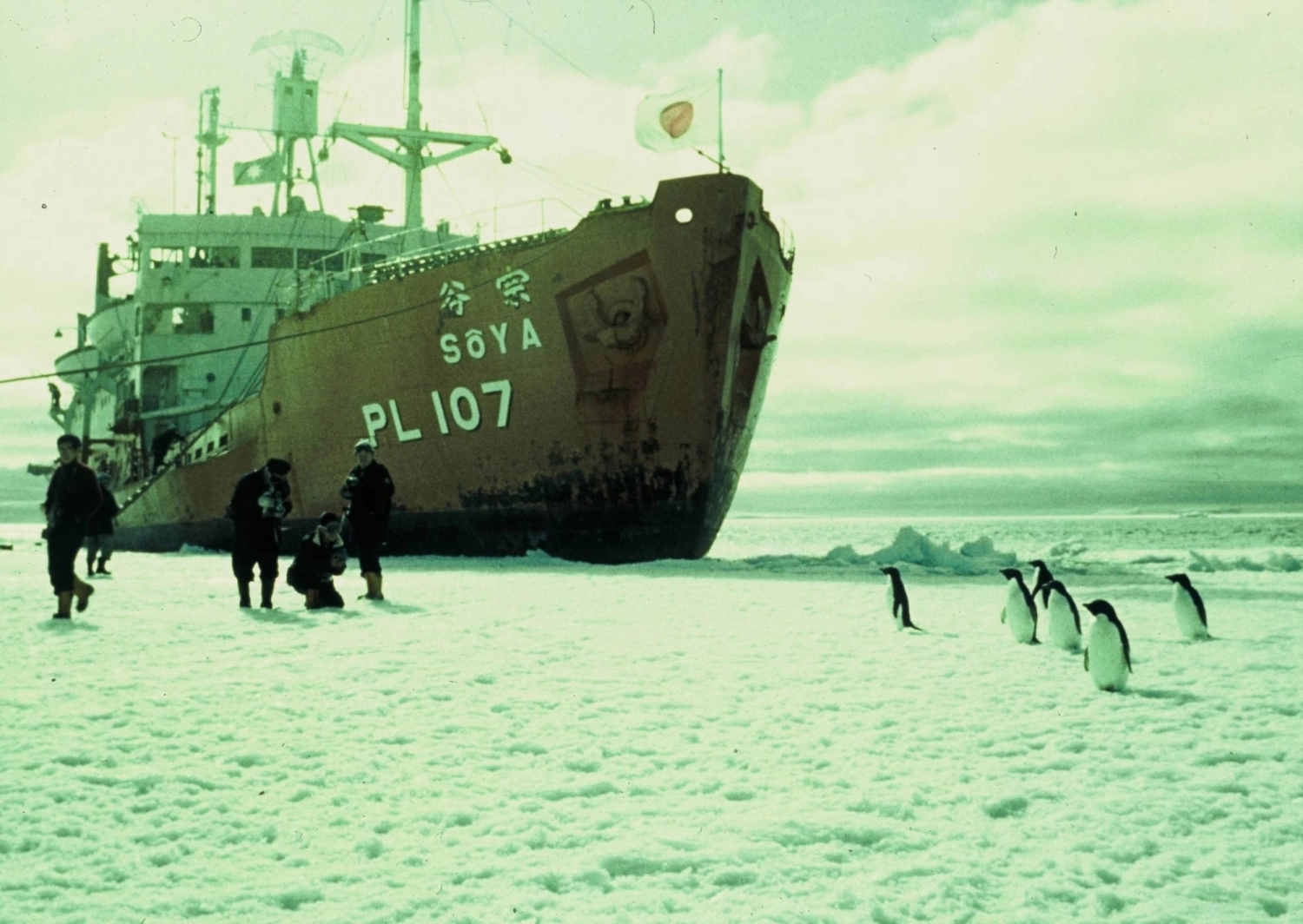
The icebreaker Soya is moored in Antarctica in 1957.
| National Institute of Polar Research
Did you have other duties as well?
Yes. My official mission was regular geophysical observation at Syowa Station: seismic activity, oceanic tides, geomagnetic intensity and visual observation of auroras. I knew nothing except earthquakes, so it was tough, but thanks to that mission, I learned a lot.
After that, the National Institute of Polar Research was established (in 1973). Takeshi Nagata became the director, coming from the University of Tokyo. NIPR needed to handle geophysics and earthquake observation, so I was transferred there from the university’s Earthquake Research Institute.
I was happy to accept the transfer. In Japanese seismology, competition is fierce, but in Antarctic seismology, I could immediately become a top researcher because there were very few scientists studying earthquakes in Antarctica.
You have also participated in joint international research.
In the 1970s, countries like the U.S. became very interested in underground resources in Antarctica. At a 1977 conference in the U.S., I was surprised to see that representatives from major oil companies were present. Director Nagata told me that, since Syowa Station is in an area known to lack oil or mineral resources, I should collaborate with the U.S. and show that Japan is producing research results in resource-rich regions, too.
So I joined joint U.S.-Japan-New Zealand projects around McMurdo Station. For about 10 years, I became a “seasonal laborer,” heading out to Antarctica late in the year and returning in the new year.
We traveled by airplane, unlike the ship travel to Syowa Station. We would leave in October or November and return around February. In the end, I visited U.S. and New Zealand bases about a dozen times, more often than Syowa Station itself.
I wintered in Antarctica twice (the 8th and 22nd expeditions) and joined summer expeditions as well (like the 19th expedition for meteorite and geological surveys). In the last 10 years of my field career, I monitored the Mount Erebus volcano with U.S. and New Zealand teams. We concluded that Mount Erebus’s eruption characteristics resemble Mount Usu in Hokkaido.
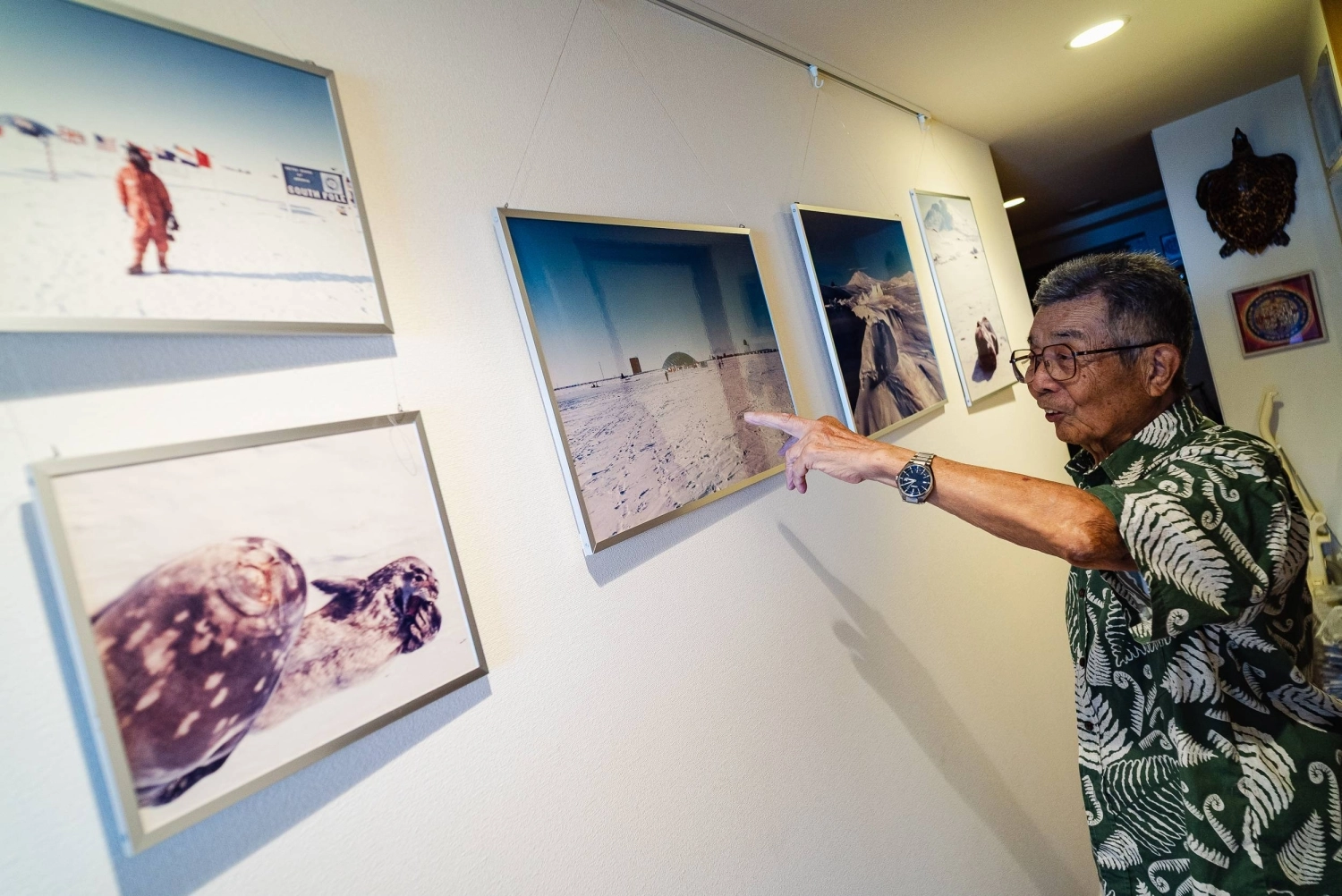
Katsutada Kaminuma discusses photos from Antarctica on display at his home in Hiratsuka, Kanagawa Prefecture.
| Johan Brooks
Among your research achievements, what do you consider the most significant?
When I first went to Antarctica, American textbooks on seismology stated that tectonic earthquakes did not occur on the Antarctic continent, and that only volcanic quakes occurred near Mount Erebus. Japanese seismology textbooks didn’t even mention Antarctica.
I had many discussions with colleagues, including a British researcher, who initially claimed what was happening was not tectonic quakes but just the cracking of the ice. Now it’s been accepted that low-level tectonic seismic activity does occur across the continent, though it took some 30 years to establish this. Proving that tectonic earthquakes exist in Antarctica was my major contribution.
Turning to the history of Antarctic research, did Japan have an interest in Antarctica before World War II?
Not really. Nobu Shirase (a retired army officer who led the first Japanese Antarctic expedition in 1910-1912) was an exception, but he struggled to get financial support. In other words, prewar Japan had virtually no culture of polar exploration or adventure.
Around 1955, during preparations for the International Geophysical Year, Japan initially intended to conduct observations of geomagnetism and gravity along the 140th meridian east, focusing on equatorial regions. But the equatorial regions were left to U.S. scientists, so Japan had some unused research funds.
Discussions about Antarctic observation then came up, and the decision was made to send a party to Antarctica.
People were eating imported rice, and Japan was still poor, though it had gotten over the chaos of the immediate postwar period. Politicians, business leaders, and media organizations such as the Asahi Shimbun, which donated about ¥100 million, strongly supported the mission.
I deeply respect those leaders. Former Axis nations like Germany and Italy didn’t start (national-level) Antarctic research until the 1980s — nearly 20 years after Japan. I’m very thankful for the support that the business and political leaders gave to the scientists back then, especially at a time when many people didn’t even understand the difference between bōken (adventure) and tanken (exploration).
I think they are completely different. Exploration means opening up unknown regions to generate knowledge that becomes a shared asset for all humanity. Adventure is purely for the personal satisfaction or thrill of the individual doing it, though it may inspire some people.
I understand the public back then had huge expectations for the first expedition, regarding it as a national morale booster after Japan’s defeat in the war.
Yes. Japan had nothing back then, but people were excited about the idea of the nation participating in something billed as the Science Olympics. There were all kinds of fundraising efforts, and people (including children) made donations. But the first Japanese mission had little knowledge about Antarctica. The members brought frozen foods and thought they wouldn’t need a freezer in Antarctica, then were surprised to find that temperatures sometimes rose above zero, and their meat was all spoiled.
What was the overall mission of the Syowa Station?
The purpose was to research the unknown Antarctica (as part of the international scientific network) and to conduct continuous observations of Earth conditions. You need a station to do that, and the data are important for many things, starting with weather forecasts. There was no station between 0 degrees East and 100 degrees East, and so Japan was asked to set up a base in that area. It was tough, but it was worth it.
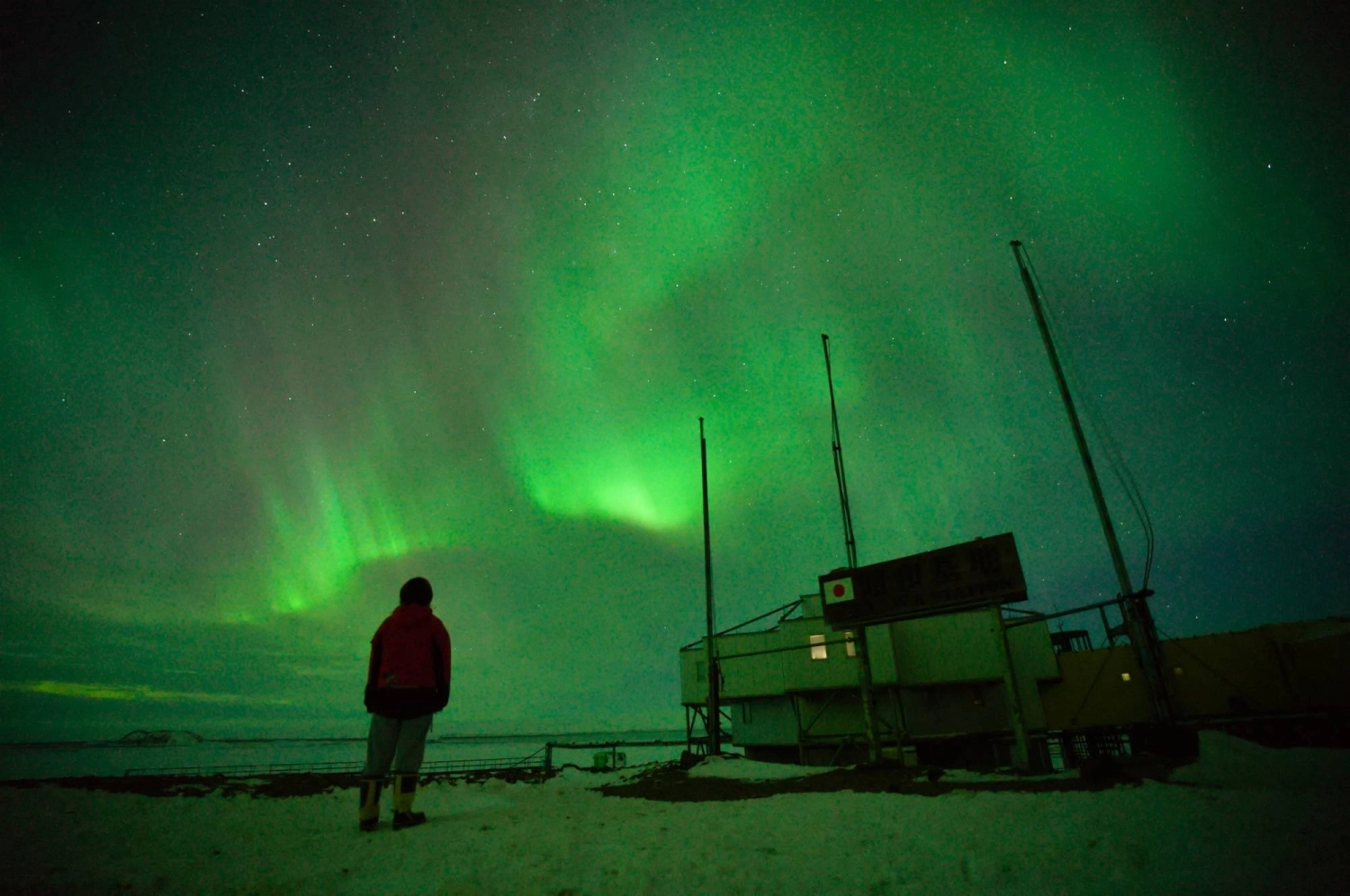
Auroras are a common sight in the sky above Syowa Station, Japan’s research base in Antarctica.
| National Institute of Polar Research
When you participated in the 8th expedition, what stage of development was the station in?
Japan’s expeditions have three eras (corresponding to the names of icebreaker ships used for Japanese expeditions over the years): the Soya era, followed by the Fuji era and the Shirase era.
It was in the Fuji era (from 1965) when living conditions improved to the point where members were able to live like humans and were given individual rooms. The Shirase era (starting from 1983) brought urban-level living conditions, with reliable power and smooth communication with families back home.
When I first went, we still didn’t have a freezer or a proper toilet. The amount of water we could use was limited, and we were not able to take a bath every day.
We had a tiny private space separated by veneer wood. When I wintered 10 years later (in 1981), I had a private room of about three tatami mats (about 4.9 square meters).
How has Japan contributed to Antarctic research?
I think Syowa Station serves three core functions. First, it’s a global baseline observation point, providing essential meteorological and seismic data for global networks. Second, it is a place for studying phenomena unique to Antarctica, such as auroras and ancient ice cores. Then, it’s an inland survey base, serving as a launchpad for deep-continent research, such as meteorite collection.
All of the three functions are important, but what is often overlooked is the first one, because participating scientists don’t benefit from the work individually. But given Japan’s cultural standing in the world, I think we should maintain the base and keep it as a crewed station.
In my view, there are three major scientific discoveries made out of Antarctica. Japan has been involved in two of them.
First, the meteorite collection. Before going to Antarctica, Japan had collected only about 20 meteorites. Japanese expeditions have collected over 17,000 meteorites in Antarctica, including ones originating from the moon and Mars. Japan is among the top collectors of meteorites, along with the U.S. (which has recovered over 23,000). If you send a mission to the moon to recover meteorites, it would be far more expensive.
Second, the discovery of the ozone hole. The routine atmospheric monitoring at Syowa Station played a role in discovering the depletion of the Antarctic ozone layer.
The last discovery, in which Japan was not involved, was the subglacial lakes buried beneath 3,000 meters of ice.
I think Japan should be proud of the fact that it has contributed to two of the three major discoveries.
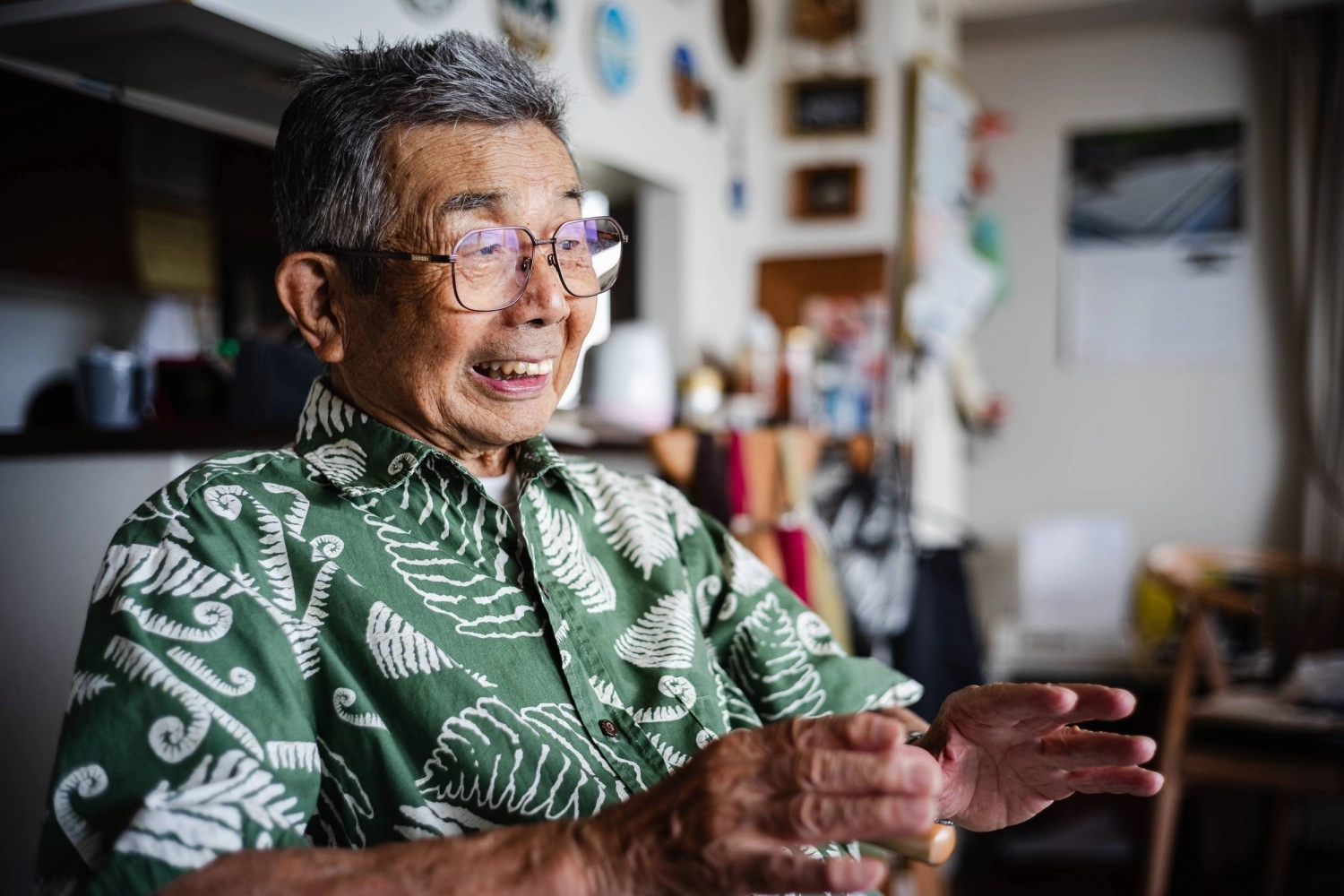
The impact of Kaminuma’s research on Antarctica is highlighted by the fact that he has two places named after him: Kaminuma Crag and Kaminuma Bluff.
| Johan Brooks
How important is Antarctic research for understanding climate change?
Over 70 years of recording at Syowa Station, average surface temperatures have remained relatively stable. Meteorologists say that cold surface air buffers the Antarctic region. However, upper stratospheric temperatures are rising. Continuous observation is vital for detecting when polar ice sheets begin to melt significantly.
The Antarctic Treaty essentially prevents countries from asserting territorial rights there, and that has allowed Antarctica to remain a place for peaceful use and scientific research. But with conflicts and wars breaking out around the world, do you feel geopolitical developments are affecting Antarctica as well?
Under a 1991 protocol created under the Antarctic Treaty, commercial resource extraction is frozen for 50 years. Antarctica represents a peaceful paradise and a model for global cooperation. However, nations like China are rapidly expanding their presence across both polar regions, including Greenland. I think diplomats and scientists should work hard under the treaty and keep saying that maintaining the current setup could serve as a model for peace on Earth. And for that, it’s important to produce solid scientific results.
Why must humanity continue Antarctic research?
Because Earth is our home. We do not seek financial wealth from Antarctica; we study it for the collective future of humanity.
AloJapan.com