

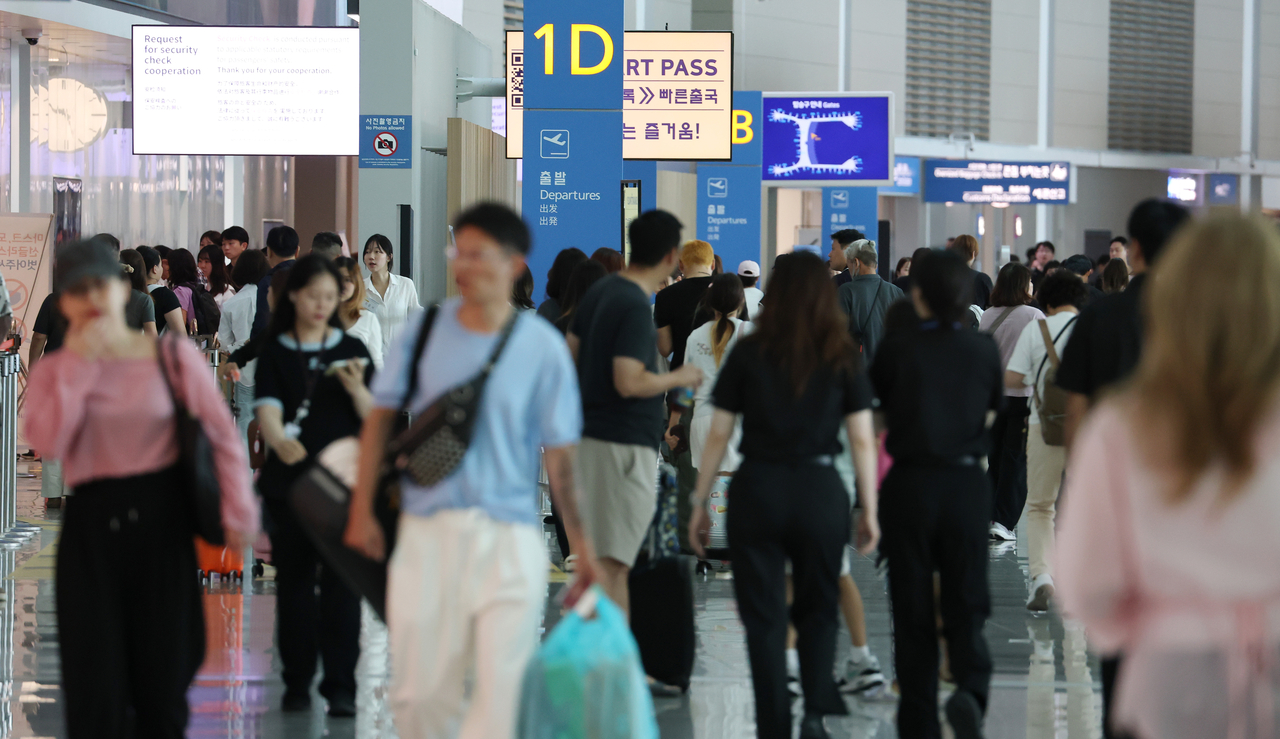
 Travelers crowd the departure hall of Terminal 2 at Incheon Airport on July 7. (Yonhap)
Despite elevated US dollar-Korean won exchange rates, Korean demand for overseas travel held steady through the first half of 2026, with Japan and Vietnam dominating the destinations travelers searched most, according to data released Tuesday.
International passenger traffic at Incheon Airport reached 32.41 million from January through May, up 7.3 percent from a year earlier, according to the Incheon International Airport Corp.
Travel platform Agoda, drawing on accommodation searches from January through June, ranked Tokyo as the most-searched overseas destination among Korean travelers, followed by Fukuoka and Osaka, also in Japan. Da Nang and Nha Trang in Vietnam, Sapporo on the northern Japanese island Hokkaido, Bangkok, Bali in Indonesia, Vietnam’s largest island Phu Quoc and Taiwan capital Taipei round out the top 10, in a list that reflects a preference for short-haul trips and beach getaways.
Phu Quoc was among the fastest climbers, with searches up 13 percent, aided by new Incheon and Busan routes launched in April. Shanghai posted the steepest increase at 15 percent. The Shanghai Municipal Administration of Culture and Tourism counted 447,500 Korean visitors from January through May.
“According to Agoda’s 2026 Travel Outlook Report, 39 percent of Korean respondents said they plan to travel abroad more often this year. This half-year data shows that Korean travelers are actively seeking a wider range of destinations, from nearby cities to tropical resorts,” said Alex Park, Agoda’s country manager for Korea.
A separate report from booking platform Klook, based on Korean users’ overseas traffic between July 1 and July 20, points to the same trend. Japan was the most-explored destination, with traffic up 60 percent from a year earlier. Vietnam, Thailand, Taiwan and China followed. China, in fifth, rose 31 percent, the second-largest gain after Japan.
Within Japan, interest spread beyond the major hubs. Traffic to Kyoto and Nagoya each rose 109 percent and Fukuoka 87 percent, while smaller cities such as Matsuyama, up 318 percent, and Miyakojima, up 281 percent, saw sharp gains.
Hotel bookings drove much of the growth. Traffic to Japan’s hotel category rose 182 percent. In Tokyo, Osaka and Fukuoka, travelers favored business and city hotels, while resort stays with pools and ocean views gained ground on the southern island of Okinawa.
Summer travelers also leaned toward outdoor activities. Compared with April, a Turtle Island tour in Yilan, Taiwan, rose 433 percent, followed by a night safari in Chiang Mai, Thailand, up 178 percent, and a Nakasu river cruise in Fukuoka, up 175 percent.
“Nearby destinations, including Japan, remained popular again this summer, and in Japan we saw interest in hotels climb sharply,” said Lee Zun-ho, Klook’s Korea general manager.
yoohong@heraldcorp.com
AloJapan.com