

Researchers in Japan have found geological traces linked to the Chicxulub asteroid impact in sedimentary layers in eastern Hokkaido, adding new East Asian evidence to the global record of the asteroid event associated with the extinction of dinosaurs about 66 million years ago.
The findings, published in Nature Communications, describe geochemical signatures interpreted as fallout from the Chicxulub impact, which created a crater about 180 km (112 miles) wide near the present-day Yucatán Peninsula in Mexico.
Scientists examined sedimentary layers corresponding to the Cretaceous–Paleogene (K–Pg) boundary, the geological marker associated with one of the largest mass extinctions in Earth’s history.
 Location map and stratigraphy of the Kawaruppu section. Credit: Ota, H., Kuroda, J., Hayashi, K. et al. The Chicxulub impact signature in East Asia
Researchers found elevated concentrations of platinum-group elements and isotopic signatures consistent with extraterrestrial material linked to the Chicxulub asteroid impact. Similar iridium-rich signatures discovered globally since the late 1970s became one of the strongest lines of evidence supporting the asteroid-impact extinction hypothesis.
Iridium is uncommon in Earth’s crust but relatively abundant in asteroids and meteorites. Additional evidence associated with the Chicxulub impact includes shocked quartz, impact spherules, tsunami deposits, and the buried Chicxulub crater beneath the Yucatán Peninsula.
The Japanese discovery does not establish a new dinosaur extinction theory, but it expands the known distribution of preserved Chicxulub-related material and provides additional evidence for how asteroid debris spread through Earth’s atmosphere and oceans after the impact.
Scientists estimate the Chicxulub asteroid was roughly 10 km (6.2 miles) in diameter before striking Earth at hypersonic velocity. The collision released enormous amounts of energy and injected dust, aerosols, soot, and vaporized rock into the atmosphere.
Studies examining the extinction event propose that these processes contributed to global environmental disruption affecting ecosystems worldwide.
Preserved K–Pg boundary sequences remain unevenly distributed globally because tectonic deformation, erosion, and sediment disturbance have altered or removed many ancient deposits.
East Asian preservation sites remain comparatively limited relative to North America and Europe, increasing the scientific significance of the newly identified Japanese evidence.
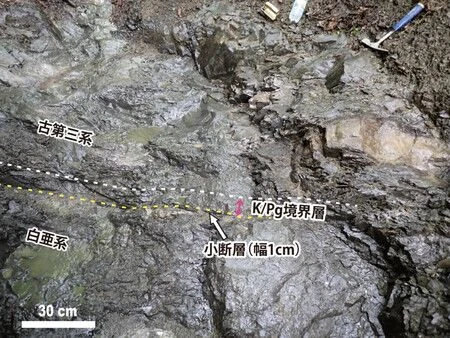 The K Pg boundary layer indicating traces of an asteroid impact from about 66 million years ago, found in the town of Urahoro, Hokkaido. Credit: Tohoku University
The Chicxulub extinction hypothesis was proposed in 1980 by physicist Luis Alvarez, geologist Walter Alvarez, and colleagues after the discovery of anomalous iridium concentrations at the K–Pg boundary in Italy.
Subsequent discoveries increasingly supported the asteroid-impact scenario as the primary driver of the mass extinction event that eliminated about 75% of Earth’s species, including non-avian dinosaurs.
The newly reported Japanese evidence contributes to broader scientific efforts to reconstruct how material from the Chicxulub collision circulated globally and became preserved in geological archives over tens of millions of years. Such discoveries continue refining scientific understanding of how large asteroid impacts can alter Earth’s atmosphere, climate, oceans, and biosphere on planetary scales.
References:
1 Ota, H., Kuroda, J., Hayashi, K. et al. The Chicxulub impact signature in East Asia. Commun Earth Environ 7, 434 (2026). DOI: https://doi.org/10.1038/s43247-026-03602-z
2 Asteroid traces found in Japan may be linked to extinction of dinosaurs – The Japan Times – May 21, 2026
AloJapan.com