
 Source: Travel Wallet
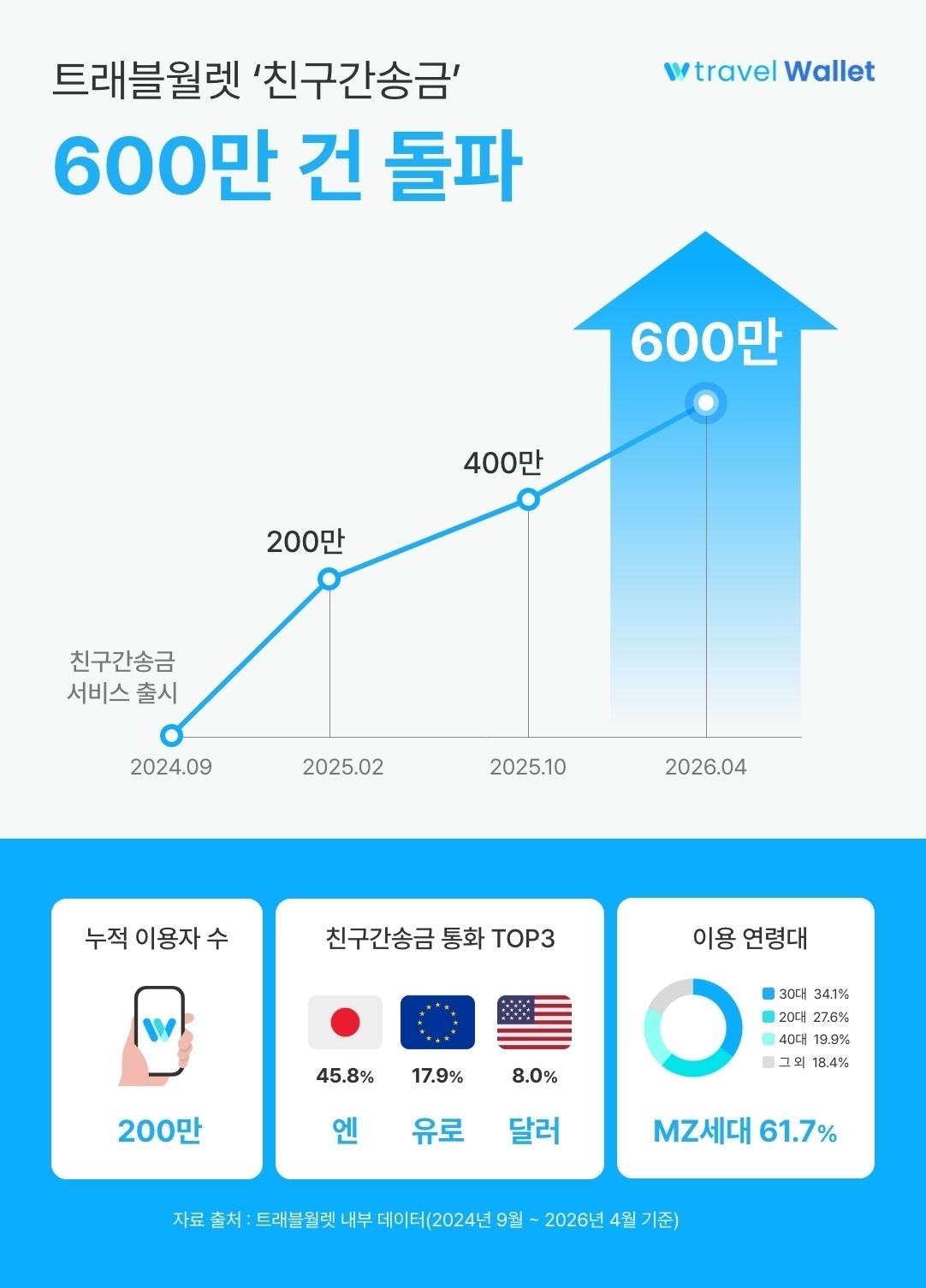
Travel Wallet’s peer-to-peer money transfer service has surpassed 6 million cumulative transactions just 20 months after its launch. Half of the transfers were denominated in Japanese yen, suggesting that outbound travel demand, particularly to Japan, has driven adoption of the service.
Travel Wallet, a global foreign exchange payment fintech company, announced Tuesday that its “Friend Transfer” service has exceeded 6 million cumulative transactions and 2 million cumulative users.
Friend Transfer allows Travel Wallet app users to send and receive Korean won and foreign currencies in real time without fees. Transferred amounts are immediately reflected in the recipient’s in-app wallet. Foreign currency can be used directly for overseas payments without a separate exchange process.
The service is mainly used for settling expenses before and after overseas trips. Users split costs such as meals and accommodations with traveling companions, or send leftover foreign currency to friends after a trip. Transfers can be initiated by entering the currency, recipient’s name, mobile number, and amount in the app. Once a transfer has been made, subsequent transfers to the same recipient require no additional information.
Transaction volume has grown steadily. Friend Transfer recorded 2 million cumulative transactions within six months of its launch, surpassed 4 million in 14 months, and crossed 6 million in 20 months.
Users in their 20s and 30s have led adoption. By age group, those in their 30s accounted for the largest share of transfers at 34.1%, followed by users in their 20s at 27.6%. The combined share of the two age groups reached approximately 62%. Younger generations, who travel more frequently and are accustomed to splitting expenses with companions, have actively used the foreign currency transfer feature.
Transfers were active among peers and adjacent age groups. The most common pairing was transfers between users in their 30s. Transfers between users in their 20s and 30s also accounted for a significant share. Rather than family living-expense transfers, the service has been notably used for settling expenses among friends, couples, and traveling companions.
The most frequently transferred currency was the Japanese yen. Yen transfers accounted for 45.8% of the total, followed by the euro and the U.S. dollar. The top three currencies combined made up 71.7%. Demand for short-haul overseas travel, particularly to Japan, is seen as a key driver behind the service’s growth.
Travel Wallet plans to expand its global cross-border payment network based on its digital wallet service, which connects overseas payments, transfers, and settlements in a single flow. The company is also currently in the process of selecting underwriters for an initial public offering.
AloJapan.com