
このページを
日本語
で読む
JAPAN Forward launched its “Ignite” series of essays in English to directly share Japanese students’ voices with their global peers. Tohoku Gakuin University student Kojiro Asano is one. As part of the TOMODACHI Initiative, Asano and other participants traveled to the region devastated by the 2024 Noto Peninsula earthquake on March 14-15. There, they examined the challenges and successes of disaster recovery efforts.
Launched after the 2011 Great East Japan Earthquake, the TOMODACHI Initiative is a Japan-United States public-private partnership to encourage future leaders in both countries.
Asano’s essay is the first submission among students who participated in the 2026 Noto Peninsula project. As a survivor of the Great East Japan Earthquake and tsunami, he found himself comparing the recovery processes he encountered in Noto with those of his own hometown in Northeast Japan. How were choices for safety and efficiency balanced, and decisions made that connect the traditions of its past to the town’s future? Let’s see.
Fortieth in the Series, ‘Ignite’
 Kojiro Asano, an alumnus of the Tomodachi Initiative’s Noto Peninsula project. (©Kojiro Asano)
Kojiro Asano, 1st Essay, the TOMODACHI Initiative Noto Peninsula Project
I was four years old at the time of the Great East Japan Earthquake, but the sight of the familiar townscape completely transformed by the tsunami, and the atmosphere of tension and anxiety that permeated the area, remain vivid in my memory to this day. Precisely because I was too young to fully articulate in words, it is a memory that is etched into my senses. At the same time, I am aware that I belong to the last generation of “eyewitnesses” who can recount those events, even if only in fragments.
Since then, I have continued to witness the town’s recovery through my daily life. While new seawalls and public facilities were being built, I also faced the reality that the former landscapes and ways of life were being lost. It was through this process that I came to understand that reconstruction is not simply a matter of returning to the way things were, but rather a continuous series of choices regarding what to preserve and what to change.
With these experiences as a backdrop, my visit to Noto led me to reexamine the nature of reconstruction. Among these, the Shiroyone Senmaida rice terraces left a particularly strong impression on me. Each of these terraces is long and narrow, built to make the most of the limited land available. They embody the “wisdom of living with the land” found in Okunoto, a region with scarce flat land.
However, today, their value is often reduced to being merely a “beautiful landscape.” In reality, they exist through the ceaseless labor of people continuously repairing the unstable terrain by hand, and it is the very act of maintaining them that holds meaning.
Connecting the Past to the Future
In the reconstruction efforts in Tohoku, safety and efficiency were prioritized, and there was a shared sense that “restoring things to the way they were” was a form of justice. In contrast, in Noto, the choice was made to continue protecting the terraced rice fields by hand, even if it meant sacrificing efficiency. Value is placed on understanding and passing down the very act of repeatedly repairing the terraces whenever they erode. This contrast made me realize that reconstruction is not merely a matter of speed or rationality, but rather an endeavor to connect the relationship between people and the land to the future.
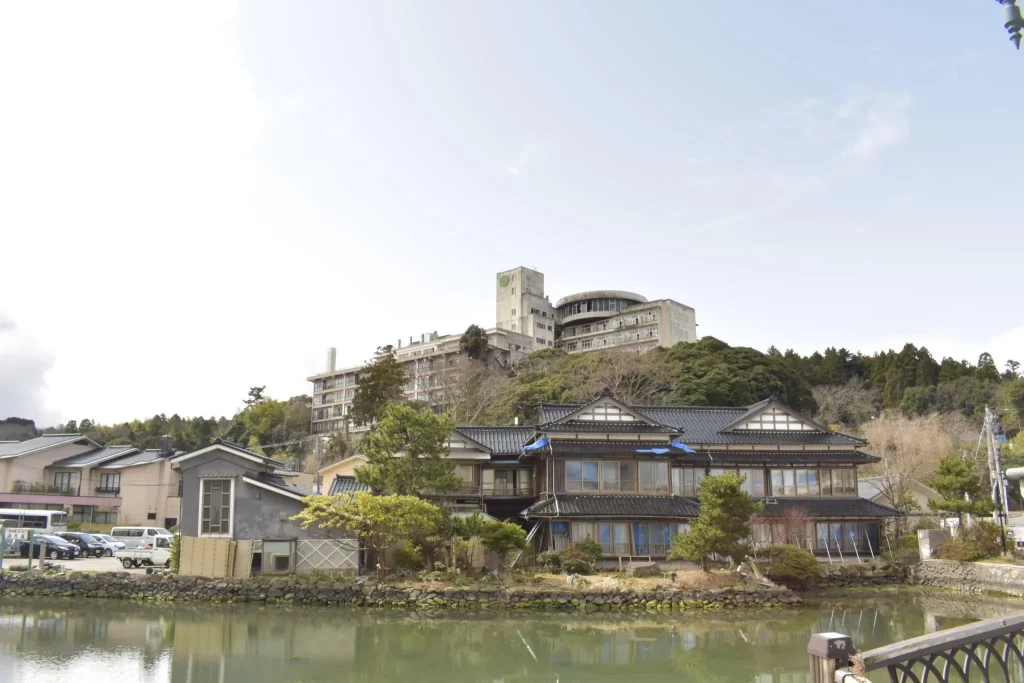 This wooden guesthouse tilted due to the earthquake and is no longer safe to occupy. Currently, it is awaiting demolition. (Photo provided by the owner)
Furthermore, in Noto, there is a prevailing trend in career guidance where “leaving the region” is equated with success, revealing a sense of stagnation and wavering pride in the local community. However, as an outsider visiting the area, I felt that unique practices and values truly exist there. Overlapping this with my own experience of realizing the value of my hometown only after leaving it, I was led to reflect on the disparity in perception between those inside and outside the community.
Envisioning a Promising Future
Additionally, there are forces at work in the reconstruction process that are not easily visible. While frameworks such as systems, budgets, laws, and subsidies serve as the foundation supporting reconstruction, they can also create a disconnect from the actual activities on the ground.
Furthermore, the mismatch in expectations between those providing support and those receiving it is another factor contributing to the difficulties of reconstruction. Amid this interplay of complex elements, what is required is not merely leadership but an attitude that identifies challenges and continues to envision a future rooted in the community.
The reconstruction of Noto is not merely an effort to return to the way things were. It is also a practical testing ground for addressing the challenges that society will face in the future. As issues such as population decline and regional sustainability become more acute, initiatives in small communities can offer insights for other regions. Reconstruction is not only an endeavor to reclaim the past but also an endeavor to anticipate the shape of future society.
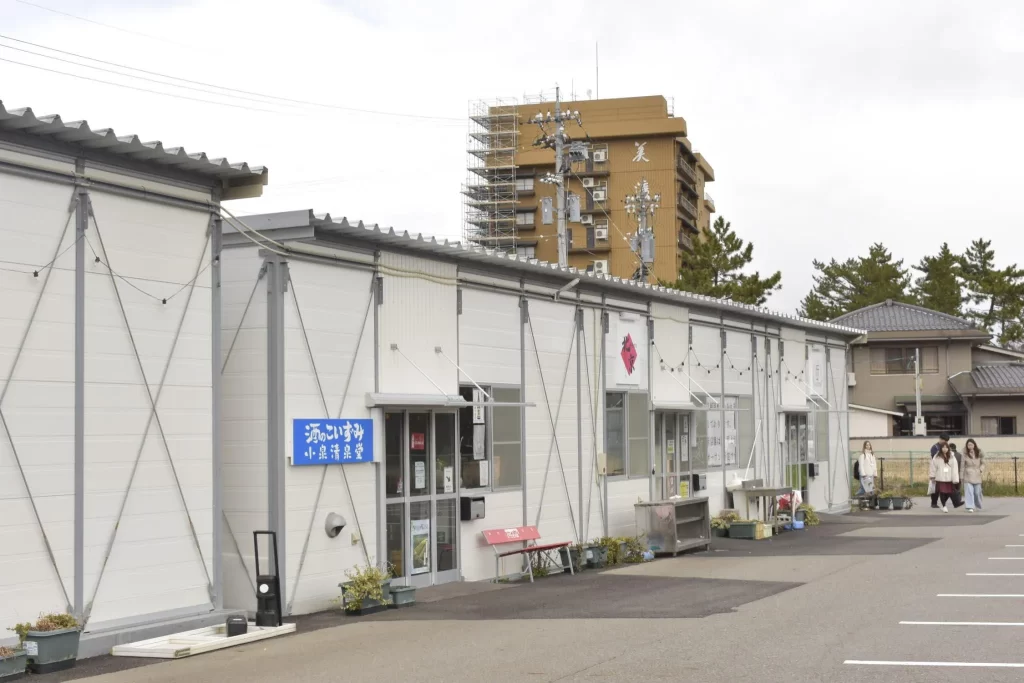 A group of temporary buildings housing shops in the Noto Peninsula Earthquake region. The ceilings of temporary buildings provided after the Great East Japan Earthquake were low. However, they were higher in those provided after the Noto Peninsula Earthquake. (©Kojiro Asano)
About the Author:
When he wrote this essay, Kojiro Asano was a second-year student in the Department of Regional Community Studies, Faculty of Regional Studies, at Tohoku Gakuin University. His hometown, Sanriku Town in Miyagi Prefecture, was one of the areas devastated by the March 11, 2011, Great East Japan Earthquake and tsunami. Now 20 years old, he is one of the alumni who helped organize the TOMODACHI Initiative’s Noto Peninsula project.
During his second year of junior high school, in 2019, Asano participated in a short-term training program in Australia. Subsequently, in the summer of 2024, he participated in the TOMODACHI Summer SoftBank Leadership Program 2.0, training in the United States. He shared this comment when he decided to contribute this essay about his visit to the Noto Peninsula earthquake region:
“When I was four years old, the Great East Japan Earthquake occurred. I decided to write this essay as someone who has experienced disaster and can speak about it in words, even if it’s only in fragments.”
Feel free to join the conversation by leaving comments on the topic in the comment box below.

RELATED:
Author: Kojiro Asano
Student, Tohoku Gakuin University
このページを
日本語
で読む
Continue Reading
AloJapan.com