
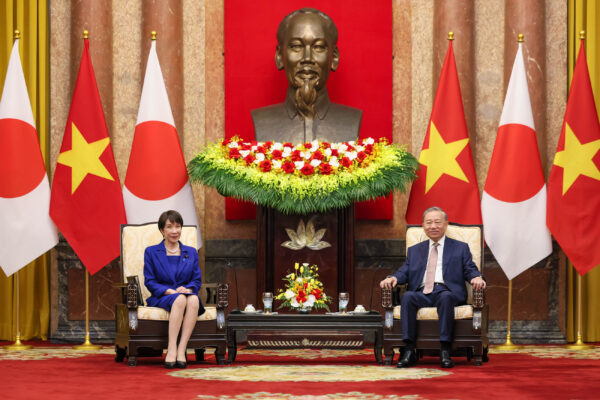
Japan and Vietnam have agreed to boost cooperation across a range of areas, including energy and critical minerals, as both nations seek to navigate an uncertain global economic climate and manage the reverberations of the war in the Middle East.
The announcements came as Prime Minister Takaichi Sanae visited Hanoi over the weekend, part of a regional tour that also includes a stop in Australia.
During her three-day visit, which began on Friday, the Japanese PM held meetings with senior leaders, including Prime Minister Le Minh Hung, National Assembly chair Tran Thanh Man, and President To Lam, who is also the chief of the Communist Party of Vietnam (CPV).
During their meeting, Takaichi and Hung signed six agreements on issues including infrastructure, agriculture, and space cooperation. The two sides agreed to work more closely on “economic security, including energy, important mineral resources, artificial intelligence, semiconductors, and space,” Takaichi said after the meeting.
“The two sides identified economic security as a new priority area for bilateral cooperation,” Takaichi told reporters. “With regard to critical minerals … both sides agreed to strengthen close coordination to ensure stable supplies and reinforce supply chains.”
Hung said that Vietnam is likely to receive crude oil from Japan under its recently announced $10 billion Partnership On Wide Energy and Resources Resilience (POWERR) Asia Initiative, which intends to help its Asian neighbors secure energy supplies to offset the impacts of the conflict in the Middle East.
Japan is also seeking to reduce its reliance on China for rare earths by strengthening critical minerals supply chains. Vietnam has large reserves of rare earth minerals but does not yet possess the capacity to refine them, making it a natural partner for Japan.
In addition to these pledges, Takaichi and Hung agreed to boost their bilateral trade to $60 billion by 2030, up from just over $50 billion in 2025. They also pledged to increase Japanese investment in Vietnam by $5 billion per year, Vietnam News reported.
Perhaps inevitably, the meeting involved discussion of the threats posed by China’s growing maritime clout, a subject of shared concern in both Hanoi and Tokyo. Hung said that the two leaders also “reaffirmed the importance of resolving disputes in the South China Sea through peaceful means based on international law.”
Like her predecessor Ishiba Shigeru’s trip to Vietnam in April of last year, which occurred shortly after the announcement of U.S. President Donald Trump’s “liberation day” tariffs, the agenda of Takaichi’s trip centered on the need to adapt to growing geopolitical competition and the recent wrenching shifts in global energy markets.
In this goal, Japan and Vietnam have a lot of reasons to collaborate more closely. Japan is a major investor in Vietnam and its largest provider of official development assistance. Both nations share a concern about China’s expansive maritime claims in disputed parts of the East and South China Seas. They are also united by a mutual desire to diversify their economic partnerships and avoid too much dependence on China.
For this reason, it is perhaps no surprise that Takaichi chose Hanoi as the location for a speech in which she laid out her vision for a “free and open Indo-Pacific,” updating a concept that was first formulated by her late predecessor, Abe Shinzo. During the speech at Hanoi National University, she said that Tokyo would be “more proactive than ever” in the Indo-Pacific, which she said “holds the key to the future peace and stability of the international community.”
“I am reaffirming my resolve to fulfill Japan’s role – as we have always done, and indeed, be more proactive than ever – in building an international order based on freedom, openness, diversity, inclusivity and the rule of law,” she said.
She specifically referenced the changes to the international order that have resulted from China’s growing power and various disruptions prompted by U.S. President Donald Trump’s second term, including his tariffs and the attack on Iran that precipitated the current global energy crisis.
Takaichi said partner nations “must adapt to these new realities, including structural changes in the international order resulting from geopolitical competition, accelerating technological innovation, and the rise of the Global South.” She said that “autonomy and resilience are necessary to determine our own destinies – in all aspects of the economy, society, and security – and essential for realizing [the Free and Open Indo-Pacific].”
AloJapan.com