
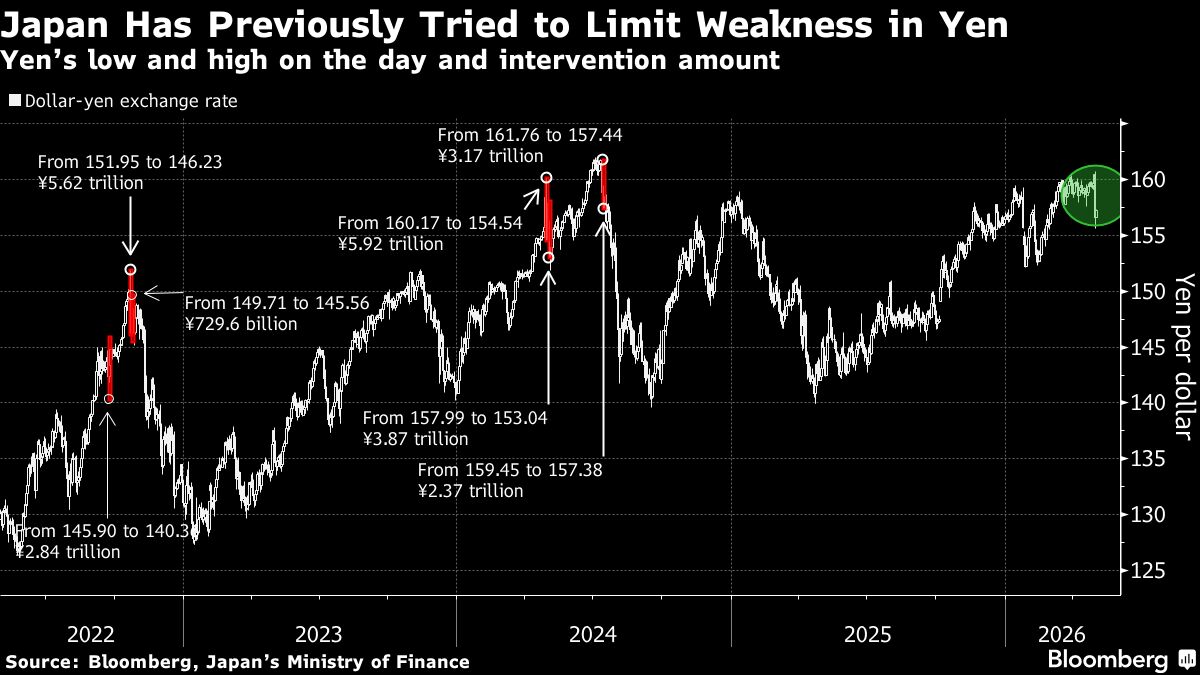
(Bloomberg) — Japan can conduct only two more sessions of three-day interventions by November if it wants to maintain its status of having a freely floating exchange rate, based on International Monetary Fund guidelines.
Most Read from Bloomberg
A Japan Finance Ministry official cited an IMF rule on Monday noting that three days of intervention count as a single market operation. The comments came after the yen surged last Thursday following reported intervention by the authorities, and also saw a number of intraday rallies on the following days.
Still, market participants are largely of the view the yen will resume its weakening trend with or without official intervention. The Iran war is negative for Japan’s energy-import reliant economy and the still-wide interest-rate differentials with the US are denting sentiment, ensuring the currency remains under pressure.
“Will they make use of it? Yes, especially given spot is stalking the 160 level,” Abbas Keshvani, director of Asia macro strategy at RBC Capital Markets in Singapore, said of further intervention. “Will it be effective? They can cap spot in the short term but beyond that, the fundamental drivers of yen weakness are still in play.”
The yen strengthened as much as 0.8% in Asia Monday before paring gains, sparking discussions across trading floors as to whether officials had waded into markets once again to bolster the currency. The surge came after Japan likely spent around ¥5.4 trillion ($34.3 billion) last week to support the yen after it had weakened past 160 per dollar.
The Japanese currency fluctuated sharply on Tuesday to trade 0.2% lower at 157.54 per dollar in London.
What Bloomberg Strategists Say…
“The question now is whether authorities are forced back into action, but the bar looks higher in an environment where active war is the main driver”
Brendan Fagan, Markets Live strategist
IMF rules state that up to three episodes of currency interventions within six months is consistent with a free-floating exchange-rate regime, the Japanese Finance Ministry official said on Monday. If the authorities exceed that number, then the IMF tends to classify the exchange-rate regime as floating rather than free floating, the official said.
The IMF did not immediately respond to a request for comment when contacted by Bloomberg.
“Japan has a lot of FX reserves,” to give it the firepower to intervene in markets, Joey Chew, head of Asia foreign-exchange research at HSBC Holdings Plc, said on Bloomberg Television. “It’s about the efficacy — whether it’s good timing to do it right now when oil prices are still rising.”
Japan’s Finance Minister Satsuki Katayama said on Monday that the authorities can take bold action on speculative currency moves in line with a US-Japan agreement. Even if Japan is on a public holiday, intervention can still be counted if global markets are open, an official said.
Some in the market are pondering what may happen if Japan decides to conduct more operations than the three allowed under the IMF guidelines.
“We are still a long way from there, but history shows that it is hard for the IMF to enforce currency rules,” said Rodrigo Catril, a strategist at National Australia Bank Ltd. in Sydney. “Future FX interventions should be expected,” unless there’s a material change in factors such as Japan’s ultra-loose fiscal policies, he said.
Options traders still see roughly 52% chance the yen will weaken to the 160 per dollar level again by the end of June, according to data compiled by Bloomberg.
“Without the Bank of Japan hiking at a pace commensurate to inflation, the yen will only weaken,” said Damien Loh, chief investment officer at Ericsenz Capital in Singapore.
–With assistance from Vassilis Karamanis.
(Updates with pricing.)
Most Read from Bloomberg Businessweek
©2026 Bloomberg L.P.
AloJapan.com