

Shareholders didn’t appear too concerned by Tokyo Steel Manufacturing Co., Ltd.’s (TSE:5423) weak earnings. We did some analysis and found some concerning details beneath the statutory profit number.
Trump has pledged to “unleash” American oil and gas and these 15 US stocks have developments that are poised to benefit.
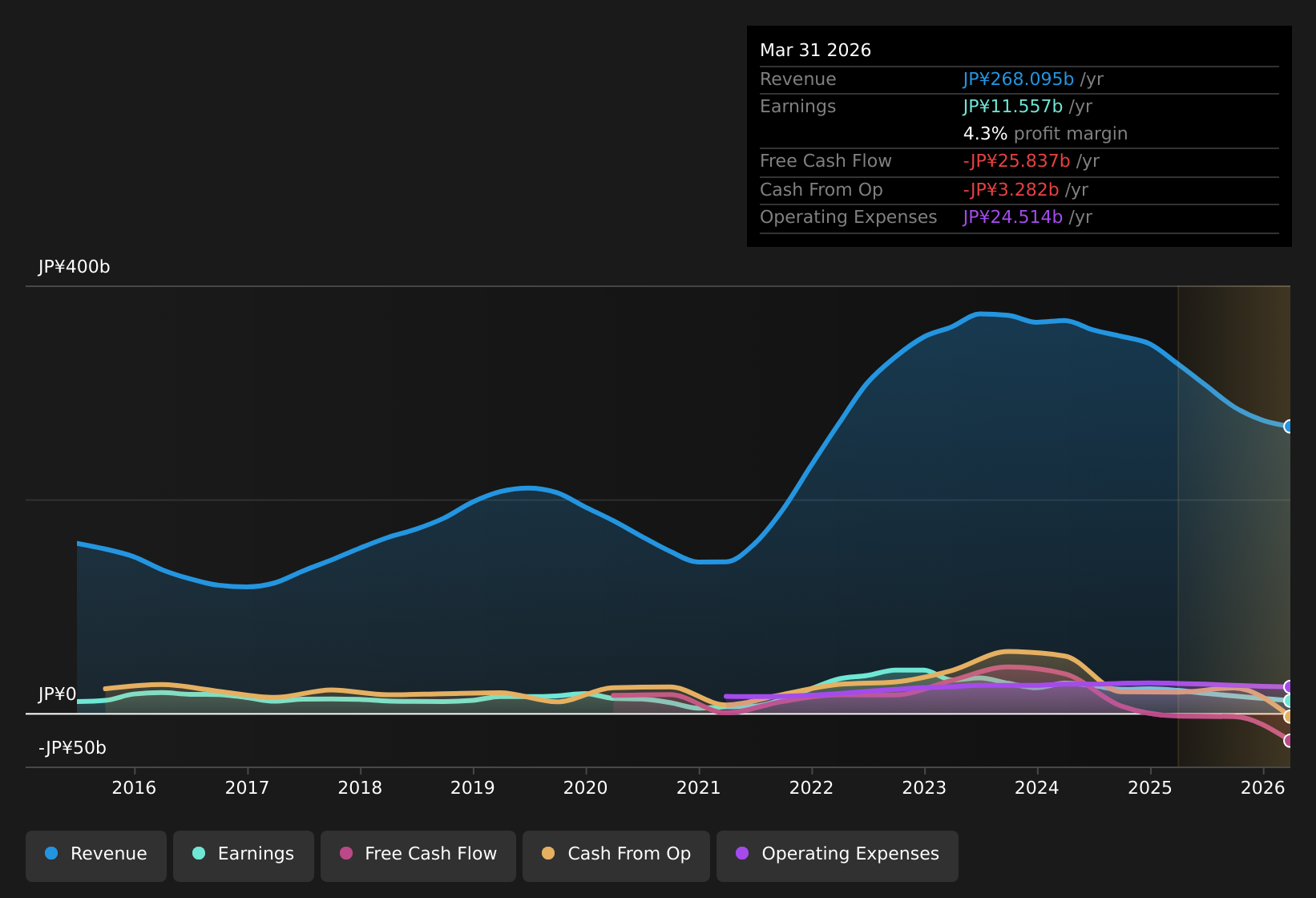 TSE:5423 Earnings and Revenue History May 1st 2026 Examining Cashflow Against Tokyo Steel Manufacturing’s Earnings
Many investors haven’t heard of the accrual ratio from cashflow, but it is actually a useful measure of how well a company’s profit is backed up by free cash flow (FCF) during a given period. The accrual ratio subtracts the FCF from the profit for a given period, and divides the result by the average operating assets of the company over that time. The ratio shows us how much a company’s profit exceeds its FCF.
Therefore, it’s actually considered a good thing when a company has a negative accrual ratio, but a bad thing if its accrual ratio is positive. That is not intended to imply we should worry about a positive accrual ratio, but it’s worth noting where the accrual ratio is rather high. That’s because some academic studies have suggested that high accruals ratios tend to lead to lower profit or less profit growth.
For the year to March 2026, Tokyo Steel Manufacturing had an accrual ratio of 0.29. Therefore, we know that it’s free cashflow was significantly lower than its statutory profit, raising questions about how useful that profit figure really is. Over the last year it actually had negative free cash flow of JP¥26b, in contrast to the aforementioned profit of JP¥11.6b. We also note that Tokyo Steel Manufacturing’s free cash flow was actually negative last year as well, so we could understand if shareholders were bothered by its outflow of JP¥26b. Having said that, there is more to the story. The accrual ratio is reflecting the impact of unusual items on statutory profit, at least in part.
View our latest analysis for Tokyo Steel Manufacturing
That might leave you wondering what analysts are forecasting in terms of future profitability. Luckily, you can click here to see an interactive graph depicting future profitability, based on their estimates.
The Impact Of Unusual Items On Profit
Given the accrual ratio, it’s not overly surprising that Tokyo Steel Manufacturing’s profit was boosted by unusual items worth JP¥5.5b in the last twelve months. While it’s always nice to have higher profit, a large contribution from unusual items sometimes dampens our enthusiasm. When we crunched the numbers on thousands of publicly listed companies, we found that a boost from unusual items in a given year is often not repeated the next year. And that’s as you’d expect, given these boosts are described as ‘unusual’. Tokyo Steel Manufacturing had a rather significant contribution from unusual items relative to its profit to March 2026. All else being equal, this would likely have the effect of making the statutory profit a poor guide to underlying earnings power.
Our Take On Tokyo Steel Manufacturing’s Profit Performance
Tokyo Steel Manufacturing had a weak accrual ratio, but its profit did receive a boost from unusual items. Considering all this we’d argue Tokyo Steel Manufacturing’s profits probably give an overly generous impression of its sustainable level of profitability. If you’d like to know more about Tokyo Steel Manufacturing as a business, it’s important to be aware of any risks it’s facing. Our analysis shows 4 warning signs for Tokyo Steel Manufacturing (2 don’t sit too well with us!) and we strongly recommend you look at these before investing.
In this article we’ve looked at a number of factors that can impair the utility of profit numbers, and we’ve come away cautious. But there are plenty of other ways to inform your opinion of a company. For example, many people consider a high return on equity as an indication of favorable business economics, while others like to ‘follow the money’ and search out stocks that insiders are buying. So you may wish to see this free collection of companies boasting high return on equity, or this list of stocks with high insider ownership.
Valuation is complex, but we’re here to simplify it.
Discover if Tokyo Steel Manufacturing might be undervalued or overvalued with our detailed analysis, featuring fair value estimates, potential risks, dividends, insider trades, and its financial condition.
Access Free Analysis
Have feedback on this article? Concerned about the content? Get in touch with us directly. Alternatively, email editorial-team (at) simplywallst.com.
This article by Simply Wall St is general in nature. We provide commentary based on historical data and analyst forecasts only using an unbiased methodology and our articles are not intended to be financial advice. It does not constitute a recommendation to buy or sell any stock, and does not take account of your objectives, or your financial situation. We aim to bring you long-term focused analysis driven by fundamental data. Note that our analysis may not factor in the latest price-sensitive company announcements or qualitative material. Simply Wall St has no position in any stocks mentioned.
AloJapan.com