
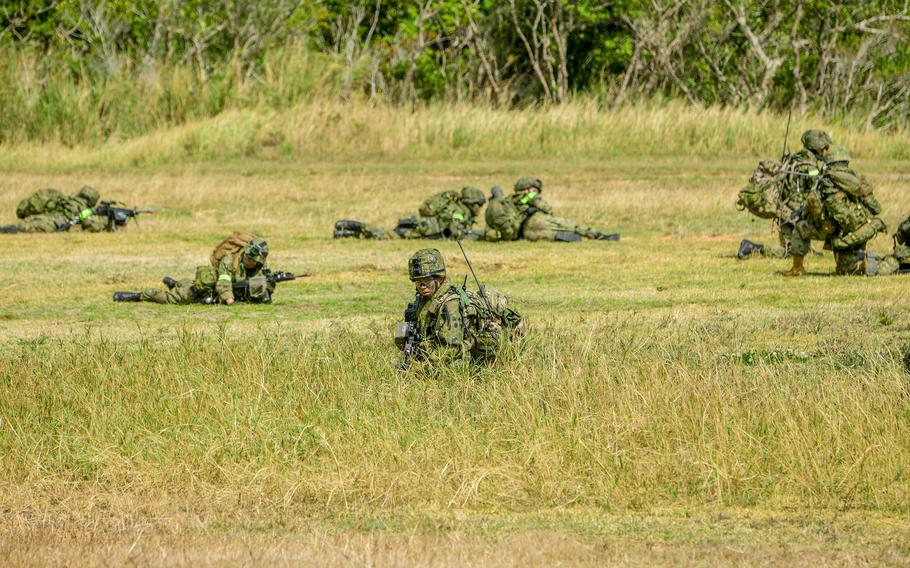
Japan Ground Self-Defense Force soldiers take positions during a landing and combat training exercise at the Central Training Area on Camp Hansen, Okinawa, on March 6, 2026. (Ryan M. Breeden/Stars and Stripes)
The Japanese army’s highest operational command will focus on remote southwestern islands near Taiwan for the first time in training that includes command-and-control drills with U.S. Marines.
The Japan Ground Self-Defense Force’s Ground Component Command will practice deploying troops and transporting supplies in the Nansei Islands from May 17 to 22, according to a Ministry of Defense news release April 24.
The Nansei chain, also called the Ryukyus, includes Okinawa and stretches from Kyushu to Taiwan. The exercise will primarily take place on Ishigaki, Yonaguni and Miyakojima.
About 300 Japanese soldiers from all regional armies will participate, a Ground Staff spokesman said by phone Tuesday.
The exercise is designed to improve deterrence and response in the region through mobile deployment and material transportation.
The command oversees Japan’s five regional armies and regularly conducts similar exercises throughout Japan, most recently in October, according to a Joint Staff news release at the time. This is the first time it will focus specifically on the Nansei Islands, the spokesman said.
The exercise will include command post training in Miyakojima city alongside 20 Marines of the 12th Marine Littoral Regiment, based on Okinawa, from May 17 to 20, according to the release.
It will be the first U.S.-Japan coordination center established on the island, the spokesman said.
Miyakojima is about 220 miles east of Taiwan and about 180 miles southwest of Okinawa.
The regiment’s Marines, assigned to Headquarters Battalion, will use “communications and command-and-control equipment necessary to establish and operate a Bilateral Communication Center,” 3rd Marine Division spokesman Capt. Kazuma Engelkemier said by email Friday.
“The command post exercise is incredibly important training,” he said. “It strengthens 12th MLR and the JGSDF’s interoperability, improving shared understanding, and enhancing the overall effectiveness of our combined partnership.”
Militaries use interoperability to describe the ability of one country to use another’s equipment and training.
Japan will deploy a Type-88 surface-to-ship guided missile launcher to Ishigaki, about 150 miles east of Taiwan, during the exercise, the release said. It will also deploy two ScanEagle II unmanned aerial vehicles to Yonaguni, Japan’s westernmost island, about 70 miles east of Taiwan. No U.S. units will be present on these islands.
Japan will use nine ports during the training to transport mostly food and water, the Ground Staff spokesman said. Along with ports on Miyakojima, Ishigaki and Yonaguni, the civilian port in Okinawa’s capital city, Naha; Muroran and Tomakomai ports in Hokkaido; Sakade port in Kagawa; Kitakyushu port in Fukuoka and Kagoshima port in Kagoshima will be used.
No ammunition will be transported during the exercise, he added.
Some Japanese government officials may speak to the press only on condition of anonymity.
Japan in recent years has sought to build up its military capabilities in the Nansei chain as it aims to counter China’s growing military presence around Taiwan and in the East China Sea.
In 2023, the Ground Self-Defense Force opened a missile base on Ishigaki that houses Type-12 surface-to-ship missiles and Type-03 air defense missiles. Japan also plans to deploy upgraded versions of the Type-03 to Camp Yonaguni during fiscal 2030, Defense Minister Shinjiro Koizumi told reporters in February.
AloJapan.com