
With more than 90 percent of its crude oil supply effectively choked off by the blockade of the Strait of Hormuz, Japan is scrambling to secure alternative oil supplies, pivoting sharply to the United States.
This strategic calculation, marked by the recent arrival of the first U.S. oil tanker, is part of a wider Asian rush for American crude that has caused transit fees through the Panama Canal to nearly triple.
The Panama Canal Authority announced on April 23 that transit fees for some vessels have skyrocketed, with the average price for a last-minute auction slot surging from $135,000–$140,000 (21.5 million-22.3 million yen) before the attacks on Iran to $385,000 in March and April.
An official revealed one tanker paid a record $4 million (approximately 640 million yen) for passage after it was forced to reroute from Europe to fuel-starved Singapore.
The number of transiting vessels has also increased from an average of 34 per day in January to 36–38 in April.
According to a report by the Financial Times, this surge includes 29 fuel-laden tankers that have changed course since the attacks on Iran, with the majority heading for Asia.
Export hubs for U.S. crude oil are concentrated along the Gulf of Mexico coast, primarily in states such as Texas and Louisiana. Tankers heading to Asia can either take a longer route through the Atlantic Ocean and around the Cape of Good Hope or the shorter route through the Panama Canal.
Although the largest oil tankers cannot transit the canal, Asian countries are so desperate to secure crude quickly that they are using smaller, costlier vessels. For these ships, the fuel savings from the shorter route can offset the high transit fees.
A PACIFIC LIFELINE
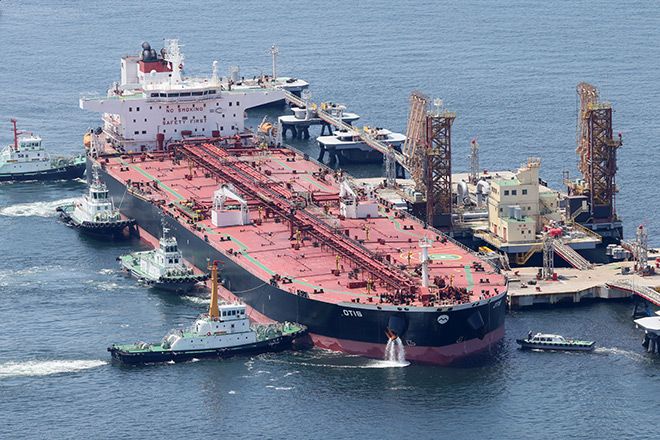
This reliance on new routes was highlighted on April 26, when the first tanker of U.S. crude procured after the Hormuz blockade arrived in Japan.
The tanker, procured by Cosmo Energy Holdings Co., delivered its precious cargo to Keiyo Sea Berth, one of Japan’s largest oil transfer facilities, in Tokyo Bay.
The shipment of 910,000 barrels—equivalent to 0.3 day of domestic consumption—was loaded in Texas on March 22 and traversed the Pacific Ocean via the Panama Canal.
The crude will be pumped through an undersea pipeline to a refinery in Chiba Prefecture to be processed into gasoline and other products.
The April 26 delivery is just the beginning. Japan’s diversification strategy is broad: while U.S. crude procurement in May is expected to be four times higher than the previous year, the government is also sourcing oil from non-Hormuz Middle Eastern sources, Central Asia, Latin America and the Asia-Pacific region.
These alternative routes accounted for more than 20 percent of last year’s import volume in April. In May, total imports are expected to reach about 60 percent of the previous year’s level, with plans to secure even more in June.
On April 23, Mexican President Claudia Sheinbaum announced that Mexico would export 1 million barrels of crude oil in response to a request from the Japanese government.
To cover the current shortfall, Japan has begun releasing its domestic oil stockpiles, which fell from eight months’ worth of consumption in March to about a seven months’ supply as of April 21.
(This article was compiled from reports written by Keitaro Fukuchi, correspondents Yuko Kawasaki and Tetsuya Kasai.)
AloJapan.com