
TOKYO – Fifteen years after one of the world’s worst nuclear disasters, one part of the Fukushima coast feels stuck in the aftermath.
Empty lots where homes once stood. Signs warning of restricted access. Convoys of construction lorries carrying radioactive dirt and materials.
And then, improbably, a tour bus.
Visitors are flowing into barely inhabited towns, attracted for the most part by the very catastrophe that drove their residents away.
The wrecked Fukushima Dai-ichi nuclear plant has become a destination for “dark tourism” – travel to sites associated with tragedy, violence or disaster, like Auschwitz, the killing fields of Cambodia, or Japan’s own Hiroshima.
In Fukushima, officials prefer to call it “hope tourism”, as the lifting of evacuation orders in surrounding municipalities has opened the way for package tours.
“There’s a very strong meaning in seeing a place where something tragic happened with your own eyes, and then forming your own thoughts,” said Mr Kotaro Toriumi, an aviation and travel analyst and part-time lecturer at Teikyo University. “It’s less about enjoyment and more about learning.”
For Tokyo Electric Power Co (TEPCO), the operator of the Fukushima Dai-ichi plant, reviving the local economy is inseparable from the long process of clean-up – and from repairing its own reputation.
Earlier in April, the company restarted commercial operations at a nuclear power plant for the first time since the disaster, after years of regulatory scrutiny and negotiations with the local authorities.
The restart is a milestone, and also a test: To keep its nuclear business alive, the company must demonstrate that it can recover from its past failures.
By far the largest of those failures became evident on March 11, 2011, when Japan’s most powerful recorded earthquake triggered a tsunami that overwhelmed the Fukushima plant.
Flooding knocked out backup generators and cut off cooling systems, leading to core meltdowns in three of the facility’s six reactors and the evacuation of more than 160,000 people.
TEPCO said in the following years that it was not prepared for an event of that scale.
Visitor numbers are now rising alongside efforts at rehabilitation.
According to TEPCO, annual visits to Fukushima Dai-ichi reached a record 20,542 in 2024.
By the standards of major tourist destinations, that figure is modest.
But in a region that spent years under evacuation orders and still has only a fraction of its former population, it is a sign of a return to life.
Tours begin with ID checks and the distribution of passes and portable radiation monitors, though protective clothing is no longer needed.
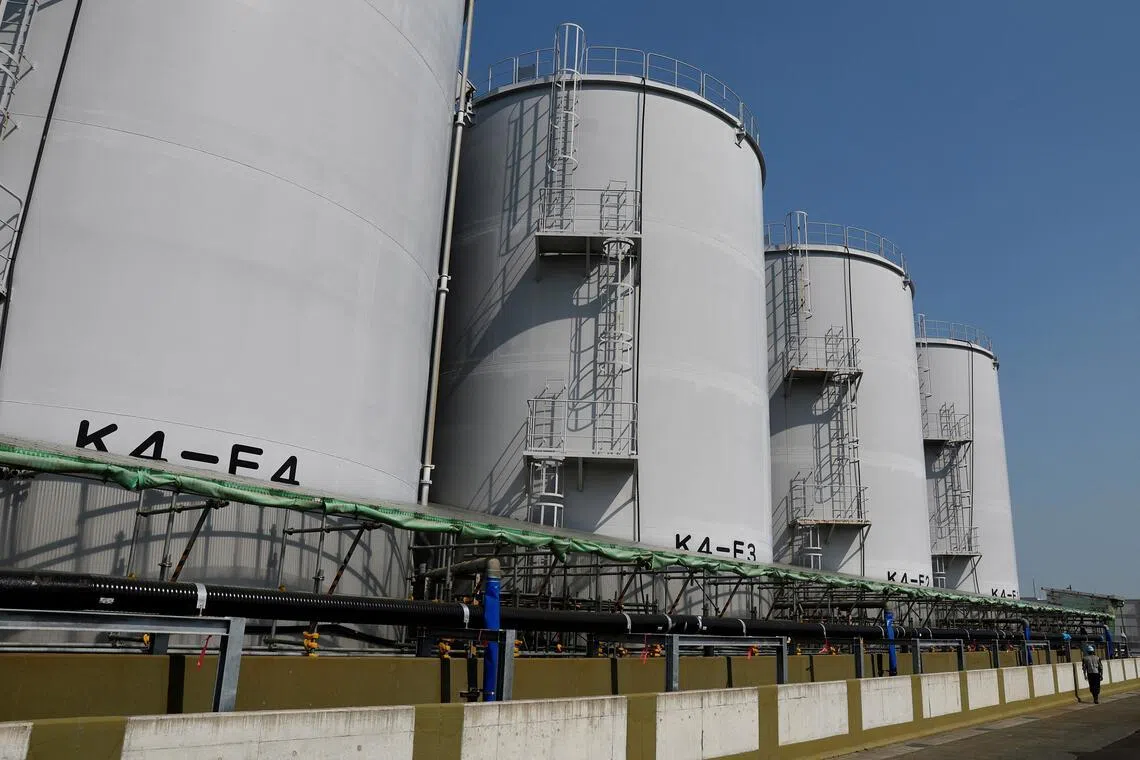
A bus carries visitors through the complex. What they see first are the hundreds of tanks full of treated radioactive water pumped from the depths of the reactors.
Then comes the “Blue Deck”, a raised observation point.
Visitors climb a short stairway to be confronted by four reactor buildings – three of them mangled by hydrogen explosions and clad in protective layers.
At the foot of the reactors, workers in white hazmat suits press ahead with the clean-up.
“It’s huge,” said Mr Kyoko Takahashi, 62, from the northern prefecture of Iwate, after taking in the view, adding that he grasped the scale of the decommissioning project only after seeing the reactors for himself.
The decommissioning process, which includes removing 880 tonnes of melted nuclear fuel, will cost hundreds of billions of dollars and is expected to last until the middle of this century.
There still is no long-term plan for disposing of the waste from the facility.
Radiation readings, meanwhile, tick higher outdoors than inside the bus, but the levels are still considered safe.
Tourism to the 12 municipalities surrounding the Fukushima plant returned to pre-disaster levels in 2024, and is thought to have continued to climb in 2025.
That stands in stark contrast to the pace of resettlement, with some areas still classified as uninhabitable.
It is a unique opportunity for those who want to visit the site of a nuclear disaster.
Chernobyl has been inaccessible since Russia’s invasion of Ukraine, while Three Mile Island in Pennsylvania is also closed to tours.
Yet this part of Japan was not previously a tourist destination and has relatively few attractions unrelated to the disaster, presenting challenges for broader tourism development.
The newly constructed Fukushima March 11 Memorial Park covers an area roughly equivalent to Tokyo Disneyland and encompasses the remains of a community abandoned after the disaster, as well as dedicated areas for reflection and the laying of flowers.
Not far away is the ruined Ukedo Elementary School.
A 98-room hotel operated by a subsidiary of Daiwa House Industry and boasting an open-air bath overlooking the ocean is set to open in the town of Futaba in June.
Mr Katsumi Saeki, 60, who retired from Japanese travel agency JTB in 2025, started a company running tours that includes a visit to Fukushima Dai-ichi for corporate clients, charging 50,000 yen (S$400) for a two-night trip.
He believes Fukushima prefecture has the potential to become comparable to Hiroshima as a destination for learning and reflection.
“People are often surprised to find out you can go inside,” he said. BLOOMBERG
AloJapan.com