
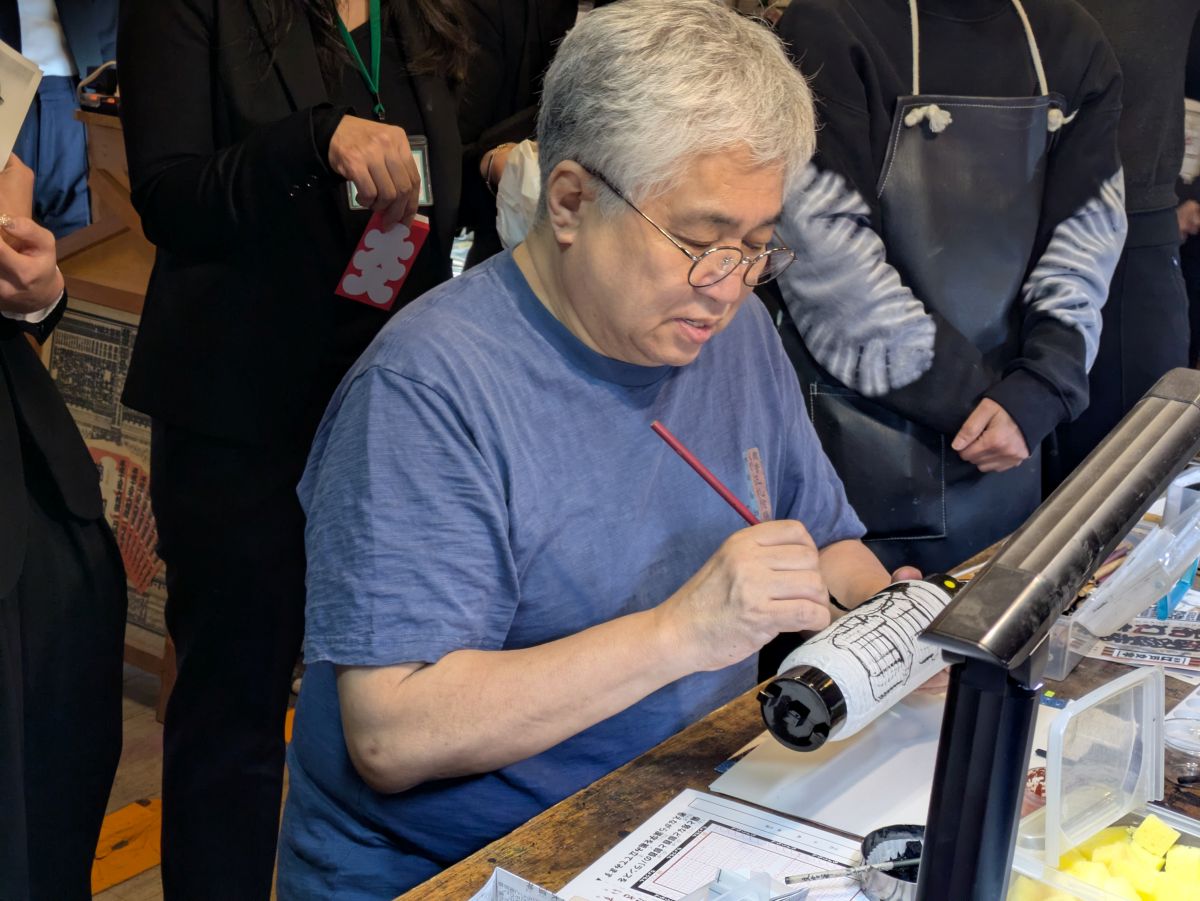
People can be strangely passionate about the order of the two strokes in a capital T. I can never remember which is supposed to be correct. But beyond penmanship, how often does anyone speak about English lettering as something alive, meaningful, or worth thinking deeply about?
For the Japanese people of the Edo period (1600-1868), however, the kanji characters of the Japanese alphabet were vessels to express their wishes, stories, and prayers.
At Atelier Sougeikan, a small calligraphy workshop in Tokyo’s Sumida Ward near Tokyo Skytree run by the amiable Tomohiro Oishi, that magical world of writing still endures. Step inside and you find colorful lanterns and folding fans densely covered with thick, dramatic characters—letters that seem to push outward, beckon people in, and carry a force beyond their literal meaning.
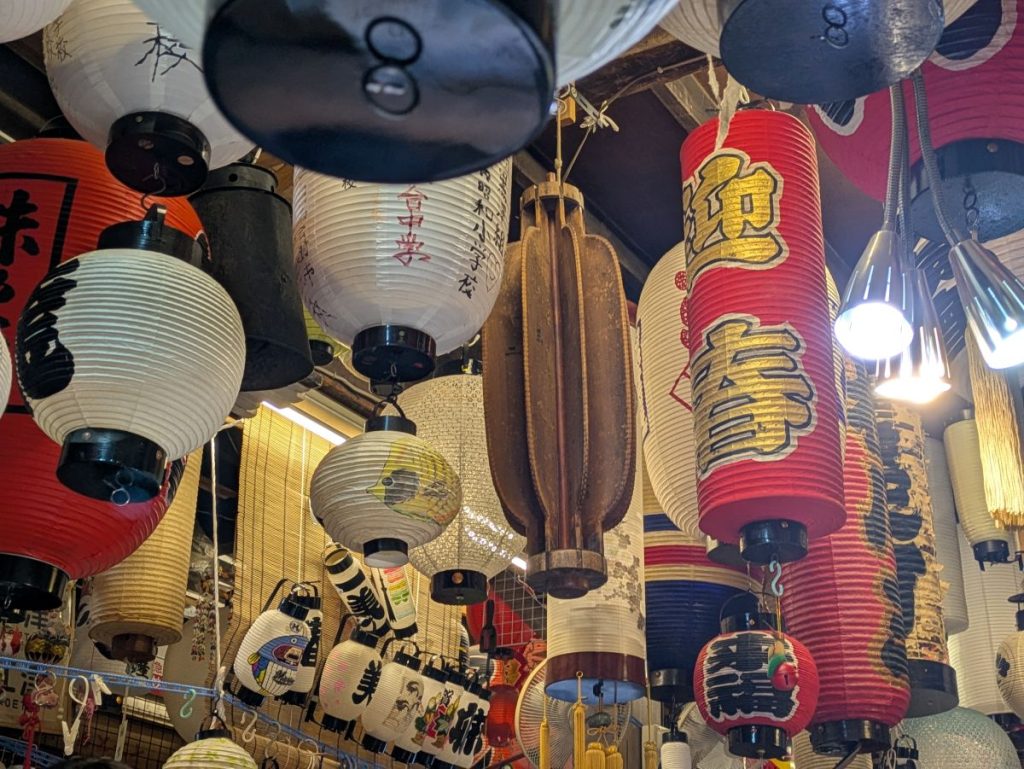 Lanterns inside the workshop. (©Japan Forward)
Here, visitors do not simply learn how to paint beautiful calligraphy. They are introduced to Edomoji, the bold decorative lettering of old Edo. The shape and style of letters—not just the words they form—could persuade, entice, and even invoke blessings.
As Oishi explains, Edo lettering was created by commoners, not by the warrior elite who prescribed formal scripts.
“Because many people in Edo had little or no schooling, those designing signs and lettering had to assume that not everyone could read,” Oishi says. “The townspeople of Edo created Edomoji with a rebellious spirit, while also pouring into it wishes for business prosperity and good fortune,” he says.
Here, that “rebellious spirit” refers less to politics than to the creative defiance of Edo commoners, who turned writing into something bold, theatrical, and distinctly their own.
These characters were designed for signboards, lanterns, playbills, and rankings—for kabuki theaters, entertainment venues, and sumo tournaments—and they carried the hopes of the people who used them.
Inside the Workshop
During the roughly two-hour experience, participants choose either a lantern or a fan and write a character of their choice in Edo style. After Oishi demonstrates the tools and basic brush handling, you practice several times on worksheets before writing your chosen character on the lantern or fan itself.
There is a list of popular, relatively easy characters to choose from, but Oishi is more than happy to indulge braver visitors who want to attempt something more ambitious. And if the results go a little sideways, he is usually able to rescue even the most wayward efforts.
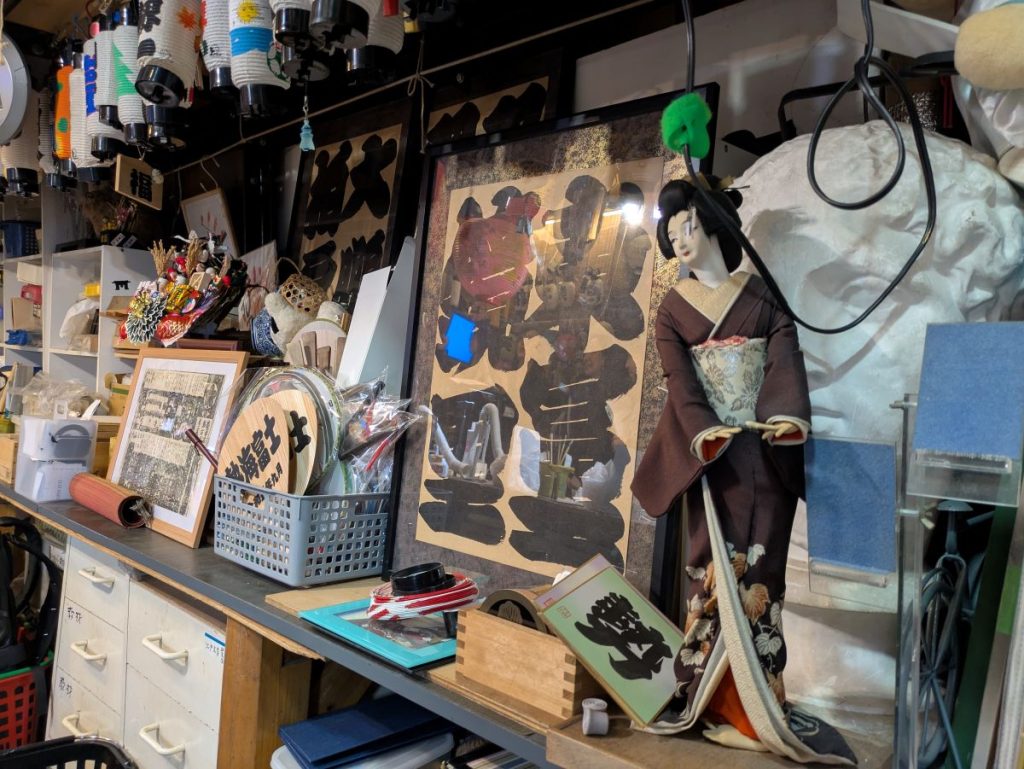 A corner of the workshop. (©Japan Forward)
Groups of up to 35 can be accommodated, and the workshop is especially popular with school trips and overseas visitors. The fee is ¥4,620 (about $29) for a lantern or ¥4,620 to ¥4,730 for a fan ($29-30). Participants are advised to wear clothes they do not mind getting paint on, though aprons and other items are also provided.
How Edo Lettering Pulled People In
A particular highlight of the workshop is Oishi’s spirited introduction to the stories behind the many styles of Edo lettering. Among the many types of lettering, the best known are kabuki lettering (Kanteiryu) and sumo lettering (Negishiryu).
Kanteiryu was devised in 1789 by Okazakiya Kanroku at the request of the Nakamura-za, one of Edo’s leading kabuki theaters.
But as Oishi explains, its unusual forms were not merely ornamental. Some lines were drawn inward to suggest people entering from outside, while enclosed forms acted almost like a lid, keeping the audience from slipping away. Strokes that might normally flick outward, meanwhile, were stopped short, because such a flourish could suggest “goodbye.” Even the upward lift of a stroke expressed the hope that the performance would keep building and improving.
Kanteiryu, in other words, was designed not just to be read, but to draw in a crowd and hold its attention.
Negishiryu appeared on grand sumo ranking sheets and promotional posters. It resembles Kanteiryu, but is even more elongated and linear, with almost no empty space.
As Oishi explains, the compressed style “reflects the auspicious wish that the venue will be packed wall to wall with spectators.” Some also say it evokes wrestlers straining against one another in the ring. Since the Edo period, the style has been passed down continuously within the sumo association, with gyoji referees teaching their juniors the art of hand lettering.
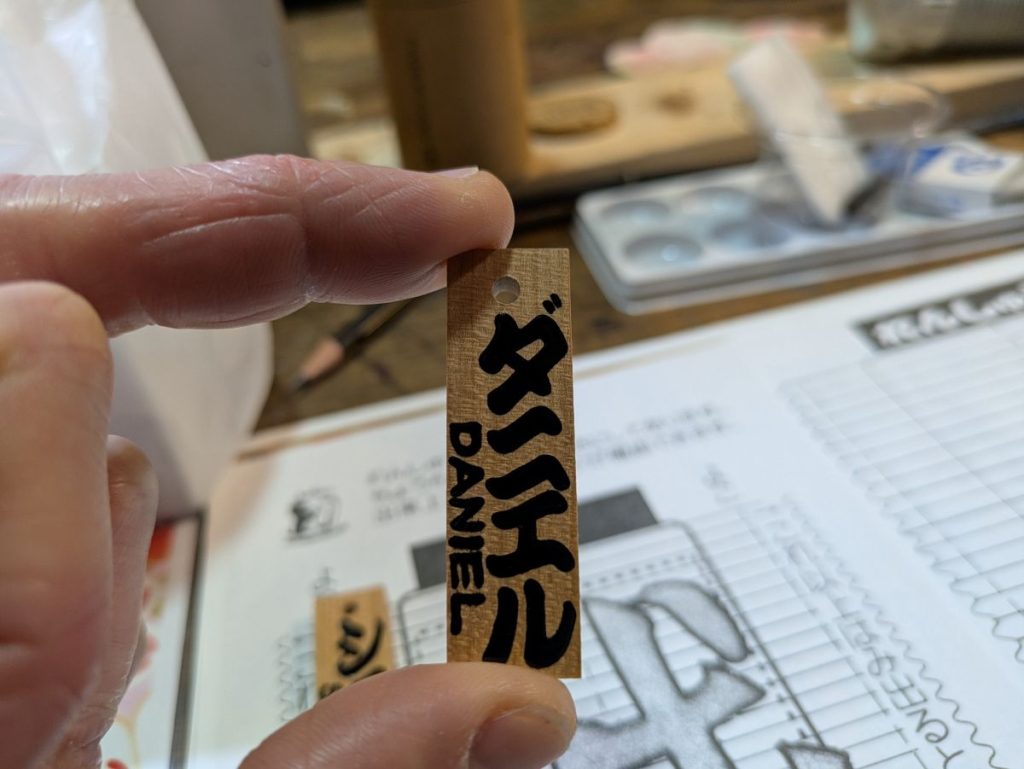 Are you feeling enticed? (©Japan Forward)

Embodying Values
But the significance of Edo lettering did not end with commerce or spectacle. It also points to a broader belief that a character’s very form can carry human values.
In one traditional reading of the kanji for hayashi, or “woods,” one of the two “trees” slightly gives way to the other so both can fit comfortably within the square. The idea is that even a character’s shape can reflect consideration for others. Writing, in that sense, was once more than a tool for communication; it was also a way of cultivating thoughtfulness.
“Writing characters was once a natural way for Japanese people to learn consideration for others,” Oishi says. “Now, unfortunately, it’s all phones and typing.”
What Atelier Sougeikan offers, then, is not just a brush with the past, but a rare chance to recover a slower, more attentive way of seeing. In the quiet stillness of the workshop, broken only by the soft glide of brush against lantern, you begin to forget the hours of writing you received as punishment at school.
RELATED:
Author: Daniel Manning
Continue Reading
AloJapan.com