
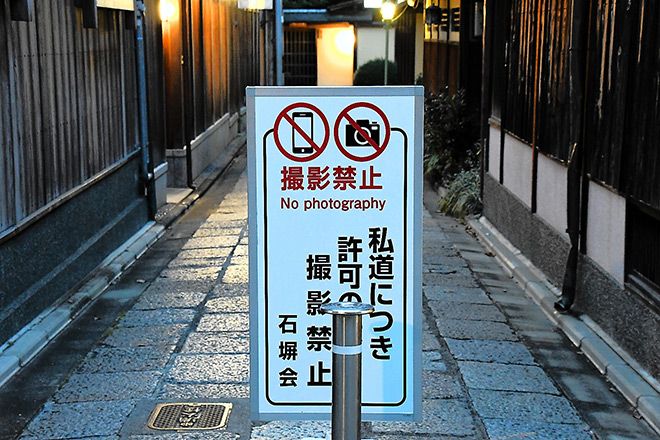
Koin Aoyama just wanted the man to move.
The 41-year-old head priest of Kodaiji Korinin temple in Kyoto’s Higashiyama Ward noticed a parked car blocking the road to the temple and asked the man inside to relocate to a nearby parking lot.
The man responded by shouting in Japanese, “I’m not an illegal taxi driver! I’ll kill you!”
According to Aoyama, the man looked Asian and his Japanese was not that of a native speaker.
While Aoyama speaks English thanks to two years studying abroad in the United States and enjoys interacting with others regardless of nationality, not every experience is pleasant.
Previously, some overseas tourists who entered temples not open to the public gave him the middle finger after being told the area was off limits.
The buildup of abrasive encounters like this had already exhausted Aoyama’s patience by the time the man screamed at him.
Unable to remain silent, he posted about the experience on X, formerly Twitter, using the temple’s account.
His recap ended with the words, “I’m sorry, but it is impossible to coexist.”
His February 2025 post immediately went viral.
Despite Aoyama not knowing or mentioning the man’s nationality, critical comments began to appear.
These included sentiments such as, “People from that country say such things?” and “We should demand a ban on entry for people from that country.”
“This may end up fueling xenophobia,” Aoyama thought.
Now feeling a sense of crisis, he clarified his intent four days later on X, writing, “That post wasn’t intended to call for hatred against a specific country or race. I meant that it may be impossible to coexist with those who lack respect and consideration for the land, culture, people, language or way of life.”
WAVE OF XENOPHOBIA
Along with the record 42.68 million inbound tourists who landed in Japan in 2025 comes the stickier issue of increased social media ire against foreigners as the government aims to increase the figure to 60 million by 2030.
The Asahi Shimbun broke down how far the head priest’s first post spread by using a pool of about 40,000 posts responding to the temple’s account within the first week.
Demographics were found using User Local Inc.’s Social Insight tool, a social media analysis and management tool.
Tokyo yielded 24.6 percent of responses, followed by 9.8 percent from Osaka Prefecture, 8.9 percent from Kanagawa Prefecture and 4.3 percent from Kyoto Prefecture.
Also, when reporters analyzed comments on Aoyama’s first post over the year, the most common word that appeared was a specific nationality. Other frequently used words such as “police,” “report (to authorities)” and “annoying” followed.
Masaaki Ito, a professor at Seikei University who specializes in media sociology, said, “Local residents who experience problems caused by inbound tourism sometimes voice their frustrations on social media. Those posts are then egged on by people outside the affected area, spreading as a wave of xenophobia.”
He attributes cherry-picking, a commonly used social media tactic, as one factor behind the phenomenon.
Cherry-picking refers to the practice of singling out a small number of damaged cherries from a full tree and presenting them as if they represent the wholee.
Ito said, “As the weak yen continues, exclusionary sentiments toward foreign tourists, who may appear wealthy and powerful, are becoming more likely to intensify, even among people who have not actually suffered any harm.”
Daisuke Abe, a professor at Ryukoku University who has expertise in urban planning, said to prevent the spread of xenophobic rhetoric, “It is important to ensure that local residents feel tourism in their area is indispensable and that its benefits are returned to them.”
He added that this could involve, for example, using revenue from sources like accommodation taxes to improve public spaces such as parks and plazas, as well as transportation infrastructure.
“Reinvesting in the community in visible ways, as shared assets that hold value for both residents and tourists, is the key to coexistence,” Abe said.
(This article was written by Akina Nishi and Haruka Ono.)
AloJapan.com