
この投稿を日本語で読む(Googleによる自動翻訳)には、こちらをクリックしてください。
Can you help? We are working to make earthquake science accessible to the public, but this effort is entirely supported by readers like you. If you can, please consider supporting our work by upgrading to a paid subscription. If you use our Substack as part of a group, or for teaching, consider a teaching or institutional subscription. Every paid subscription makes a real difference — and unlocks access to the more than three hundred posts in our archive!
At 4:52 PM local time on April 20th, 2026, a magnitude 7.4 earthquake struck off the coast of northern Japan. Shaking was reported felt across almost the entire country, with strongest values locally reaching JMA intensity 5+. JMA intensity 5 can be strong enough to make people feel unstable and cause unsecured furniture to move or fall. On the chart below, we have included a “translation” from JMA shaking intensities to matching MMI intensities, which are how the USGS reports shaking. We are not aware of any reports of damages.
As expected when a large subduction earthquake occurs offshore Japan, a tsunami warning was issued. In some regions, the tsunami waves were anticipated around the same time as high tide, exacerbating the potential for flooding. Fortunately, although the initial warnings indicated that waves up to 3 meters were possible, the actual waves heights recorded at coastal stations were less than 1 meter. The highest wave shown on the map below was 0.8 meters at Kujiko. You can explore the tsunami warning system over time, provided by the Japan Meteorological Agency, here; the figure below shows three snapshots, with the first just three minutes after the earthquake.
 Figure 2: Three snapshots of the tsunami warning issued by JMA: (top) 3 minutes after the earthquake, (middle) 32 minutes after the earthquake, and (bottom) 43 minutes after the earthquake. The yellow and blue bars on the bottom image show actual wave heights below 1 meter. At the original website, each bar can be clicked to see the local measured value.
As has also become fairly standard following large subduction earthquakes in Japan, the JMA issued a megaquake advisory. A megaquake advisory is essentially a statement recognizing the scientific fact that when a large earthquake occurs on a megathrust, there is an elevated risk that a larger earthquake might soon be triggered. The system of advisories was put in place in 2019, and the first megaquake advisory was issued in 2024. The advisory issued in response to this recent earthquake is the fourth thus far.
Over time, the text surrounding these advisories has evolved toward providing more specific statistics. The group in charge of issuing the advisories is surely wrestling with the fact that an elevated risk is not the same as a high risk, and the difference can be hard to communicate. Currently, the JMA is saying that the chance of a M8+ earthquake is about ten times higher than usual — putting it around 1% over the next week, above the background 0.1%. The probability of a large earthquake is always objectively low over a short time period, even in seismically active areas.
In essence, this is pretty similar to the aftershock forecasts that the USGS sometimes puts out following earthquakes. There is no USGS forecast in this case, because the USGS has different arrangements with different countries. However, when these forecasts exist, they will show a high likelihood of smaller aftershocks occurring, and a low (but present) probability of a large event occurring, including the possibility of a triggered earthquake larger than the original event. The Japanese megaquake advisory system focuses exclusively on those larger events, without expressing those other probabilities of smaller events.
With four Japanese megaquake advisories under our collective belt since 2024, we have seen zero Japanese megaquakes over that same time period — as expected.
If it feels like you were just reading about earthquakes offshore Japan, there’s a reason for that: it’s been less than a month since we wrote about this area offshore Honshu. That last post addressed a magnitude 6.5 earthquake on March 26th. In it, we commented that we had already written about two large earthquakes in the six months prior: a M6.8 on November 9th, 2025, and a M7.6 on December 8th, 2025. (Those latter two events were two of the earthquakes that led to megaquake advisories.)
Well, we can now add this latest M7.4 to the list. All of these earthquakes are associated with the great subduction zone that underlies northern Japan, where the Pacific Plate is sinking westward beneath the country. Plotting the entire JMA earthquake catalog in this area is interesting: there are around 660,000 events in this map region:
 Figure 3: Seismicity reported by the JMA, colored by depth, with a cross-section across the subduction zone.
This is a beautiful profile that shows off a few important features of the subduction zone: a classic double Wadati-Benioff zone, a region of intense crustal deformation in the forearc (between the coast and the trench), and a locus of shallow earthquakes just outboard of the French, where the slab breaks in tension as it begins to bend downward.
Let’s take a look at how the recent large earthquakes fit into the great mosaic of Japan Trench ruptures. The M6.8 in November was part of a complex sequence, with a week of foreshocks that cascaded upward to the mainshock. That mainshock was located far offshore, near the trench, initiating at a shallow depth of 18 kilometers. It was followed in March 2026 by a M6.5 earthquake, an unusually large, delayed aftershock for an earthquake of its size.
In contrast, the M7.6 in December occurred ~200 kilometers to the northwest, near the Shimokita Peninsula. It had no known foreshocks, and at ~41 kilometers depth, reflecting the geometry of the west-dipping slab interface. The mainshock was followed by two large aftershocks above M6.5 (M6.6, M6.7) in the days afterwards, within the expected range for a M7.6. Note that a M7.6 earthquake releases about 16 times as much energy as a M6.8, so this really was much larger than the earthquake in November.
The recent M7.4 occurred between the two previous clusters: in space, in magnitude, in depth (35 kilometers).
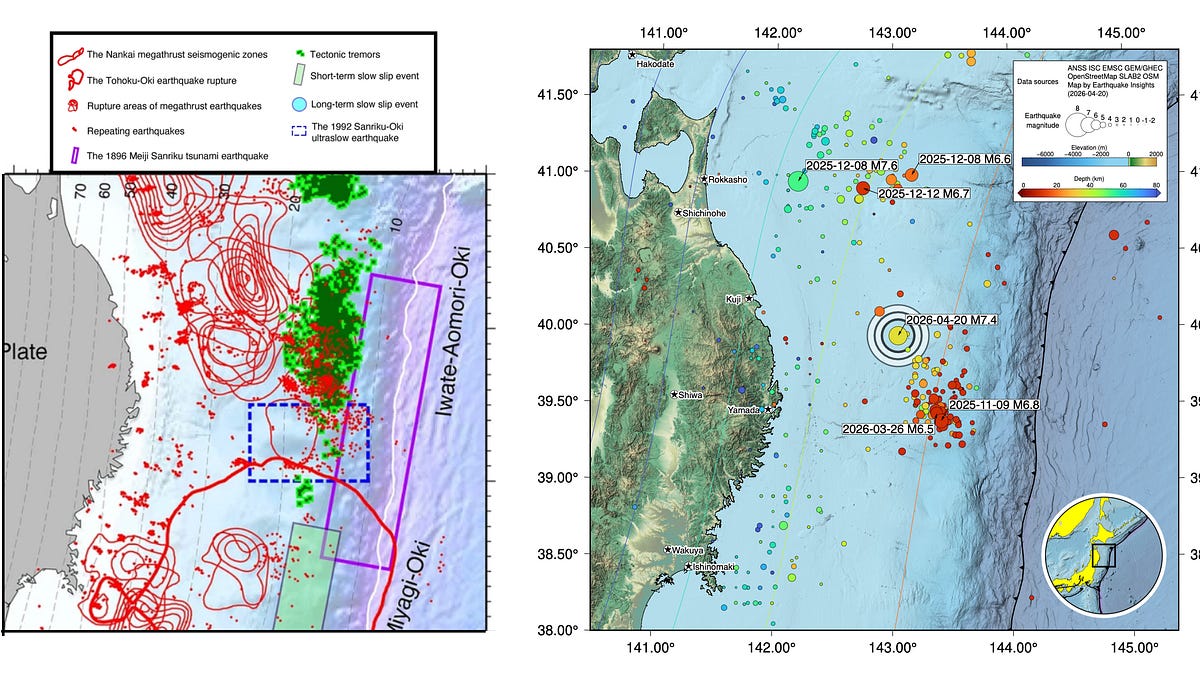
 Figure 4: Earthquakes since 2026-06-01 offshore northern Japan, colored by depth. Colored lines are 20-km depth contours of the subduction interface from Slab2.0. The recent M7.4 earthquake is highlighted with a bull’s-eye. Events above M6.5 are labelled. This map does not include the JMA catalog and is also a shorter time period — that’s why it looks sparser than the map above.
The Japan Trench has been extensively studied — in part because this is the subduction zone that produced the deadly 2011 M9.1 Tohoku-Oki earthquake. Using instruments both onshore and offshore, Japanese (and many international) scientists have developed a detailed record of not just earthquakes, but also more complex fault behavior, including various seismic signals like repeating earthquakes, tectonic tremor, very-low-frequency earthquakes (VLFEs), and slow slip events (when the fault slides, but too slowly to radiate elastic waves). These phenomena are clues to how the megathrust behaves and evolves during the long time intervals separating large earthquakes.
Put simply, these gentler fault phenomena are all thought to have a similar origin: slow movement along the subduction fault. The tectonic tremors are thought to arise from slow sliding of the shallow plate interface, causing weak and long-lived seismic signals from many small sources. VLFEs are a bit more like earthquakes – they represent a coherent slip of a large section of fault, just too slowly to be sensed as earthquakes. Repeating earthquakes probably represent little stuck patches of fault that rupture over and over as the surrounding area of fault slides more freely. Here is a map showing some of this information, published in 2023 in a review paper by Nishikawa et al.:
 Figure 5: The plethora of earthquake behaviors observed along the Japan Trench. Figure 1b of Nishikawa et al. (2023).
The red contours on the left-hand map show rupture regions of previous large earthquakes. Most of these ruptures occurred between 20-50 kilometers depth.
The Mw9.1 Tohoku-Oki earthquake stands out due to its huge rupture area that extended all the way up to the trench, which explains why (in combination with very slip) that earthquake produced such a large tsunami. Because the 2011 earthquake was so large, with so much slip, we could certainly expect that the stresses acting on this part of the subduction zone were strongly impacted by the slip in 2011, even outside the main slip area.
You can also see that the light green and dark green patches marking regions of tectonic tremor are located to the east of these historic rupture zones — the tremor emanates from the shallower part of the megathrust.
How do these features match up (or not) with the recent earthquakes? Let’s line that map up with our map of recent events:
 Figure 6: Comparison of Figures 4 and 5.
First, let’s look at the November sequence — that complex, cascade-up earthquake sequence that produced a M6.8 earthquake. These earthquakes all occurred just north of the Tohoku-Oki earthquake rupture patch. The sequence also overlaps with the blue dashed rectangle, which represents the approximate area of the 1992 Sanriku-Oki ultraslow earthquake.
The 1992 earthquake is itself quite interesting. The sequence began with a M6.9 earthquake on July 18, 1992, which was followed by slower slip over the course of about a day that ultimately added up to a M7.3-7.7 event: the first interplate “ultra-slow” earthquake ever clearly documented. In 1992, modern technologies like GPS were in their infancy, and the measurement of this slow earthquake was instead performed with quartz-tube extensometers: sets of 30 meter long quartz tubes oriented in different directions, installed in fairly creepy, dark, and deep tunnels. Like doing science in the Mines of Moria.
 Figure 7: Picture of and measurements from the Esashi Earth Tides Station, used to measure strain.
One end of each long rod is affixed to the bedrock while the other end floats freely near a pedestal, itself fixed to the bedrock. A tiny strain of the crust is revealed by measuring the displacement of the free end of the quartz rod versus the pedestal. Basically, the quartz rod is used as a perfect ruler to measure the length change of the surrounding Earth’s crust.
Three such meters, arranged appropriately, give a sensitive horizontal strain measurement. While these devices were originally invented to measure crustal strains due to Earth and ocean tides, and atmospheric/hydrological loads, it was eventually noticed that strains from large earthquakes could also be measured. By removing the tidal and environmental signals, the earthquake-related strains could be isolated — both the permanent strain, and even the transient strains due to low-frequency seismic waves. Thus, in 1992 the system was already fortuitously in place to record an event that to this day is extremely rare: a small earthquake with a proportionally huge component of subsequent slow slip.
Since then, other gentle earthquake sources have been measured in the area of the 1992 earthquake, including repeating earthquakes and tectonic tremors. Combined with the interesting “cascade-up” behavior observed in November, and the large late aftershock, there seems to be a lot going on in this area!
In contrast, the M7.6 in December 2025 and the latest M7.4 were sourced from regions with more standard stick-slip behavior over the observational period.
What does that all tell us? Unfortunately, there aren’t a lot of conclusions that we can draw about future behavior from these patterns, however fascinating they might be. Tectonic tremor, slow slip events, and other phenomena are quite interesting because they are a constant source of information. This stands in contrast with the large ruptures that are sudden, short-lived, and ultimately quite rare. However, we still don’t have a very clear idea of what the constant buzz and hum of a megathrust can reliably tell us about future large earthquakes.
That leaves us in a situation where we can monitor and detect lots of things in subduction zones, but not use them to say anything definitive about hazard. One prominent example is the Cascadia subduction zone, offshore Oregon and Washington. We know that this subduction zone pops off a megaquake (M8-9) every now and then, most recently in the year 1700 CE. We also know that this subduction zone has a strange dichotomy of few significant earthquakes, combined with lots of very interesting slow slip and tremor. And yet, we do not yet know whether that slow slip and tremor can tell us anything useful about time-dependent risk. And since large earthquakes are (fortunately) rare, we can only accumulate knowledge about their patterns slowly and sporadically, trying to make sense of faults in different parts of the world, under different stresses, and with different geology.
Bradley, K., Hubbard, J., 2024. M7.1 earthquake strikes southern Japan; megaquake advisory issued. Earthquake Insights, https://doi.org/10.62481/cea4a692
Bradley, K., Hubbard, J., 2025. M7.6 earthquake strikes offshore Honshu, Japan. Earthquake Insights, https://doi.org/10.62481/85f72316
Hubbard, J. and Bradley, K., 2026. M6.5 subduction earthquake rattles northern Honshu, Japan. Earthquake Insights, https://earthquakeinsights.substack.com/p/m65-subduction-earthquake-rattles
Hubbard, J. and Bradley, K., 2025. M6.8 earthquake offshore Japan preceded by upward cascade of foreshocks. Earthquake Insights, https://doi.org/10.62481/d6ad8513
Kawasaki, I., Asai, Y., Tamura, Y., Sagiya, T., Mikami, N., Okada, Y., Sakata, M. and Kasahara, M., 1995. The 1992 Sanriku-oki, Japan, ultra-slow earthquake. Journal of Physics of the Earth, 43(2), pp.105-116. https://doi.org/10.4294/jpe1952.43.105
Nishikawa, T., Ide, S. and Nishimura, T., 2023. A review on slow earthquakes in the Japan Trench. Progress in Earth and Planetary Science, 10(1), pp.1-51. https://doi.org/10.1186/s40645-022-00528-w
Wald, D.J., 2020. Practical limitations of earthquake early warning. Earthquake Spectra, 36(3), pp.1412-1447. https://doi.org/10.1177/8755293020911388
AloJapan.com