
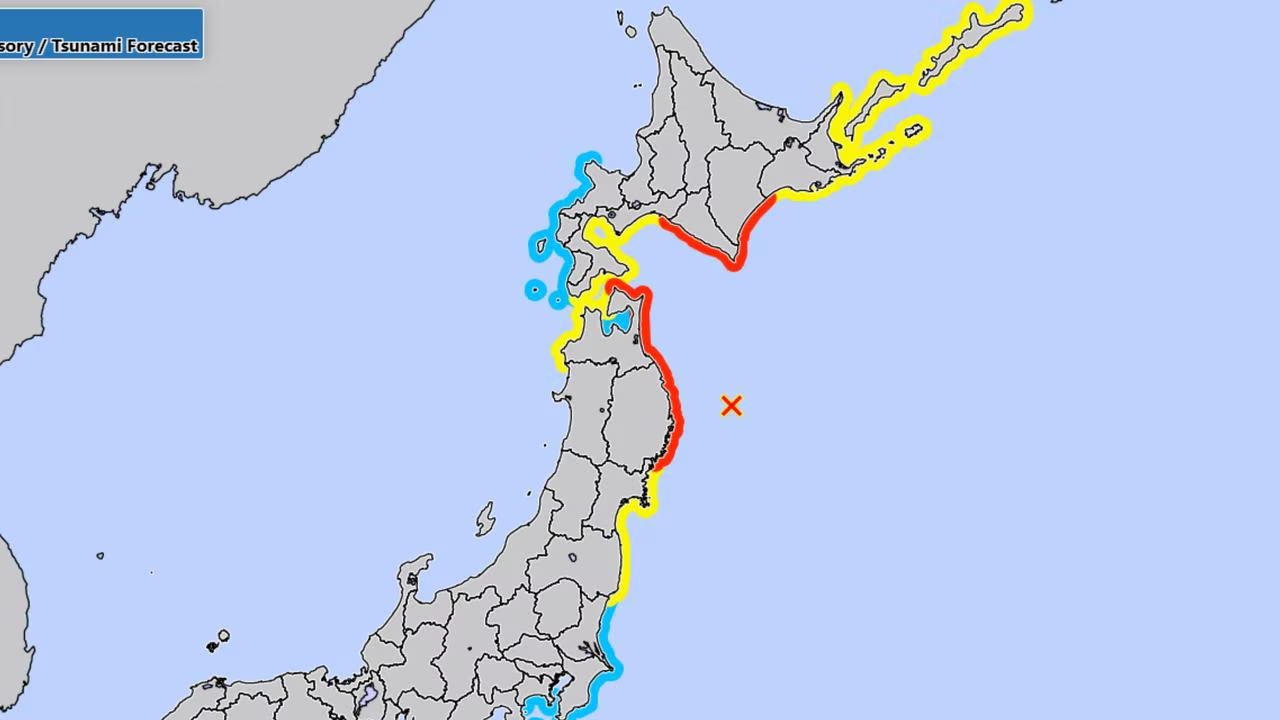
Japan is bracing for a “potential mega-quake” after a 7.7 magnitude earthquake rocked the country on Monday.
The Japan Meteorological Agency (JMA) advised that the country is at increased risk for a mega-quake along two sea trenches in the Pacific Ocean, according to local broadcaster NHK.
The 9.0 magnitude earthquake that hit the island nation in 2011 was a mega-quake – it caused a nuclear meltdown and killed around 20,000 people.
Earlier on Monday, the JMA forecast that tsunami waves of up to 3m may reach the Pacific coast of Hokkaido and Iwate prefectures. These warnings have since been downgraded but residents are being advised to stay inland until all warnings have lifted.
A tsunami of under 1m was recorded as the first waves hit Kuji. Smaller waves also barrelled into Miyako, Hachinohe, and Urakawa.
About 100 homes are without power and a number of bullet train services in the country’s northeast have been put on hold.
Japan’s Prime Minister Sanae Takichi said that “human and material damage” had been reported. She added that the government is trying to confirm if there have been any casualties.
The PM also advised residents to carry emergency supplies for a week to “maintain readiness” in case a mega-quake hits.
A resident in Hokkaido told the BBC that authorities are using loudspeakers to warn the public.
“Right now, local authorities are using loudspeakers in the neighbourhood to warn people about a possible tsunami and to stay alert,” they said, “Office workers have been allowed to leave work early.”
Tsunami warnings have been issued for Iwate prefecture, the central part of the Pacific coast for Hokkaido, and the Pacific coast of Aomori Prefecture.
A total of 128,471 people in 12 cities and towns have been warned to evacuate.
In a statement the JMA said: “Evacuate immediately from coastal regions and riverside areas to a safer place such as high ground or an evacuation building.
“Tsunami waves are expected to hit repeatedly. Do not leave safe ground until the warning is lifted.”
Advisories have been issued for other parts of the Pacific coast of Hokkaido and Aomori prefectures, as well as the Miyagi and Fukushima prefectures.
The JMA has also warned that further earthquakes of a similar scale could strike the country in the next week.
‘Upper 5’ quake
The tsunami comes after a quake measuring an ‘upper 5’ on Japan’s seismic intensity scale hit off the coast of Sanriku at 4.52pm local time. It was initially recorded as 7.4 magnitude but was later revised to a 7.7.
Authorities are checking the Onagawa nuclear power plant for any abnormalities following the earthquake.
Hokkaido is popular among Australians for skiing. Qantas’ direct flights to its capital Sapporo wrapped up for the season at the end of March, but tourists can still fly there via connecting services in Tokyo.
Top destination for Aussie tourists
Japan is a top destination for Australian travellers.
The country overtook Indonesia for the first time in official figures last week that show where Australians are travelling.
The Australian Bureau of Statistics latest overseas arrivals and departures data found Australian travellers’ most popular overseas destinations in February were New Zealand, Japan and then Indonesia – home to the wildly popular island Bali.
There were 113,460 Aussie residents who returned from short trips across the Tasman, 103,360 who were back from visiting “The Land of the Rising Sun”, and 101,630 who touched down from Indonesia.
The Australian dollar hit a 40‑year high against the yen in February.
On travel industry rankings Japan was expected to be the most popular spot for international travel this April as Aussies caught the end of the snow season. The famous cherry blossom season is also in full swing.
Japan took the top spot on Booking.com and Expedia’s most popular rankings this Easter, followed by Indonesia and Singapore.
Japan’s own official figures revealed a new record for Australian travellers in 2025, with 1,058,300 visiting, an increase of 15 per cent on 2024.
It was the first time more than one million Aussies visited the country in a calendar year.
More to follow.
– with The Sun
AloJapan.com