
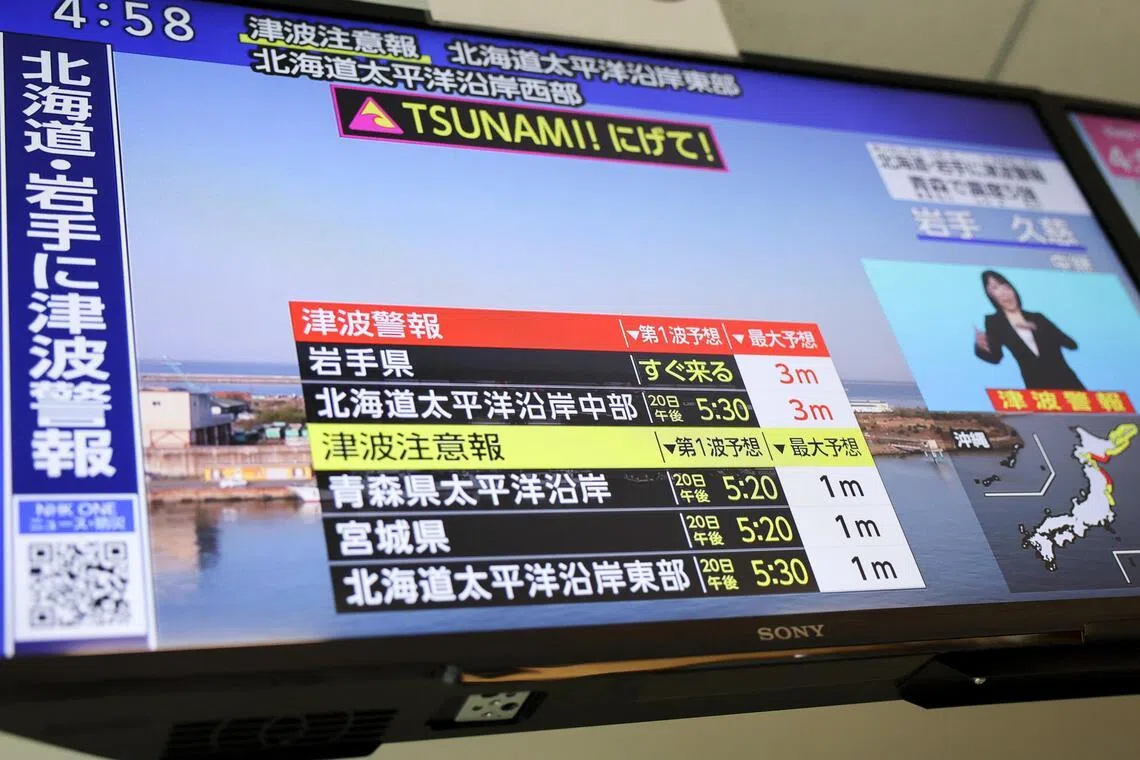
TOKYO – An earthquake with a preliminary magnitude of 7.4 struck off the northeastern coast of Japan on the afternoon of April 20, the Japan Meteorological Agency (JMA) said.
The quake hit at 4.53pm (3.53pm, Singapore time) in Pacific waters off northern Iwate prefecture and the tremor was strong enough to shake large buildings as far as Tokyo, hundreds of kilometres away.
The JMA warned of a tsunami as high as 3m in Iwate prefecture and parts of Hokkaido.
The earliest tsunami waves could reach the northern shoreline immediately, the weather agency said.
“Evacuate immediately from coastal regions and riverside areas to a safer place such as high ground or an evacuation building,” it said, warning that damage due to tsunami waves was expected.
“Tsunami waves are expected to hit repeatedly. Do not leave safe ground until the warning is lifted.”
An 80cm wave was observed at 5.34pm at a port in Kuji, Iwate, the JMA said. It previously said a 70cm wave had struck at 5.32pm.
The tremor had an epicentre in the Pacific Ocean and was 10km deep, according to the JMA.
Bullet train services in Aomori at the northern tip of Japan’s main Honshu island were halted due to the tremors, Kyodo news agency reported.
Footage from national broadcaster NHK did not show any immediate visible damage around several ports in Iwate.
The prime minister’s office said it had set up a crisis management team.
“For those of you who live in areas for which the warnings have been issued, please evacuate to higher, safer places such as higher ground,” Prime Minister Sanae Takaichi told reporters, adding that the government was trying to confirm whether there were any casualties or property damage.

Japan’s Prime Minister Sanae Takaichi speaks to media after Japan Meteorological Agency issued a tsunami warning at her official residence in Tokyo, Japan, on April 20.
PHOTO: REUTERS
There are no nuclear power plants currently in operation in Hokkaido and Tohoku regions but Hokkaido Electric Power and Tohoku Electric Power have a number of shutdown nuclear power plants there.
Tohoku Electric said it was checking the impact of the earthquake and tsunami on its Onagawa nuclear power plant.
The Singapore Embassy in Tokyo advised Singaporeans to monitor local conditions closely and refer to the JMA website and NHK News for the latest updates, as well as for warnings and advisories.
Japan is one of the world’s most seismically active countries, sitting on top of four major tectonic plates along the western edge of the Pacific “Ring of Fire”.
The archipelago, home to around 125 million people, typically experiences around 1,500 jolts every year and accounts for about 18 per cent of the world’s earthquakes.
The vast majority are mild, although the damage they cause varies according to their location and the depth below the Earth’s surface at which they strike.
In 2011, a magnitude-9 quake triggered a tsunami that left 18,500 people dead or missing and caused a devastating meltdown at the Fukushima nuclear plant. REUTERS, AFP
AloJapan.com