
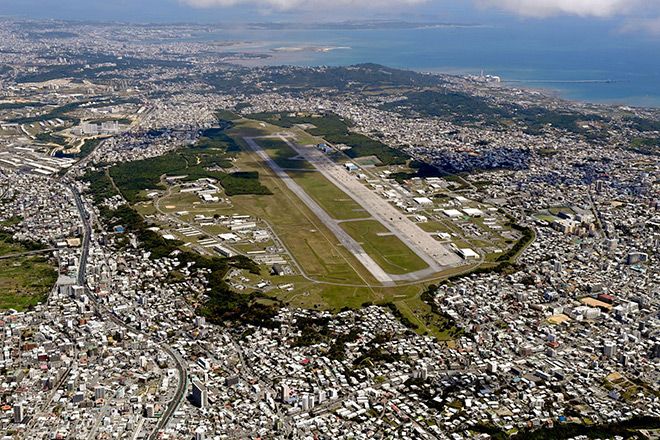
Located in the south-central part of the main Okinawa island, Ginowan has a park located on higher ground that was the site of fierce fighting during the Battle of Okinawa.
The park offers a clear view of the Osprey transport aircraft lined up in the U.S. Marine Corps Air Station Futenma.
The base is located amid a densely populated residential area and in 2003 when he flew over it, U.S. Defense Secretary Donald Rumsfeld said it was a wonder that an accident did not occur there.
Nothing has changed about the site in the interim.
April 12 marks the 30th anniversary of an agreement between Japan and the United States to return all of the Futenma base.
After a young Okinawa schoolgirl was raped by three U.S. servicemen, the Okinawa people who had long suffered from a concentration of U.S. bases in their prefecture raised their voices in anger.
Fearing a major shakeup in the Japan-U.S. security treaty framework, the two governments put together the Futenma return as a symbolic act to reduce the base burden on Okinawa.
But on the grounds that a deterrent had to be maintained, a condition for the return was construction of a replacement facility within Okinawa.
Despite Okinawa opposition, the central government is pushing forward with the current plan to build a runway on reclaimed land off the coast of Henoko in Nago.
The area was found to have a soft foundation and difficulties in construction are unavoidable.
The initial agreement set a timetable of between five to seven years for the Futenma return, but it is nowhere close to realization.
Even if the government’s construction plan goes according to schedule, it will take another 10 years for completion.
With the continued use of Futenma leading to concerns of that becoming a permanent step because the replacement facility has not been built, concerns have also arisen about the possibility that Futenma will not be returned even if the new facility is built.
The Futenma runway is about 2,700 meters long, but the two to be constructed at Henoko will only be about 1,800 meters.
On the grounds that some aircraft would not be able to use the Henoko runways, the U.S. Defense Department in September released a document stating that Futenma would not be returned until the selection was made of a runway long enough that could be used as a replacement.
Government officials insist they have never considered the possibility that Futenma would not be returned after the replacement facility was completed, but they have not indicated how they would respond to the latest U.S. request.
A likely possibility is the use of a private-sector airport, but the government should not be allowed to remain silent while avoiding a detailed explanation of what it is considering.
The starting point of the agreement was to immediately remove the dangers of the Futenma base.
In 2004, a large U.S. transport helicopter crashed and burned on the campus of Okinawa International University located next to the Futenma base.
We should not forget that the base still contains such possible dangers.
With about 70 percent of U.S. military bases in Japan concentrated in Okinawa Prefecture, which has only about 0.6 percent of Japan’s total area, reduction of the excessive base burden is also an urgent matter.
An added factor is the shift by the Self-Defense Forces in recent years toward the Nansei chain of islands that includes Okinawa.
Without the acceptance of the local community and with the expected difficulties in construction work, questions have to be raised about whether the current plan can actually be carried out.
The two governments should revise their positions that the Henoko move is the only solution and begin the process from now of reviewing the plan by returning to the original point of the agreement.
–The Asahi Shimbun, April 12
AloJapan.com