
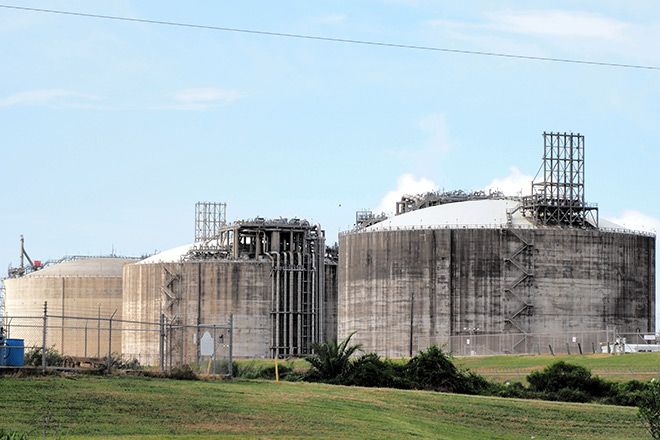
Fossil fuel-related facilities described as “tainted with pollution” account for more than 90 percent of the first round in Japan’s U.S.-bound investment package under Tokyo’s tariff deal with Washington.
When implemented, the facilities could generate greenhouse gases equivalent to 20 percent of Japan’s annual emissions, according to an estimate by The Asahi Shimbun.
That output runs counter to Japan’s domestic efforts to reduce greenhouse gas emissions to net zero in the next 25 years.
Japan is investing about 5.7 trillion yen ($35.6 billion) in the three projects: a synthetic diamond plant in Georgia; a gas-fired thermal power plant in Ohio; and a crude oil export facility in Texas.
They are part of the U.S.-Japan trade deal worth $550 billion.
The gas-fired plant and the petroleum export facility make up more than 90 percent of the investment package.
The Asahi calculated both direct and indirect CO2 emissions from the two projects based on released documents. To gain the estimates, it multiplied the emission intensity per unit of fuel burned or electricity generated by the amount of fuel or electricity used.
The U.S. Department of Commerce says the thermal plant in Ohio is the world’s largest gas-fired generating project, capable of generating 9.2 gigawatts of electricity.
Toshiba Corp., Softbank Group Corp. and other Japanese companies are expected to play a role in the project.
When the power plant is installed with cutting-edge equipment and operates at 60 percent of capacity, it will emit about 15.5 million tons of CO2 annually, equivalent to the amount released by Nepal or Puerto Rico.
Mitsui OSK Lines Ltd., Nippon Steel Corp. and other firms are interested in supplying equipment to the oil facility in Texas, expecting to export crude oil worth between $20 billion and 30 billion annually.
Based on crude oil prices before the U.S.-Israel attack against Iran ($66 per barrel), the amount is equivalent to 300 million and 450 million barrels of oil.
Crude oil is not directly burned at the facility.
But from the standpoint of the life-cycle environmental impact, between 130 million and 200 million tons of greenhouse gases would be emitted annually when all oil shipped from the facility is burned at its supply destinations.
That would account for 0.5 percent of the world’s CO2 emissions, on a par with those of Pakistan or the United Arab Emirates.
LONG-TIME EMISSIONS
When combined, the two facilities will generate the equivalent of between 14 and 21 percent of Japan’s annual emissions, which reached about 1.017 billion tons in fiscal 2023.
Methane, which is dozens of times more powerful as a greenhouse gas than carbon dioxide, could also leak from each facility.
These facilities are expected to operate from 30 to 40 years.
The Group of Seven, after its summit in Elmau, Germany, in 2022, issued a joint statement pledging to “end new direct public support for the international unabated fossil fuel sector by the end of 2022, except in limited circumstances.”
The exceptions include risks to national security and when a country is consistent with its goal of limiting the average global temperature increase by 1.5 degrees compared with pre-Industrial Revolution levels.
Japan and the United States agreed with the statement.
The International Energy Agency has said new fossil fuel infrastructure is unnecessary under the Paris Agreement’s 1.5-degree target.
The Intergovernmental Panel on Climate Change (IPCC) also said in its report that emissions from existing fossil fuel infrastructure would push global warming beyond 1.5 degrees.
‘TAINTED WITH POLLUTION’
U.S. news agency Bloomberg, citing the climate impact, described the first round of Japan’s investment package as being “tainted with pollution.”
In a joint statement released on Feb. 20, 29 civil society organizations in Japan and the United States said, “As climate disasters intensify in Japan and around the world, it is unacceptable to allocate public funds to new gas-fired power plants or crude oil export infrastructure.”
They are calling on the Japanese government, the Japan Bank for International Cooperation (JBIC) in charge of investing and providing loans to private companies, and Nippon Export and Investment Insurance (NEXI), which offers loan guaranties, to immediately withdraw consideration of support for these projects.
Nathan Hultman, a professor at the University of Maryland who was involved in shaping U.S. climate policies as a senior adviser to the State Department, expressed an understanding of the difficulties in building a relationship with the Donald Trump administration.
But he pointed out that it will also be difficult to deal with the science-based, long-term realities of climate change while continuing to invest in fossil fuel infrastructure.
Hultman added that it is imperative to determine whether investments are reasonable in the long-term energy transition even if profits are generated in the short-term future.
‘BENEFICIAL TO JAPAN’
A trade ministry official told The Asahi Shimbun that the government as a whole concluded that the investment package constitutes a limited circumstance specified in the G-7 statement of the Elmau summit.
“Both the JBIC and NEXI will make appropriate decisions based on environmental guidelines,” the official said. “It will be beneficial to Japan as Japanese companies deliver equipment to each project.”
AloJapan.com