
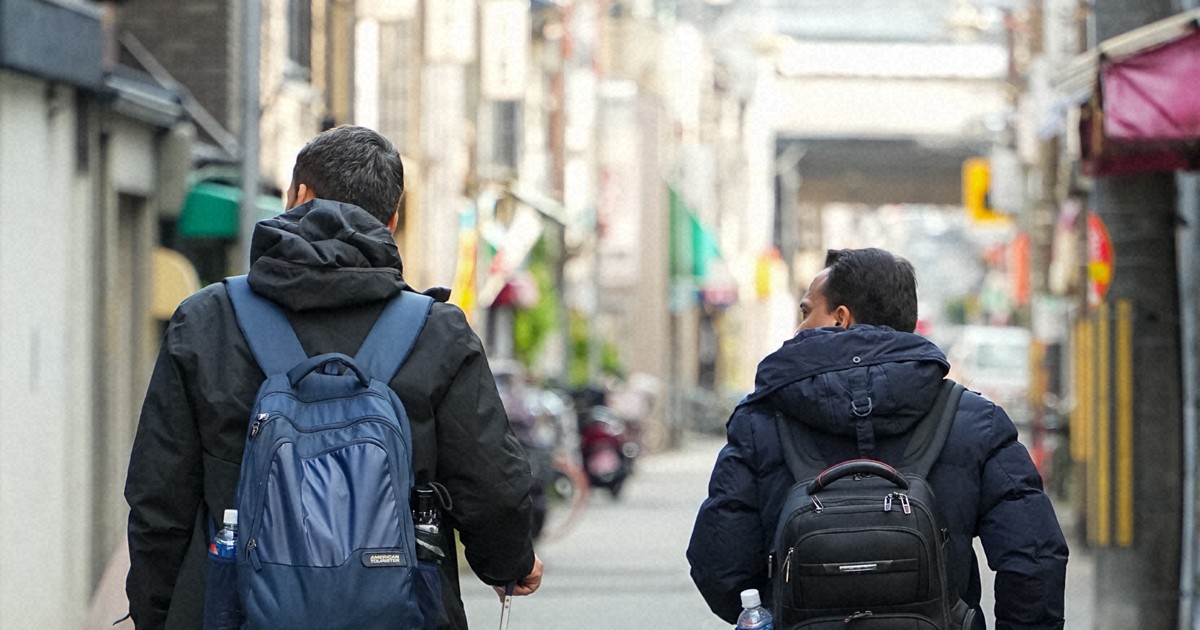
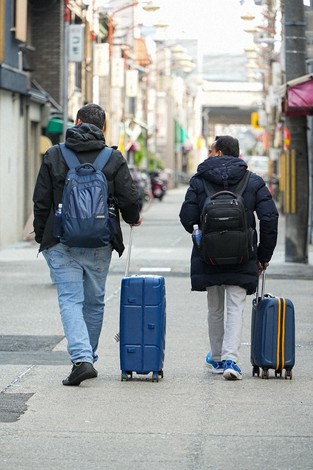
Travelers are pictured with suitcases in Osaka’s Nishinari Ward on Oct. 27, 2025. (Mainichi/Takashi Murata)
OSAKA — Of over 10,000 applications filed under a national strategic special zone private lodging system introduced in Japan in 2016 with the partial aim of easing accommodation shortages for inbound tourists, just one had been rejected as of January 2026, it has been learned.
The findings raise the possibility that amid deregulation, screening criteria for “special zone minpaku,” as the private lodging facilities are known, may have become excessively lenient. With a surge in complaints about noise and garbage around these properties, the adequacy of the screening process has come under scrutiny.
Private lodging facilities in Japan are operated under either one of three laws: the Hotel Business Act, the Private Lodging Business Act (the new minpaku law), or the Act on National Strategic Special Zones (special zone minpaku).
Special zone minpaku require a minimum stay of two nights and three days, a room size of at least 25 square meters, and advance explanation to neighboring residents, among other conditions. However, the requirements are not as strict as those under the Hotel Business Act, and profitability is said to be higher than under the new minpaku law, which limits the number of days they can operate.
The special zone minpaku system was first introduced in Tokyo’s Ota Ward in January 2016 and applications can now also be filed with the Osaka Prefectural Government and the local governments of the cities of Osaka, Kitakyushu, Niigata and Chiba, and the town of Kibichuo in western Japan’s Okayama Prefecture.
The city of Osaka has 7,930 approved properties — roughly 90% of all special zone minpaku nationwide. Between October 2016, when the city started accepting applications, and the end of January 2026, it received a total of 10,814 applications. Of these, 10,754, or 99.4%, passed screening. Only one was rejected for failing to meet the minimum floor area requirement. There were also 59 cases where applicants withdrew their filings.
Tokyo’s Ota Ward had approved 413 applications as of the end of January 2026 — the second highest after Osaka — with none rejected other than voluntary withdrawals. All other participating municipalities except Kibichuo, which had seen no applications, similarly told the Mainichi Shimbun they had approved every filing.
However, since fiscal 2023, when the COVID-19 pandemic subsided, Osaka has seen a sharp rise in complaints linked to special zone lodgings. Reports jumped from 126 in fiscal 2022 to 956 in fiscal 2025 (as of the end of January 2026), a record high. The city will accordingly halt new special zone minpaku applications on May 29 and plans to impose administrative penalties, including revocation of certification, against problematic operators.
(Japanese original by Ririn Iitsuka, Osaka City News Department)
AloJapan.com