
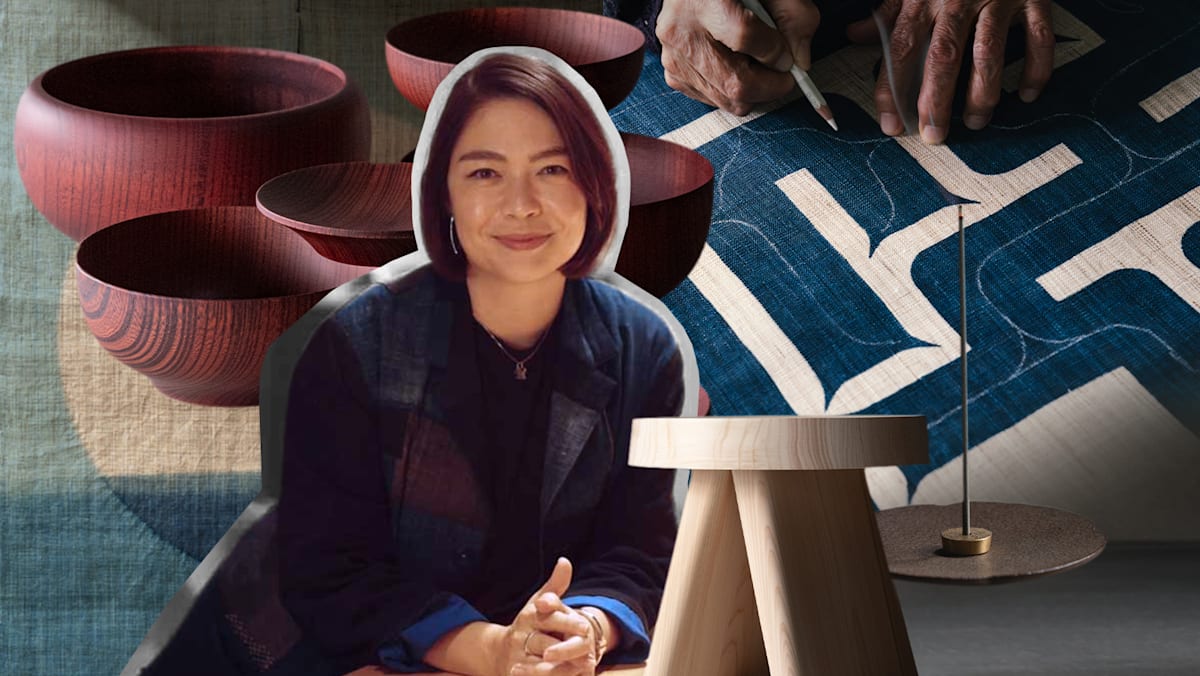
In Kyoto, Masao Kiyoe has spent 47 years natural-dyeing textiles from a workshop on the path up to Kiyomizu Temple – shibori tying and kusaki-zome, the extraction of colour from plants, bark and root. Neither skill came through formal lineage. Kiyoe originally worked in construction, but a workplace accident redirected him, and he taught himself both techniques from scratch, in a field where the two processes are traditionally kept separate. The indigo wall pieces he now produces with POJ are among the studio’s best-selling objects.
Then there is Wataru Myoshu, a Kyoto ceramicist whose vessels take their reference not from nature but from things marked by time – aged building surfaces, ancient bronze, Roman glass. Objects that have been changed rather than protected. The results sit somewhere between archaeology and studio practice, and are among POJ’s most singular pieces.
Koyama approaches every partnership the same way: she listens first. She arrives at workshops without a product brief, asks craftspeople what they hope their own futures look like, and works outward from there. The object that eventually exists is one both parties have arrived at, rather than one imposed from outside. There is, she says, rarely any creative tension. POJ takes on the financial risk throughout – the moulds, the sampling, the commitment to buy – which changes the nature of the relationship from transaction to something closer to alliance.
Koyama’s ambitions now extend well beyond product. A woodworking school has opened in Keihoku. A pottery residency is under construction in Shigaraki – eight students at a time, in a space being built with a traditional temple carpenter, with the first programme planned for early 2027. A foundation is being established.
She has also begun talking about what she calls “craft villages” – actual communities where production, education and rural life are woven together so that younger people can picture staying, or returning, or arriving from abroad to learn. The kintsugi apprenticeship programme has already produced alumni now teaching the practice in Los Angeles and New York.
The engine behind all of it is something Koyama does not try to obscure. “From a young age, I’ve been very aware of mortality,” she said. “Questioning what gives life meaning and what, if anything, endures.” It is a very particular kind of ambition – not to be remembered, exactly, but to build something that does not require her continued presence to carry on. The craftspeople she works with think in generations.
She has decided, it seems, to think that way too.
AloJapan.com