
✕
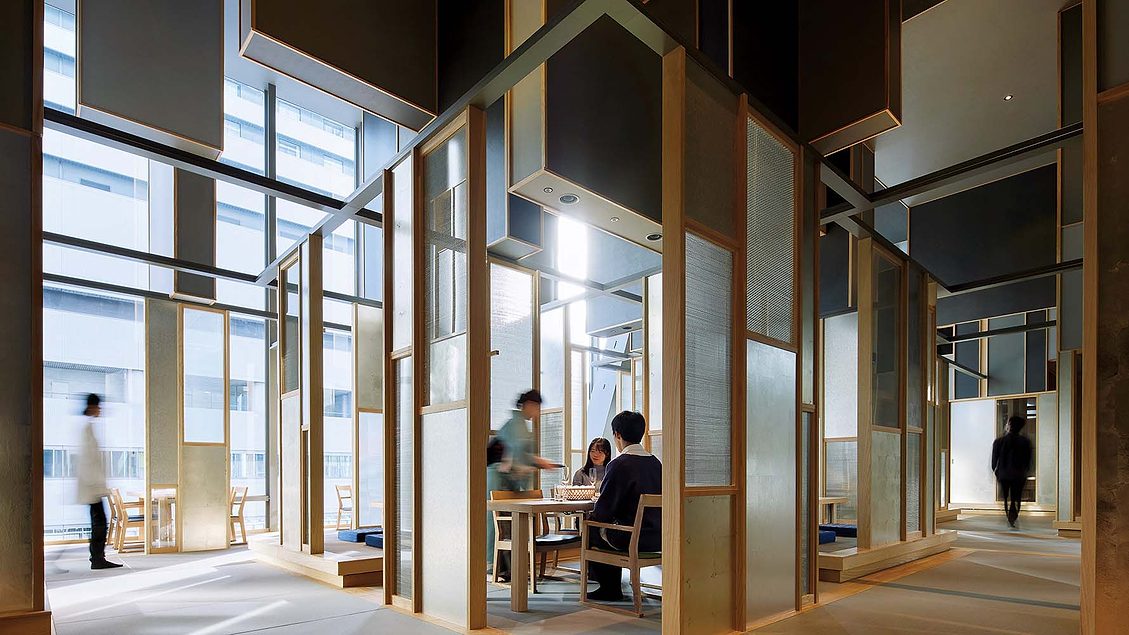
The Osaka outpost of Kyoto Hyōto restaurant serves up traditional Japan—with a contemporary twist. Patrons do shed their street shoes at the door and then dine on shabu-shabu hot pot while seated on tatami mats. Yet these activities take place in an open, airy space where the ceiling soars to 23 feet and, instead of the usual shoji paper, industrial-strength aluminum honeycomb panels—here arranged in a dazzling array of heights and sizes—are the house specialty.
The latest collaboration between the Tokyo architect Manabu Chiba and a Kyoto-based restaurateur, the 3,400-square-foot project is located on the 12th floor of a commercial high-rise adjacent to Osaka Station. Leaving the city’s hustle and bustle behind, a 7-footsquare sliding wood door greets customers. It leads to the restaurant’s foyer, flanked by small rooms for shoe storage and for the cashier. From there, the angled entry portal reorients guests toward the 100-person dining area, bathed in daylight by full-height windows at lunch, and city lights at night. Food is prepped for tabletop cooking in the adjacent, square kitchen.
1
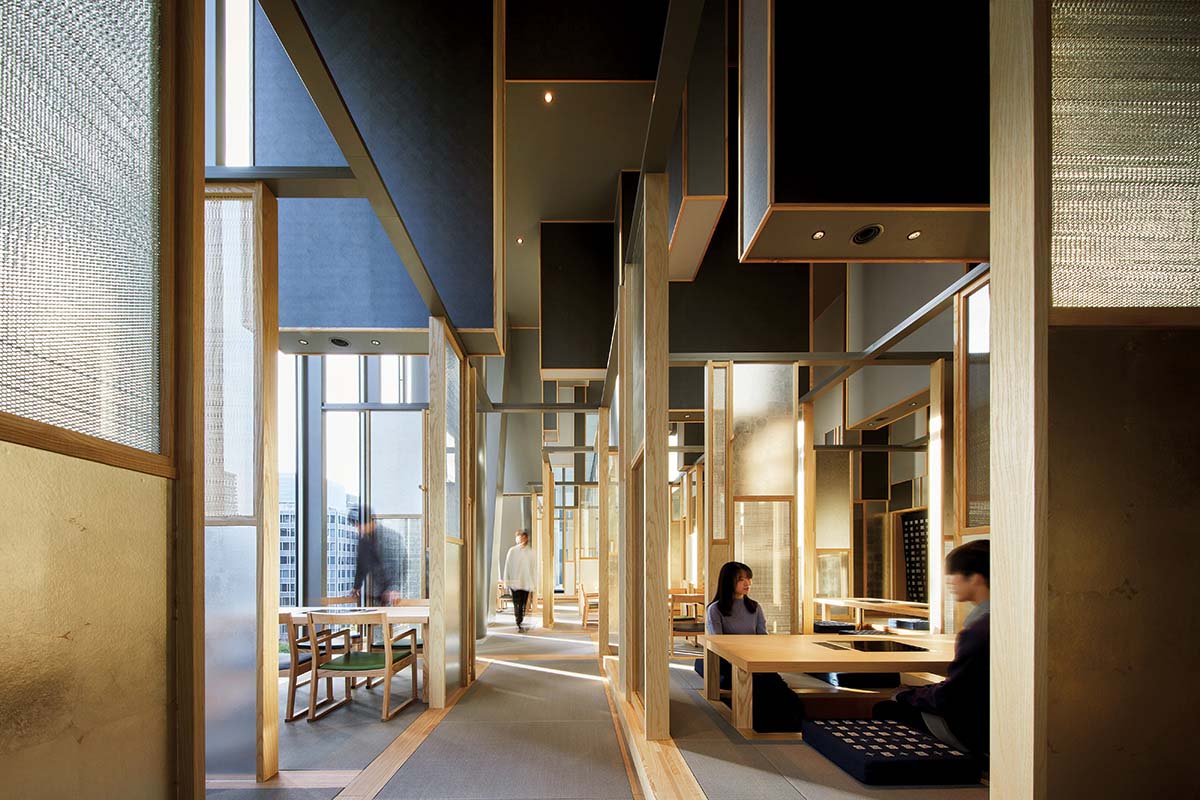
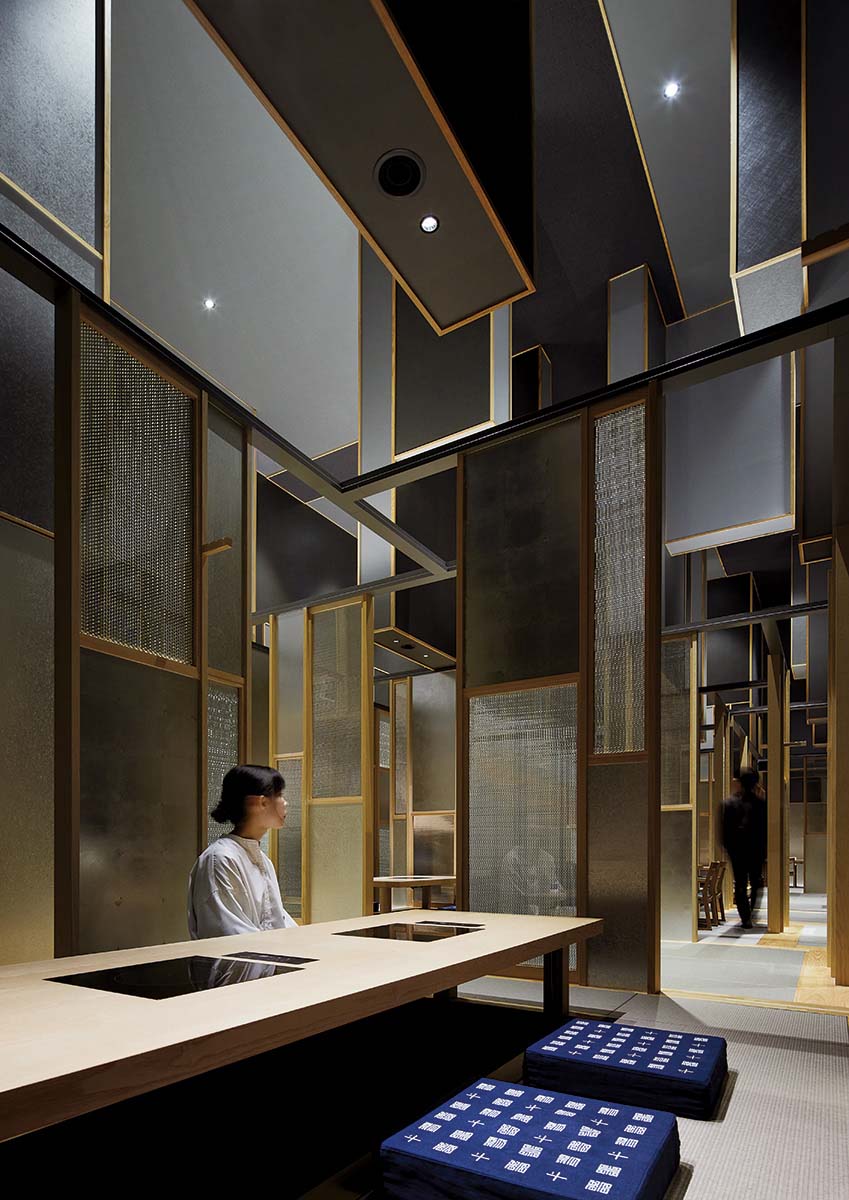
Evoking traditional Japanese rooms separated by sliding shoji, private dining areas are divided by honeycomb panels (1 & 2). Photos © Forward Stroke, click to enlarge.
2
Evoking the fluidity of Japanese interiors subdivided by movable walls, the tatami-covered dining area holds a combination of lightly partitioned expandable private rooms and open clusters of table-and-chair seating. Ranging from 130 to 65 square feet, the individual rooms center on low tables where guests stir the pot from cloth-covered zabuton cushions. Thanks to horigotatsu openings in the tatami, they can discreetly stretch out their legs under the table. For those who’d rather not dine at floor level, there is the table-and-chair option. But Chiba, who designed the blond ash-wood furnishings throughout, notes that their eating and sitting surfaces are lower than most. And sled-shaped bases prevent chair legs from puncturing the delicate mats.
Like tatami, some materials used in Japan require periodic replacement—a practice built into the restaurant’s removable metallic wall panels. Anticipating the inevitable wear and tear caused by soup spills and roving food trays, the panels range in size, but all are small enough to be swapped out by a single carpenter. They are arranged randomly, yielding a medley of silvery surfaces that gently delineate one space from another. Reminiscent of historic post-and-beam construction, a three-dimensional ash-wood framework holds the panels in place and is anchored to the concrete slab below the straw-mat flooring.
The panel materials consist of off-the-rack silver washi wallpaper and aluminum honeycomb normally found inside furniture or an airplane fuselage. “It looks like a collection of small windows that reflects light in a beautiful way,” remarks Chiba. Sandwiched between glass sheets, these tiny cellular openings are transparent when seen head-on but block sightlines when viewed at an angle. This balance of enclosure and exposure is particularly well suited to restaurants, says Chiba. “You want to enjoy time with your friends while sharing the space with many people,” he explains. For the wallpapered panels, the architect chose three different tones and textures. When these wear out, the surfaces can be redone with whatever silver shades are available. The more varied, the less obvious the repairs.
Some of the private rooms have the 7-foot-high ceilings typical of floor-based tatami spaces. Elsewhere, Chiba mitigated the restaurant’s double height with an assortment of T- and L-shaped boxes suspended from the building’s concrete slab and steel structure above. Supported internally with thin steel frames, the boxes are made of ash wood and paper cladding. They conceal ducts and hold downlights while imparting a shadowy mood to the room’s upper reaches. “It feels like you’re in a forest with big trees,” muses the architect. More than the boxes themselves, it is the openings in between that create this distinctive atmosphere.
Untouchable yet effective, voids of all types have long fascinated Chiba, who works them into his designs regularly. Gaps and glitches, such as the required slots of space between buildings, or narrow walks leading to hidden shrines and temples, relieve the stress of Japan’s densely built environment. But openings at any scale leave room for the imagination to run and the body to relax—essential ingredients for savoring sips of sake and simmered slices of meat.
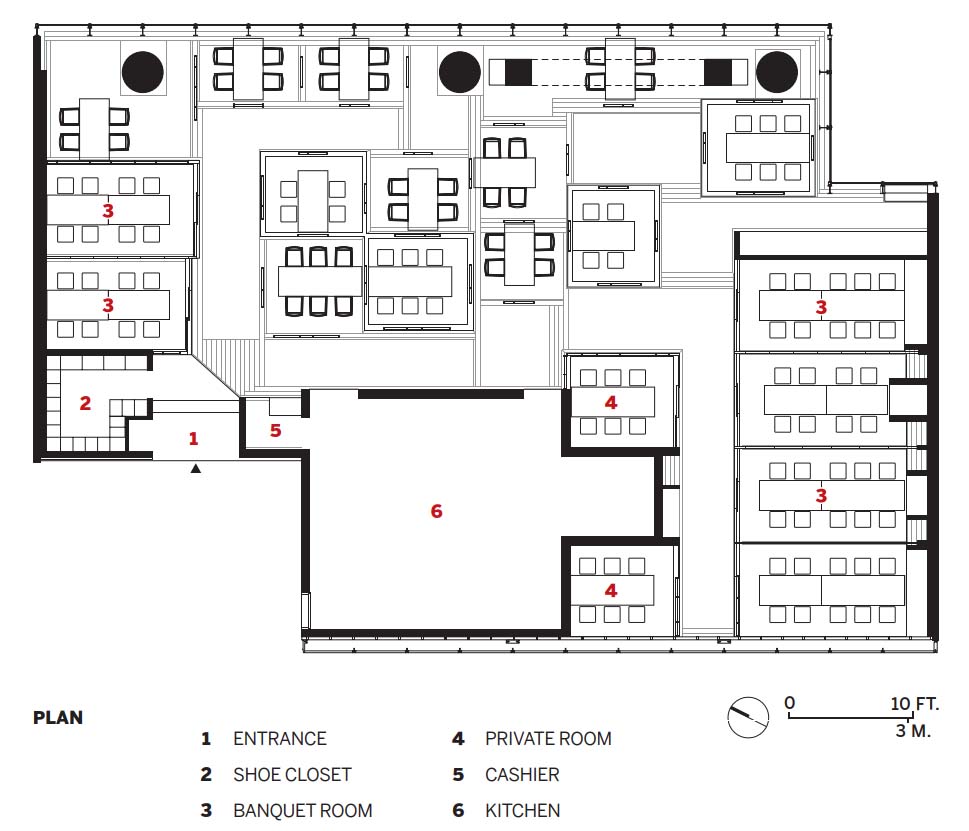
Image courtesy Manabu Chiba Architects
Credits
Architect:
Manabu Chiba Architects
Engineer:
Kankyo Engineering (MEP)
Consultant:
Izumi Okayasu Lighting Design
General Contractor:
CA Leading
Client:
Mihaku
Size:
3,400 square feet
Cost:
$1.98 million (construction)
Completion:
December 2025
Sources
Wallcoverings:
Kamism, Sangetsu, Sincol, Lilycolor
Lighting:
Daiko
Honeycomb Glass:
Hollander Glass
Acoustical Ceilings:
Yoshino Gypsum
AloJapan.com