
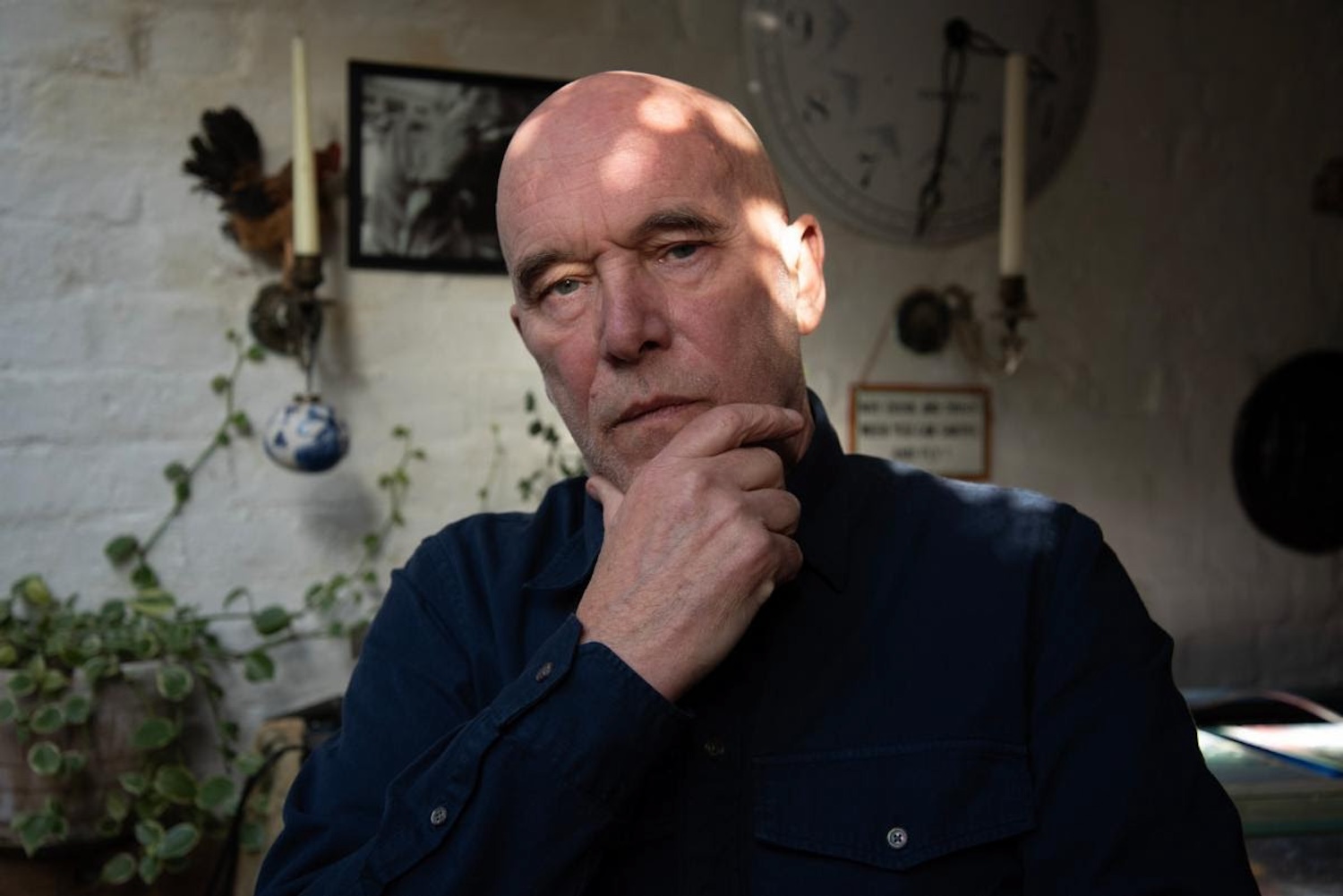
“I’ve made a lot of records, but I’ve usually been on the back cover,” says Adrian Sherwood from his home in Kent, England. The British producer and dub pioneer jokes about how it took nearly two decades to release his first solo album, Never Trust a Hippy, in 2003.
An early settler on the London dub and reggae scene by the late-‘70s, Sherwood navigated punk—helping the Slits find their experimental sound—and later co-wrote and produced several of Lee “Scratch” Perry’s albums, while mixing into the post-punk, working with Ministry, Skinny Puppy, Nine Inch Nails, Cabaret Voltaire, and KMFDM.
In 2022, Sherwood also reimagined Spoon’s 2022 album, Lucifer on the Sofa, transforming it into a dub remix, Lucifer on the Moon, and did the same for Panda Bear and Sonic Boom’s 2022 release, Reset, all while crafting his ninth solo output, The Collapse of Everything.
“I always think they’re my records, whatever I’m doing,” laughs Sherwood. “Well, it’s part of me and everything, but I’m pleasing an artist, or a band, or something. Being on the cover, I’ve got the chance to make something that is where my head’s at the moment.”
Still the sonic provocateur, on The Collapse of Everything, Sherwood experimented with “tunings and things crashing together,” he says, would somehow make a cohesive album. He also made a conscious decision to incorporate a live band during live shows, which took him out of his comfort zone, joined by longtime collaborator, bassist Doug Wimbish (Living Color, The Sugar Hill Gang), Alex White (Primal Scream), and Mark Bandola (The Lucy Show), flanked by a mixing desk and a setup of “noises” on stage.
[RELATED: American Songwriter Interview With Lee “Scratch” Perry — Dubbing ‘Rainford,’ Making Magic Music, and Still Believing in Miracles]
“I have all the drums and the percussion and noises,” he says, “and I have a noise pad, three reverbs, three delays.”
Following the four-track EP The Grand Designer in 2025, The Collapse of Everything, Sherwood’s first solo album in 13 years, released on the On-U Sound label he founded in 1979, kicked off with a ‘Dub sessions 20th anniversary’ show in Japan, and a show in London in February 2026. Sherwood planned to bring his Live Dub Sessions tour to North America, Australia, and Europe in 2026, but was forced to postpone the shows to 2027 due to visa issues.
Sherwood started putting the pieces of The Collapse of Everything, a follow-up to Survival & Resistance from 2012, together nearly four years ago, filing away different “beds and grooves” for songs. “I was experimenting like an idiot,” he says, “exploring my journey.”
“I use techniques from the old dub masters and things I’ve learned in all these years. I see everything as a picture, like a sonic picture.”
Adrian Sherwood
The Collapse of Everything also developed around the loss of two of Sherwood’s closest friends, Mark Stewart of the Pop Group in 2023, and hip-hop drummer and producer Keith LeBlanc, a year later. Stewart had written a song for anarchist author Scott Crow, and part of his lyrics became Sherwood’s title, The Collapse of Everything.
“It’s an homage to Mark,” says Sherwood, “and also the fact that I thought it was so appropriate, there’s the title glaringly looking at me.”
Alongside the loss of Stewart and LeBlanc, the album also ties to the state of the world, “both politically and environmentally,” Spaghetti Western films (“Spaghetti Best Western”), and more, says Sherwood. “All the tracks, while they’re instrumental, give a nod to some Japanese films, including his nod to the 1973 Japanese crime drama of the same name, Battles Without Honour and Humanity, and some life experiences, and obviously Spaghetti Westerns,” he says. “I got a bit of a tongue-in-cheek sense of humor about it.”
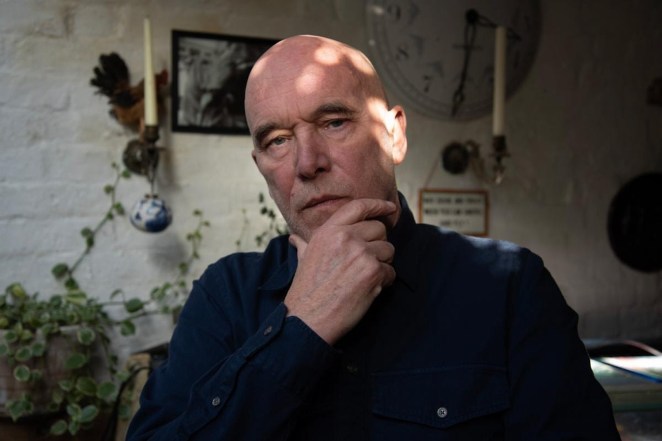 Adrian Sherwood (Photo: Nana S.R. Tinley)
But Sherwood insists the album isn’t as “doom and gloom” as it sounds. There is levity and positivity through the beats. After releasing the single “Russian Oscillator” in 2025, the track was harder and “tougher,” which made Sherwood realize he wanted something warmer and with a “healthier tension” for The Collapse of Everything.
“Obviously, when everything collapses, you have to rebuild again,” he says. “I was trying to evoke … I think people always say ‘Dub this, dub that,’ and I produce music—be it folk, jazz, African, whatever—and I use techniques from the old dub masters and things I’ve learned in all these years. I see everything as a picture, like a sonic picture.”
He continues, “I wanted to create something quite beautiful, and had elements of tension in it, but also was a challenge to listeners.”
It was also a chance for Sherwood to play around with new plug-ins, including outboard equipment, and the AI-powered RIP X DAW software. “It enabled me to ghost my own productions,” says Sherwood. “They create ghosting effects over driving them. So, for me, it was a chance to sonically do what I wanted, rather than doing it for somebody else. It’s all part of what we’re doing but making a record for myself, just do what I like, and it’s quite liberating.”
The Collapse of Everything is Sherwood’s most personal release and plays, with its ambience and blues, like a soundtrack to some indie cult film. Thinking back on Never Trust A Hippy, when Sherwood’s name first moved from the back to the front cover of an album, nothing much changed, since Sherwood always felt his place was mixing, producing, and writing, and being at the service of other artists.
“It’s taken me a while to get used to the idea, but now I’m comfortable with being out front, even on the live stage, so I’ve tried to make something really sonically challenging, and take myself out of my comfort zone,” said Sherwood. “It’s important to keep moving forward.”
Photo: Nana S.R. Tinley
AloJapan.com