
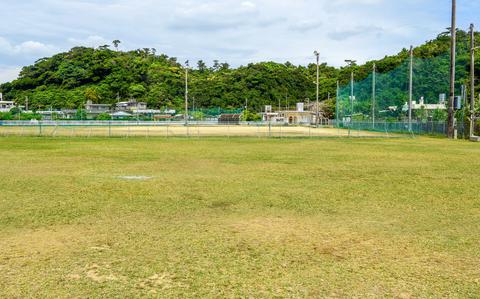
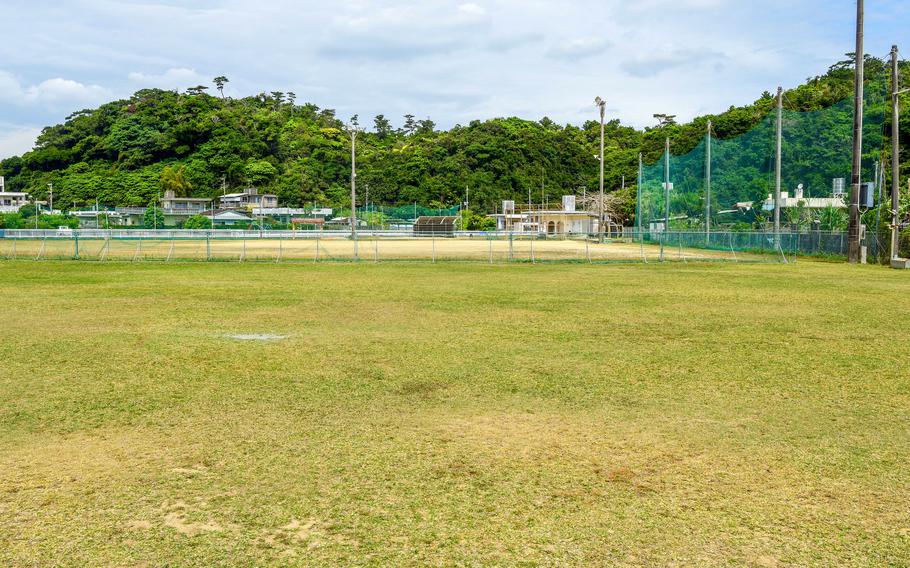
The spot where a Marine Corps UH-1Y Venom helicopter made a precautionary landing near a baseball field in Nago city, Okinawa, as seen March 9, 2026. (Ryan M. Breeden/Stars and Stripes)
CAMP FOSTER, Okinawa — Okinawa’s government plans a formal protest to the U.S. military and Japanese government over a Marine Corps helicopter’s precautionary landing that forced a youth baseball team to flee a practice field earlier this month.
The Okinawa Prefectural Assembly on Friday drafted a letter urging the U.S. military to disclose the cause of the incident and “clearly indicate measures to prevent recurrence and ensure the safety of local residents,” according to a copy posted on the prefecture’s website.
It also asks the military to review aircraft maintenance and inspection requirements and calls for a revision of the Japan-U.S. Status of Forces Agreement to prohibit flight training over residential areas.
The letter will be sent in mid-April to U.S. Ambassador to Japan George Glass; Air Force Lt. Gen. Stephen Jost, commander of U.S. Forces Japan; Marine Lt. Gen. Roger Turner, commander of the III Marine Expeditionary Force; and U.S. Consul General Andrew Ou, an assembly spokesman said by phone Monday.
An identical opinion letter will be sent to Japan’s prime minister, minister of foreign affairs, minister of defense and chief cabinet secretary.
Some Japanese government officials may speak to the press only on condition of anonymity.
A UH-1Y Venom landed at about 8:20 p.m. March 6 in a grassy area about 50 feet from Kyoda Baseball Field in Nago due to an onboard warning during routine training, the 1st Marine Aircraft Wing said at the time. No injuries or property damage were reported, but a youth baseball team was practicing on the field.
The site is about 100 feet from homes, and because children were present, the landing “caused strong anxiety and fear among local residents,” the letter states.
The U.S. military routinely makes low-altitude flights over residential areas, which are permitted under the Aviation Special Measures Act based on SOFA but are otherwise prohibited under Japan’s Civil Aeronautics Act, according to the letter.
“The landing site in this case is a public facility used daily by citizens, and a single mistake could have led to serious human casualties,” the letter states.
The safety of pilots and Japanese citizens is “our number one priority during flying operations,” USFJ spokesman Air Force Col. John Severns said by email Monday.
“Our pilots are trained to conduct their missions in the safest way possible, and our aircraft are thoroughly maintained prior to and directly after each flight,” he said. “The most effective preventative measure for mishaps is continued training, which ensures our service members are prepared to operate under any circumstances and in any operating environment.”
Assembly member Ryotaro Odo, one of the letter’s authors, said the assembly understands the landing was made to avoid danger.
“I believe they landed there because the lights were on and it was clear,” he said by phone Monday. “But we would like the U.S. military to avoid landing near residential areas as much as possible.”
AloJapan.com