
We need your help! We are dedicated to providing rapid scientific analysis following earthquakes, but to make this effort sustainable, we need financial support. If you can, please consider upgrading to a paid subscription. If you use our Substack as part of a group, or for teaching, consider a teaching or institutional subscription. Every paid subscription makes a real difference — and unlocks access to the more than three hundred posts in our archive!
Free subscribers still get all of our new posts by email, and all of our posts are free to read for one month. If you have recently lost your job or are a student or researcher without ability to pay, let us know and we will upgrade your subscription to “paid” at no cost.
At 11:18 PM local time on March 26, 2026, a magnitude 6.5 earthquake occurred off the coast of northern Japan. Shaking was reported across most of northern Honshu and southern Hokkaido.
For people living in the area, earthquakes are a fairly regular occurrence. In the last six months, we have written about two large earthquakes that caused shaking in these regions: a M6.8 on November 9th, 2025, and a M7.6 on December 8th, 2025, farther to the north. Many people in the region probably felt many more earthquakes, since each of these produced aftershocks.
This latest M6.5 earthquake looks very similar to that M6.8: a similar location along the Japan subduction zone, with a very similar focal mechanism indicating thrust slip on a low-angle fault dipping towards the west-northwest. We can readily conclude that both earthquakes are megathrust events, reflecting slip on the subduction interface itself.
 Figure 1: Earthquake focal mechanisms since January 1st, 2025, offshore northern Honshu. Earthquakes are also projected onto a timeline on the right. The November 9 M6.8 and March 26 M6.5 earthquakes are highlighted with bull’s-eyes.
Given the similarity in location and mechanism, it is unsurprising that the groundshaking reports are also similar (although with slightly lower shaking intensities overall in this latest earthquake, since it was somewhat smaller.
 Figure 2: Shaking intensities from the JMA in the 2025-11-09 M6.8 earthquake (left) and the 2026-03-26 M6.5 earthquake (right). Intensities are on the JMA intensity scale.
Here at Earthquake Insights, we usually default to the Modified Mercalli Intensity scale (MMI) to talk about shaking intensities, which is the scale used by the USGS. However, when an earthquake occurs in Japan, the data from the Japanese Meteorological Agency (JMA) is far more complete — but it is on a different intensity scale. Both scales are intended to represent the experience of people who felt the earthquake. Both have numbers that increase in value as the shaking gets stronger. But the precise meanings of those numbers are different.
The MMI scale uses Roman numerals from I to X, where I = not felt and X = extremely destructive. The JMA scale uses regular Arabic numbers from 0 to 7, where 0 = not felt and 7 = extremely destructive. To provide extra refinement, the JMA scale also divides intensities 5 and 6 into “upper” and “lower,” so they actually have a total of 10 different levels, just like MMI; it’s just that each number means something different.
And it isn’t just that the numbers are scaled differently: the whole JMA scale is centered around the types of construction in Japan, with impacts specifically broken out for wooden houses versus reinforced concrete buildings. Since most deaths due to ground shaking are caused by building collapse, it is extremely helpful to have a guideline for damage that takes into account local building styles. One of the reasons that the 2024-01-01 M7.5 Noto earthquake was so destructive in Japan is because it occurred in a region with a large amount of traditional wooden construction built before new building codes were put in place in 1981. These kinds of structures are vulnerable not just to ground shaking, but also to fire following earthquakes. The JMA scale provides the kind of refinement needed to consider the impact on those structures directly. Meanwhile, the MMI scale is a more general scale that tries to provide a universal framework for thinking about earthquakes everywhere in the world.
Whenever this issue comes up, we like to drop this figure, which is a footnote in a paper by David Wald (2020), and as far we know is the best reference for comparing the two scales. Wald credits a book by Munon and Cecić for providing the data supporting the comparison. Note that Wald shows intensity IX as the highest value. This USGS webpage lists intensity X as the top of the MMI scale. And the Wikipedia page for the MMI scale lists two higher values (XI and XII), which were apparently added by Adolfo Cancani in 1904, but are used infrequently or not at all! We have heard that there is debate about whether any values above IX should be used at all. If you have a strong opinion about this, let us know!
 Figure 3: Comparison of JMA and MMI intensity scales. Note 12 of Wald (2020).
Whatever the details, the important thing in this recent M6.5 earthquake is that the shaking intensities were almost all 1-3, with the very occasional 4. On the JMA scale, those intensities might be scary, but they should not have caused damage.
So: was this M6.5 earthquake an aftershock of last year’s M6.8? Actually, the word “aftershock” has always been a little muddy. Usually, we consider any smaller earthquake that occurs after a larger earthquake to be an “aftershock” as long as the rate of seismicity continues to be elevated in the region. However, there’s a catch. If the smaller earthquake is close in magnitude to the first one, we will sometimes call it a “triggered” earthquake. This phrase can be especially useful if the second earthquake occurred on a different (nearby) fault. Because the M6.5 was close(ish) in size to the M6.8, it is unclear to us whether “aftershock” or “triggered earthquake” is the right term to use here.
Further complicating matters, the term “aftershock” implies that the later, smaller earthquake was somehow caused by the earlier, larger one. That makes a lot of sense when there is a clear mainshock followed by smaller events. However, when we wrote about the M6.8 last November, we noted that it was preceded by some pretty complicated seismicity over the five days prior: a M5.2 foreshock followed by several days of aftershocks, then a “cascade up,” with three progressively larger M5-6 earthquakes on November 8th, before the mainshock on November 9th. Here is the figure we made then, using the seismicity catalog from the JMA:
 Figure 5: Seismic sequence associated with the November 2026 M6.8 earthquake offshore Japan.
That kind of swarmy earthquake behavior suggests that there might be some other processes at work triggering earthquakes (like fluid movement, or aseismic creep of some part of the fault). If that physical process is still at work, then assigning responsibility for the M6.5 to the M6.8 is more of a stretch.
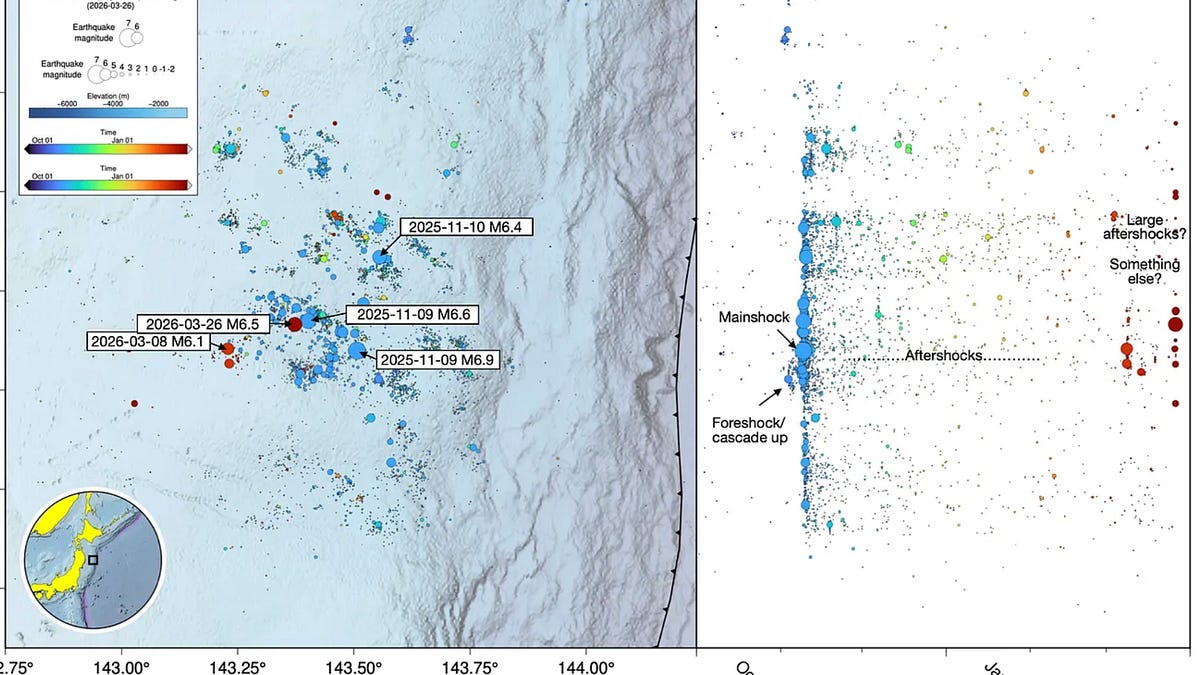
With all that in mind, let’s look at a map of all the seismicity in this location since last October, again using the JMA catalog. What can we learn? Here we have zoomed in, and also colored seismicity by time to better see newer activity against older activity.
 Figure 6: Seismicity since October 1 2025 around the recent M6.5 earthquake. Earthquakes are colored by time, and also projected to the right onto a timeline. Below the map there is a time series showing seismicity, and also a histogram showing number of earthquakes per day. Earthquakes above M6 are labelled. Note that the event magnitudes are slightly different (M6.9 vs M6.8) than for the same events in the USGS catalog.
The first thing to see is that the main decay in seismicity following the mainshock happened as normal. Following the strong initial decay, there has been an elevated background “hum,” which is normal: aftershocks decay as 1/time, which means that the decay is fastest at the beginning and then slows down.
Second, this recent M6.5 earthquake is not the only larger earthquake to have occurred in the last few weeks. On March 8th, there was a M6.1 earthquake.
What does this mean? Well, this could all be perfectly normal aftershock behavior. Delayed large aftershocks happen regularly. While typically the largest aftershock of an earthquake has a magnitude ~1.2 less than the mainshock, there are plenty of earthquakes that violate this “law” (more of a loose guideline).
It is also possible that there is some underlying physical process happening here that is helping to trigger earthquakes. Certainly the foreshock and cascade up before the mainshock were suggestive. If that is true, then this recent resurgence in earthquakes might be related to that.
We also notice that the aftershocks are quite patchy, forming distributed clusters over a broader region. We generally trust the locations from the JMA catalog, because they are derived from an ultra-dense network of seismometers. This type of pattern is fairly unusual in our experience, although it may simply be the case that most networks cannot resolve these kinds of details. If an earthquake is too small, it does not generate aftershocks over a broad area, so we don’t see scatter like this. If the earthquake is too large, it causes intense aftershocks all over. And if an earthquake occurs on a steeply dipping fault, earthquakes at different depths will be mapped on top of each other, obscuring details. Perhaps the M6.8 was a Goldilocks event — just the right magnitude to display this interesting behavior, on a conveniently low-angle fault, and observed by the right network?
Was that enough hand-waving for one day? We think so. If you have any thoughts about this earthquake sequence, or about different intensity scales, please let us know in the comments!
Hubbard, J. and Bradley, K., 2025. M6.8 earthquake offshore Japan preceded by upward cascade of foreshocks. Earthquake Insights, https://doi.org/10.62481/d6ad8513
Musson, R.M. and Cecić, I., 2012. Intensity and intensity scales. In New manual of seismological observatory practice 2 (NMSOP-2) (pp. 1-41). Deutsches GeoForschungsZentrum GFZ. https://gfzpublic.gfz.de/rest/items/item_43219_11/component/file_916905/content
Wald, D.J., 2020. Practical limitations of earthquake early warning. Earthquake Spectra, 36(3), pp.1412-1447. https://doi.org/10.1177/8755293020911388
AloJapan.com