
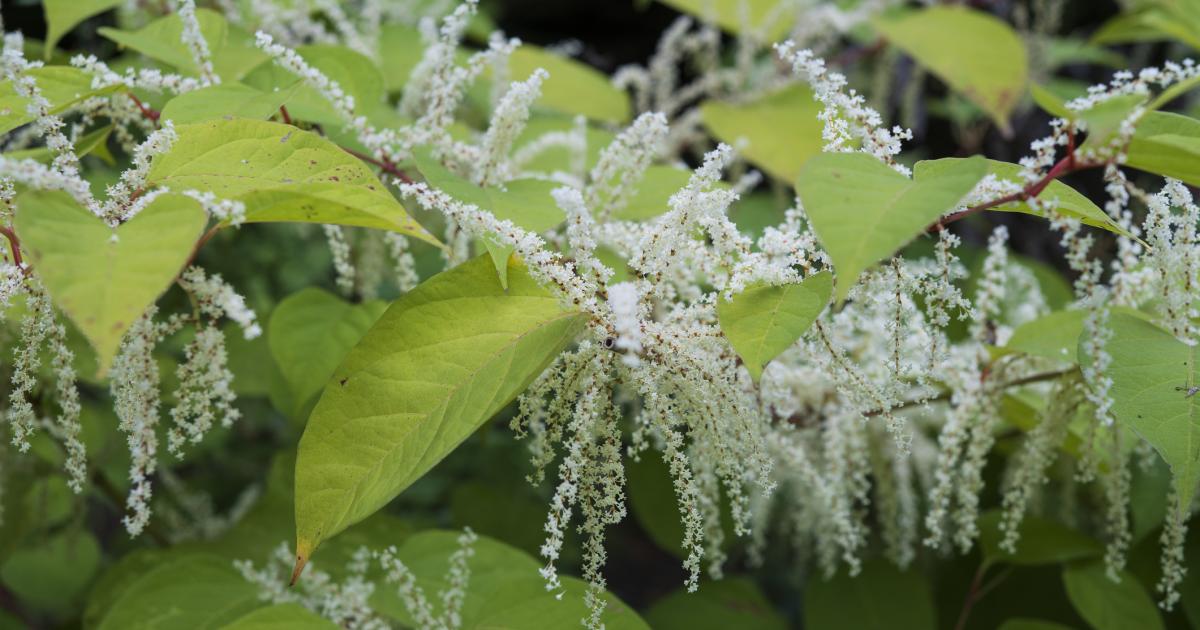
Japanese Knotweed is a fast-growing, invasive weed, and is the most common of four invasive knotweed plant species in the UK, with the others being Dwarf Knotweed, Giant Knotweed and Bohemian (hybrid) Knotweed.
Its aggressive nature sees its roots burrow deep underground, which can be up to 3 metres down in some cases.
Here is when this plant typically flowers in the UK, what it looks like and what to look out for, and most importantly, if found, how to report and remove it.
What does Japanese Knotweed look like and when does it flower in the UK?
Japanese Knotweed is described as “a persistent, clump-forming herbaceous perennial” by The Royal Horticultural Society (RHS).
It explains: “In spring, rounded pink buds form at ground level and from these reddish-purple shoots emerge.
“The soft shoots grow rapidly, becoming bamboo-like stems.
“These are characterised by reddish-purple speckling, conspicuous nodes and hollow centres.
“Stems usually grow about 2 metres (6½ft) tall, reaching their full height in late summer, by which time they may be arching over at the top.”
Japanese Knotweed grows “rapidly in summer and is most prominent from August to September”, says Saga’s home insurance and property expert Anna Thunstrom.
Japanese Knotweed stems usually grow about 2 metres (Image: Getty Images)
She explained: “Keep an eye out for its characteristic shield or shovel-shaped leaves, along with clusters of creamy white flowers that bloom during late summer”.
However, the RHS warns that while Japanese knotweed stems die back in winter, in sheltered locations, dead stems may remain upright through the winter.
What to do if I find Japanese Knotweed?
While it is not an offence to have Japanese knotweed growing in your garden, it is an offence to plant or cause it to grow in the wild, and you should take steps to prevent it from spreading.
It can also cause damage to your property, as the expert Ms Thunstrom explains: “Japanese knotweed is particularly notorious for causing structural damage to buildings, potentially impacting the property’s value.
“As a result, sellers are obliged to disclose its presence.”
She also warns to act quickly, as it could “anywhere between £1,000 to £12,000 to have Japanese Knotweed removed, depending on the garden size and severity of the infestation”.
Japanese Knotweed law in the UK
As the RHS explains: “Japanese knotweed is listed on Schedule 9 of the Wildlife and Countryside Act 1981, Section 14, making it an offence to plant or cause Japanese knotweed to grow in the wild.
“The penalties for offences under Section 14 include fines and imprisonment.”
While it is not illegal to have Japanese Knotweed in your garden, it is important to control it to prevent it from becoming a problem in your neighbourhood.
As explained by the RHS, as part of the Anti-social Behaviour, Crime and Policing Act 2014, if Japanese Knotweed has a “detrimental effect of a persistent or continuing nature on the quality of life of those in the locality”, property owners may be prosecuted.
If problems with the plant happen in a neighbouring garden, you should be in touch with your neighbour about it before contacting your local council.
Soil or plant material contaminated with non-native and invasive plants like Japanese Knotweed can cause ecological damage and may be classified as “controlled waste”, adds the Gov.uk website.
How to remove Japanese Knotweed
It is advised not to treat knotweed yourself unless you have the appropriate skills and experience, but instead get professionals to come and remove it.
Thomson Environmental Consultants are experts in invasive species management and have experience in controlling and managing Japanese Knotweed.
Craig Godbehere, a site supervisor and certified surveyor in Japanese Knotweed at Thomson, explained various control measures that can manage Japanese Knotweed on a site.
These are:
In-situ treatment using approved herbicides
Controlled contaminated soils from the site to an approved facility using an approved waste carrier
Burial at either 5m with a cap or 2m completely encapsulated
Stockpiling of the contaminated soils
Soil screening/sieving with potential re-use on-site
‘Installation of Root Barriers’ where all contamination cannot be removed
Mr Godbehere added: “Strict biosecurity measures should be enforced to prevent the accidental spread of the Japanese Knotweed.
“All plants, vehicles, equipment, and clothing must be thoroughly cleaned before leaving contaminated areas.
“Cleaning should take place in the location (or immediate vicinity) where the soil or living material originated before equipment and personnel leave the buffer zone.”
He also explained how herbicide treatment is regularly used, as this is usually the most cost-effective option.
However, he warned that herbicide treatment shouldn’t be used in isolation where there is likely to be future soil disturbance around the infested area.
“If this option is used, achieving the desired results may take many years,” he said.
Recommended reading:
Best companies for Japanese Knotweed removal
The Gov.uk website has listed some companies that specialise in treating knotweed.
It said to look for a contractor with the following accreditations and registrations:
Amenity Forum Membership
BASIS Professional Register
BASIS Amenity Training Register look
BASIS Nominated Storekeeper (NSK) Professional Register
It adds that many of these companies belong to either the Invasive Non-Native Specialists Association (INNSA) or the Property Care Association (PCA).
Have you had any issues with Japanese Knotweed? Let us know in the comments.
AloJapan.com