
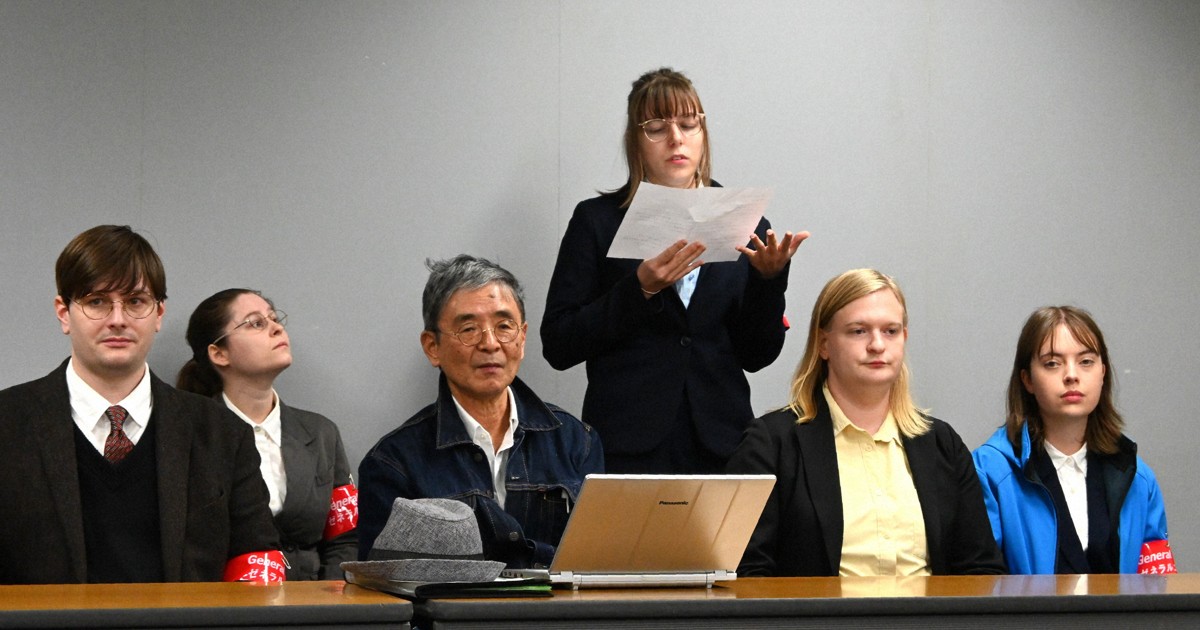
Dispatch ALTs working at Kyoto Prefectural schools describe their situation during a press conference on the first day of their job stoppage, in Kyoto’s Kamigyo Ward, Nov. 12, 2025. (Mainichi/Saki Hidaka)
KYOTO — In November 2025, seven assistant language teachers (ALTs) employed by a private firm and working at prefectural high schools in Kyoto Prefecture went on strike, demanding better pay. They do the same job as other ALTs — yet earn more than 1 million yen (approx. $6,290) less per year. The reason comes down to how they were hired.
Across Japan, ALTs are employed under three main arrangements: through the government-sponsored Japan Exchange and Teaching (JET) Programme, through private dispatch companies, or directly by local governments. The mix varies from prefecture to prefecture.
Osaka Prefecture runs its own direct-hire system, known as “NET.” In Hyogo Prefecture, all 132 ALTs in fiscal 2025 came through JET.
JET is run by the Council of Local Authorities for International Relations (CLAIR) in cooperation with the education ministry and others, with the aim of strengthening foreign language education and promoting international exchange at the local level. Participants are selected at Japanese diplomatic missions abroad and placed as ALTs according to local government needs. More than 80,000 people have come to Japan through the program since its launch in 1987.
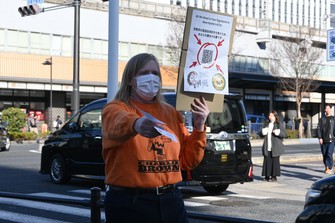
Beatrice Baker holds a sign and distributes fliers asking people to sign an online petition calling for Kyoto Prefecture to directly employ dispatch ALTs working at its schools, in Kyoto’s Minami Ward, Dec. 20, 2025. (Mainichi/Saki Hidaka)
Dispatch ALTs earn far less
In Kyoto Prefecture, 31 of the 41 prefectural ALTs are JETs. The remaining 10 are dispatched through an Aichi Prefecture-based private company — and all seven who went on strike belong to that group.
The seven are men and women in their 20s to 40s from Britain and the United States. Their employer won an open competitive bid worth about 36.89 million yen (approx. $231,800) for fiscal 2025 work with the Kyoto Prefectural Board of Education. Each teacher earns a monthly salary of 210,000 yen (about $1,320) plus a 60,000-yen ($377) annual bonus, for a total annual income of 2.58 million yen (around $16,200).
JET ALTs, by contrast, earn between 4.02 million and 4.32 million yen (approx. $25,260 and $27,150) a year, according to the prefectural BOE. They can also stay for up to five years if they choose and receive support with housing and daily life.
Kyoto Prefecture began using dispatch ALTs in fiscal 2020 to secure teacher numbers, when pandemic travel restrictions made it impossible to bring new JET participants from overseas. The prefecture switched to competitive bidding for contractor selection partway through fiscal 2021.
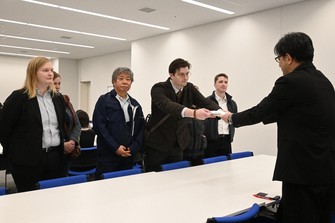
Dispatch ALTs working at Kyoto Prefectural schools, left, hand the results of a petition calling for their direct employment to prefectural board of education officials, Dec. 22, 2025. (Mainichi/Saki Hidaka)
Because contractors are chosen by bid, the company supplying ALTs to the Kyoto board changes every year. Dispatch ALTs who want to keep working in the same prefecture must track down whichever firm has won the latest contract. Those who stay with the same dispatch company may be assigned to schools in a different prefecture, forcing them to move every year. Many dispatch ALTs are former JET participants with years of experience — yet the more experienced they are, the more precarious their situation tends to be.
The prefectural board says it is aware of the pay disparity but “cannot intervene in salary structures set by private companies.”
Dispatch continues after the coronavirus pandemic
Why does the dispatch system persist now that the pandemic is over? The board says “securing personnel” is the primary reason. While it acknowledges that hiring all ALTs through JET would be possible, it notes that when a JET participant leaves mid-term, finding a replacement takes time. Dispatch companies can fill vacancies quickly, minimizing disruption in schools.

Samuel Bloom holds a sign and distributes fliers asking people to sign an online petition calling for Kyoto Prefecture to directly employ dispatch ALTs working at its schools, in Kyoto’s Minami Ward, Dec. 20, 2025. (Mainichi/Saki Hidaka)
A fiscal 2023 education ministry survey found that among about 18,000 ALTs working in Japan’s public elementary, junior high and high schools, 34.1% were dispatched — the largest share — followed by 28.0% through JET and 20.0% directly hired.
Yet a 2022-23 survey by General Union found that the national pay gap between JET and dispatch ALTs exceeds 1 million yen a year, despite identical job duties. The union argues this violates the principle of equal pay for equal work.
Samuel Bloom, 36, from the United States, is one of the seven who went on strike. His dispatch company has changed every year for the past three years. “It feels like the people responsible for education are being decided by annual bids — like we’re products,” he said.
‘Treat them as educators’

Dispatch ALT Kellan Fisher, right, speaks about his and other dispatch ALTs’ conditions, Dec. 22, 2025, in Kyoto’s Kamigyo Ward. Fisher and other dispatch ALTs are calling on Kyoto Prefecture to employ them directly. (Mainichi/Saki Hidaka)
Eighteen days after the strike began, the seven reached a settlement with their dispatch company: a roughly 16% pay increase, bringing their monthly salary to 240,000 yen with a 120,000-yen bonus. Even so, their earnings remain well below JET levels.
The teachers have also been calling for direct employment by the prefecture. The prefectural board says it takes the demand “seriously as a heartfelt appeal” but will “carefully review bidding and hiring procedures” — a cautious response.
Yoji Kambayashi, a specially appointed professor at Rikkyo University who specializes in public service labor sociology, said dispatch ALTs represent “a kind of government-created working poor, built outside the public administration.” He added, “Rather than treating ALTs as mere ‘English machines,’ we need to think of their conditions in terms of their role as educators.” Within the current dispatch framework, he said, meaningful improvements would require longer contract periods and more rigorous calculations of bid prices.
(Japanese original by Saki Hidaka, Kyoto Bureau)
AloJapan.com