
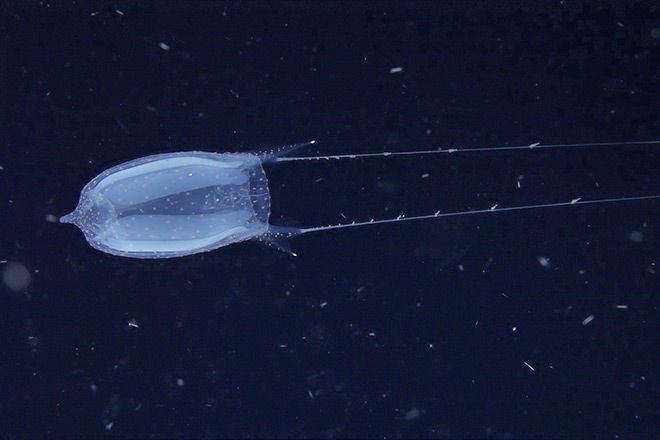
A new species of jellyfish that uses its long tentacles as “fishing lures” has been discovered off Kumejima island in Okinawa Prefecture, researchers said.
The tentacles are lined with bumps that resemble copepods, which are zooplankton, and may attract fish that the jellyfish prey upon.
Ryo Minemizu, an underwater photographer based in Shizuoka Prefecture, discovered the jellyfish by chance while shooting ocean scenes at night off Kumejima in 2022.
Multiple jellyfish of the same species were later found in the surrounding waters.
The jellyfish has an elongated bell measuring 3 centimeters across that is dotted with reddish brown grains.
A team of scholars led by Sho Toshino, a principal researcher of phylogenetic systematics with the Kuroshio Biological Research Institute, a public interest incorporated foundation based in Kochi Prefecture, conducted morphological and genetic studies on the creature.
The team said the medusae belongs to a new species closely related to the highly venomous box jellyfish.
The scientists named the new species Manokia bandiera.
Their research results appeared in article format in an English-language journal published jointly by the Plankton Society of Japan and the Japanese Association of Benthology (https://doi.org/10.3800/pbr.21.63).
Manokia bandiera has four tentacles, including two longer ones that extend nearly 2 meters and are lined with numerous bumps called lateral branches.
These tentacles may appear like strings of copepods to fish, the researchers said.
The researchers said they believe Manokia bandiera evolved to reliably catch food even where prey is scant.
“The ecology of the jellyfish is extremely singular if they are using these lures to efficiently catch fish,” Minemizu said. “That makes me realize how wonderful the evolution of living creatures is.”
AloJapan.com