
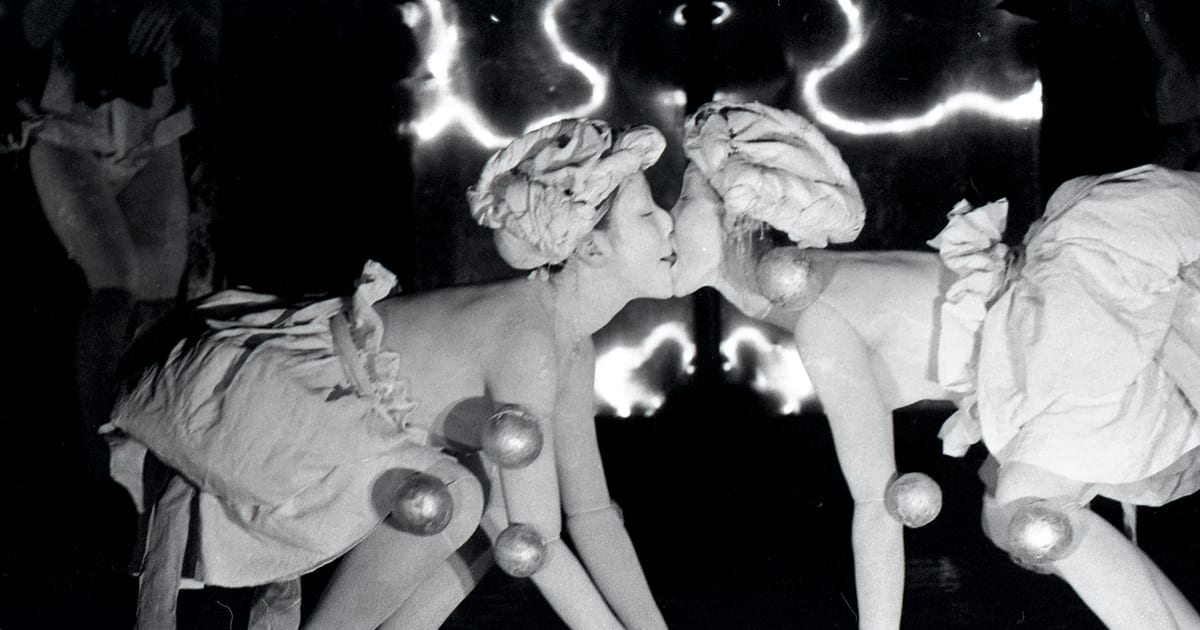
But Mishima’s collaborations with Eikō Hosoe and Tadanori Yokoo on Barakei lived on as a requiem. “Eroticised male bodies, images of martyrdom, the aesthetics of sacrifice and noble death – you find these across the entire political spectrum,” Ravalec says. “The same intensity, the same obsession with the body pushed to its limits, could serve completely opposing ideologies. It wasn’t a unified movement with a single political direction. It was a cauldron of contradictions, and the art drew its power precisely from that tension.”
Drawing upon uniquely Japanese aesthetics, artists embraced the grotesque – not as something other, aberrant, transgressive, or shocking – but as a place of deep honour in the cultural imagination. It was celebrated not just in what but in how one looks, in rejecting the formal languages of art and creating them anew. With Provoke, Kōji Taki, Takuma Nakahira, Takahiko Okada, Yutaka Takanashi, and Moriyama came together in 1968 and 1969 to create just three issues of one of the most influential magazines in photography history.
“Born from a time of radical political unrest, Provoke rejected the idea that photography should simply reflect reality. Instead, it aimed to fracture it,” Ravalec says, “Their aesthetic – are, bure, boke: ‘grainy, blurred, out of focus’ – reversed from its roots the very notion that photography must always reflect something. It demolished the hierarchy between high and low art, between the worthy subject and the unworthy one. They took the tools of representation – the camera, the photo book, the poster, the body on stage – and turned them into instruments of resistance and reinvention. As Nobuyoshi Araki said, ‘Provoke wasn’t a protest against art, it was a protest against life as it was being lived.’”
AloJapan.com